Which Solar Panel Size Do I Need?
Choose a solar panel size by matching daily energy use to usable sunlight, then check battery storage, controller limits and device input limits. A 100W panel can suit small loads, while 200W or more gives you room for larger daily needs when conditions allow.
On this page (13 sections)
- Which solar panel size do I need for my daily energy use?
- What can different solar panel wattages run?
- How much solar panel capacity do I need for an RV or camping trip?
- What size charge controller do I need?
- Should I choose monocrystalline, bifacial or flexible panels?
- Which solar panel connectors do I need?
- How do I choose between portable panels and a solar kit?
- Which solar panel size should you choose for common setups?
- Which solar panels fit the needs of this guide?
- What should you check before buying a solar panel?
- How do you protect solar panels from weather and damage?
- Explore solar panels and controllers by topic
- What is the right solar panel size for your setup?
The solar panel size you need depends on how much energy you use each day and how many useful sun hours your location gets. Estimate daily watt-hours first, then account for shade, weather, battery storage and the input limits of your controller or power station.
A panel's watt rating is its output under specified conditions, not a promise of the same output all day. A 100W panel may suit phones, lights and small devices, while larger loads or shorter charging windows can call for 200W or more.
Start by listing the devices you want to run or recharge. This guide covers panel size, controller fit, panel types, connectors and the practical trade-offs between portable and fixed arrays.
Which solar panel size do I need for my daily energy use?
Estimate panel watts by dividing your daily energy use in watt-hours by the usable sun hours you expect, then add room for real-world losses. Use your daily energy target, not the appliance's peak wattage alone.
For each device, multiply its watts by the hours you expect to use it. Add those daily totals together:
| Device | Example calculation | Daily energy |
|---|---|---|
| 10W light | 10W × 5 hours | 50Wh |
| 40W cooler | 40W × 8 hours | 320Wh |
| 60W laptop | 60W × 3 hours | 180Wh |
| Total | 550Wh |
If you expect 5 useful sun hours, 550Wh divided by 5 hours equals 110W before losses. In practice, choose more panel capacity or reduce use to allow for heat, clouds, shade, panel angle and charging losses.
This is an estimate, not a guarantee of daily output. Your results depend on season, location, panel direction and how much sunlight reaches the cells.
How do I calculate what size solar panel I need?
Use this simple estimate:
Daily energy used (Wh) ÷ usable sun hours = estimated panel watts before losses.
A device that draws 50W for 4 hours uses about 200Wh. With 5 usable sun hours, that is 40W of panel capacity before losses, so a 100W panel gives more practical margin than a panel rated close to the calculation.
If an appliance cycles on and off, estimate its average energy use over a day rather than multiplying its maximum draw by 24 hours. A watt-hour meter can help measure loads when the appliance's label does not show typical daily consumption.
Keep the battery in the calculation. It needs enough capacity to hold energy for nighttime use and cloudy periods, while the panel needs enough output to refill it during available sunlight.
What can different solar panel wattages run?
A panel wattage only tells part of the story; the battery and sunlight determine how much stored energy is available when you need it. These ranges are planning examples, not fixed device limits.
| Panel size | A reasonable starting use | Check before choosing |
|---|---|---|
| 100W | Phones, lights and small devices | Daily energy use and power station input cap |
| 200W | More daily charging or several small loads | Battery capacity, controller current and space |
| 400W | Larger daily energy needs with a suitable system | Array voltage, controller rating and mounting |
| 500W or more | Higher consumption or shorter charging windows | Wiring, overcurrent protection and roof or ground area |
A 100W panel may fit a modest camping setup. Read what a 100W solar panel can run to compare common small loads.
For a 200W starting point, compare best 200 watt solar panels. If you need a larger system, our 1000 watt solar panels guide explains the bigger array trade-offs.
How much solar panel capacity do I need for an RV or camping trip?
Choose enough panel capacity to replace the energy you use during the day while keeping the battery charged for evening and overnight loads. RV roof area and campsite shade often matter as much as the watt target.
For an RV, list daily loads such as lighting, water pumps, a fan, electronics and refrigeration. Separate loads that run constantly from brief-use items, then check whether the battery can cover use when the sun is down.
Portable panels can move into sunlight when the vehicle is parked in shade. For EV charging specifically, read what portable solar panels can do for EVs.
Fixed panels are easier to keep connected, but their output depends on the vehicle's parking position and roof layout.
For camping, choose a panel you can carry, position and protect from foot traffic. See our guides to best portable solar panels for camping and best RV solar panels.
How much panel do I need for cloudy days?
Plan for lower output when clouds reduce direct sunlight, and avoid treating a panel's nameplate rating as a daily energy promise. More panel capacity can help, but it cannot guarantee a full battery through prolonged poor weather.
A larger array may collect more energy during bright intervals and diffuse light, but battery capacity and the length of the cloudy spell still set the limit. Reduce discretionary loads or bring another charging option if reliable power matters.
See do solar panels work on cloudy days for a closer look at reduced sunlight, and compare best solar panels for cloudy days for buying considerations.
What size charge controller do I need?
Choose a controller that supports the array's voltage and current and matches the battery's charging requirements. Learn PWM charge controller basics before comparing controller types.
The controller must safely handle the combined panels, not just one panel's label wattage.
A rough current estimate is array watts divided by battery charging voltage. For example, 200W divided by about 12V is roughly 17A, but actual charging voltage, panel conditions and controller specifications affect the final choice.
Check the controller's maximum PV voltage, maximum charging current and supported battery chemistry. For series wiring, add the panels' open-circuit voltages and leave room for cold-weather voltage rise if the controller instructions require it.
For a focused comparison, read best solar charge controllers. If you are pairing a controller with a 200W array, verify the panel configuration and battery voltage before choosing a rating.
What size MPPT controller do I need for a 200W solar panel?
For a 200W panel, start by checking the battery charging voltage and estimate current as watts divided by voltage, then select an MPPT controller with adequate current capacity and a suitable PV voltage range. Use the controller maker's sizing chart for the final choice.
A 12V battery system may need a controller in a different current class than a 24V system for the same array wattage. Series wiring also raises array voltage, so verify the controller's maximum PV input before connecting panels.
Don't size from watts alone. Panel open-circuit voltage, battery chemistry, temperature and expansion plans all affect the correct controller.
Should I choose monocrystalline, bifacial or flexible panels?
Choose panel construction around your available space, mounting surface and need for portability. Efficiency matters most when space is tight; weight, shape and installation needs can matter more elsewhere.
Monocrystalline panels use cells made from a single crystal structure and are common in both rigid and portable designs. Learn what a monocrystalline solar panel is and compare best monocrystalline solar panels.
Bifacial panels can collect light from the front and rear, but the rear-side benefit depends on reflected light and installation height. Ground surfaces that reflect more light may help, while a panel mounted close to a dark roof may gain little.
Flexible panels bend to fit some curved surfaces and can weigh less than rigid frames, but check the maker's mounting and heat guidance. Our best bifacial solar panels and best flexible solar panels guides explain their use cases.
Are rigid panels better for a fixed installation?
Rigid panels suit installations where a firm frame and stable mounting points are available. They can be a practical choice for a roof or ground rack when their dimensions and mounting method fit the site.
Check roof structure, wind exposure, ventilation, shade and access before installing. For flexible-panel mounting guidance, see flexible solar panel installation tips.
A panel that fits the roof may still need space around it for wiring and service.
Compare best rigid solar panels and review best solar panel mounting brackets for roof before planning a fixed array.
Which solar panel connectors do I need?
Match the panel connector to the controller or power station input, and use compatible cables rated for the system. A connector that physically fits may still have the wrong polarity or electrical rating.
Many rigid panels use MC4-style connectors, while portable panels may include several output options or an adapter. Check each device's input requirements, cable length and connector type before connecting.
Read what connectors do solar panels use for a connector overview. Avoid joining mismatched plugs by force or cutting factory cables without understanding the system design.
How do I choose between portable panels and a solar kit?
Choose a portable panel when you need to move it into sun or pack it between trips. A kit can save setup steps when it includes the controller and cables your battery system needs.
For a portable setup, compare folded size, weight, cable reach, kickstands and the output limits of your power station. For one 200W option, read the Jackery SolarSaga 200W panel review.
For an installed system, include the controller, mounting hardware, wiring and protection devices in your plan.
See best portable solar panels and best solar panel kits for these different buying approaches. For a power station, confirm its maximum solar input before you buy a panel.
Which solar panel size should you choose for common setups?
Start with the smallest panel that can meet your measured energy needs with reasonable margin, then confirm the system limits. For higher-output options, compare 400 watt solar panels.
These examples are starting points, not universal prescriptions.
| Setup | Starting point | Why it may fit |
|---|---|---|
| Phone and light charging | 100W | Portable scale for modest energy needs |
| RV battery top-ups | 200W or more | More capacity for several daily loads |
| Small cabin backup | Calculate from daily Wh | Fixed use can vary widely by appliance |
| Power station charging | Match its input cap | Extra panel watts may not raise its input |
| Boat electronics | Calculate use and mounting space | Exposure, shade and marine mounting affect output |
For a compact 200W option, explore best compact 200 watt solar panels. If you need panels for marine use, see best solar panels for boats.
A microinverter system is a different setup from charging a battery through a controller. If you're considering that route, read how to choose a microinverter for a 400 watt solar panel.
Which solar panels fit the needs of this guide?
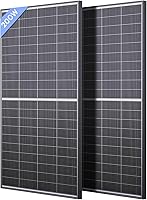
These four options illustrate portable 100W and 200W choices and a fixed 200W pair. Check your battery, controller or power station compatibility before choosing any of them.
The DOKIO portable kits include standalone PWM controllers for 12V battery charging. The Renogy 100W pair uses solar connectors, while the portable Renogy 200W panel has MC4 output and requires a compatible connection for your power station.
The panel wattage is only one part of the purchase. Match the connector, voltage, controller and device input before setting up the system.
What should you check before buying a solar panel?
Check the full system path from sunlight to the device you want to power. A panel is a good fit only when its output, storage and connections work together.
- Daily use: Add the watt-hours for the devices you expect to use.
- Sun hours: Consider season, shade, panel angle and local weather.
- Battery: Confirm voltage, chemistry and capacity.
- Controller: Check maximum PV voltage, charging current and battery support.
- Power station: Match its input cap and connector.
- Space: Measure roof area, storage space or ground setup area.
- Mounting: Confirm brackets, kickstands or other supports suit the location.
- Expansion: Leave controller and wiring capacity if you may add panels later.
A larger panel can shorten charging time in suitable conditions, but only if the controller, battery and device accept the added power. If one part limits input, extra panel capacity may not improve the charging rate.
How do you protect solar panels from weather and damage?
Follow the panel maker's handling and mounting instructions, and secure panels against wind before leaving them unattended. Weather resistance does not mean a panel is immune to impact or poor installation.
Keep connectors dry and properly joined, route cables where people cannot trip over them, and avoid shading cells with loose gear. Clean the surface gently using the care guidance for that panel.
Hail risk depends on hail size, panel construction and mounting conditions. See hail damage to solar panels for what to consider before installing panels in exposed locations.
Explore solar panels and controllers by topic
- Best 500 Watt Solar Panels
- Best 100 Watt Solar Panels
- Best Renogy Solar Panels
- Best EcoFlow Solar Panels
- Best Solar Panels for Jackery Power Stations
What is the right solar panel size for your setup?
The right solar panel size starts with your daily watt-hour use and expected sun hours. Choose 100W for modest loads when the estimate supports it, 200W or more for larger daily needs, and verify battery, controller and power station limits before connecting.
Choose portable panels when you need to follow the sun, rigid panels for a fixed mounting plan, and bifacial designs only when the rear side can receive useful reflected light. For your next step, compare best portable solar panels for power stations or browse best ECO-WORTHY solar panels.
Frequently asked questions
Which solar panel size do I need for a small power station?
Start with the power station's maximum solar input, then compare it with your daily energy use and the panel's rated watts. A panel larger than the input limit won't make the station charge faster than that limit.
Check connector type and voltage range before buying.
How many watts of solar do I need for an RV?
Add the watt-hours your RV uses in a day, then divide by the usable sun hours at your location to estimate panel watts. Add room for cloudy weather, shade and conversion losses.
Check the battery voltage, charge controller limits and roof space before choosing an array.
What size MPPT controller do I need for a 200W solar panel?
Choose an MPPT controller that supports the panel array's maximum voltage and can handle its expected charging current at your battery voltage. A rough current estimate is array watts divided by battery charging voltage, with headroom for conditions.
Follow the controller maker's sizing instructions.
Do bifacial solar panels need a different size?
Bifacial panels still need to be sized from your energy use and available sunlight. Their rear side may add output when reflected light reaches it, but the gain depends on mounting height, surface color and surroundings.
Don't count on a fixed increase without site-specific measurements.
Can I connect solar panels with different watt ratings?
You can combine panels only when their electrical ratings and the controller's limits suit the wiring arrangement. Series wiring adds voltage, while parallel wiring adds current.
Different panel ratings can cause mismatch losses, so check operating voltage and current before connecting them.