9 Best Portable Solar Panels (November 2026)
The best portable solar panels include the Jackery Solar Generator 1000 v2 and 200W for a matched power station kit, the Renogy 400W Portable Solar Panel for high-capacity charging, and the ZOUPW 100W Portable Solar Panel for Power for direct device charging.
On this page (17 sections)
- The best portable solar panels compared
- 1. Jackery Solar Generator 1000 v2 and 200W
- 2. Renogy 400W Portable Solar Panel
- 3. ZOUPW 100W Portable Solar Panel for Power
- 4. SOKIOVOLA N-Type 16BB 200W Portable Solar Panel
- 5. Renogy 200W Portable Solar Panel for Power
- 6. Ecosonique Technology 400W Portable Solar Panel for Power
- 7. ZOUPW 480W Bifacial Portable Solar Panel N-Type
- 8. BougeRV 200W Portable Solar Panel
- 9. Jackery HomePower 3600 Plus & 2x200W Solar
- How to choose the right portable solar panel wattage
- Which portable solar panel connector do you need?
- Are portable solar panels waterproof?
- How to set up and care for portable solar panels
- Are folding and suitcase solar panels easier to use?
- More guides on this topic
- Final verdict on the best portable solar panels
The best portable solar panels are the Renogy 400W and Jackery 200W bundle for most buyers, depending on whether you need a panel alone or a complete solar power system. The Renogy supplies high rated output in a foldable suitcase, while the Jackery pairs a 200W panel with a 1,070Wh power station.
Portable solar panels differ most in rated wattage, folded size, weight, connector type and weather protection. A 100W panel may be easier to carry, but a 400W or 480W panel can suit a larger power station when its voltage and input limits match.
If you're unsure about sizing, start with our guide to which solar panel size do i need. Then compare the charging capacity with the solar input limit of your power station.
Our picks at a glance
-
1
 Best for a matched power station kit
Jackery Solar Generator 1000 v2 and 200W
9.6/10 our score
See it on Amazon -
2

-
3
 Best for direct device charging
ZOUPW 100W Portable Solar Panel for Power
9.5/10 our score
See it on Amazon
- 4
 Check it
SOKIOVOLA N-Type 16BB 200W Portable Solar Panel
Best for high-efficiency 200W output - 5
 Check it
Renogy 200W Portable Solar Panel for Power
Best for a light 200W panel - 6
 Check it
Ecosonique Technology 400W Portable Solar Panel for Power
Best for a lighter 400W format - 7
 Check it
ZOUPW 480W Bifacial Portable Solar Panel N-Type
Best for large high-voltage power stations - 8
 Check it
BougeRV 200W Portable Solar Panel
Best for simple XT60 setups - 9
 Check it
Jackery HomePower 3600 Plus & 2x200W Solar
Best for extended home backup
The best portable solar panels compared
The best portable solar panel depends on your power station and how often you will move it. High output panels suit RVs and home backup, while lighter 100W and 200W models make more sense for campsites, road trips and smaller stations.
For a matched campsite setup, compare camping solar panel and battery kits.
Your station sets the ceiling for useful output. A panel may carry a high rating, but the station can only accept power within its stated input limit.
That is why wattage alone does not settle the choice. Connector type, voltage, folded size, weight and weather protection all affect whether a panel is easy to use each day.
Smaller panels are usually easier to carry and store between trips. They can still charge phones, tablets, cameras, GPS units and smaller power stations, especially when they include direct USB outputs.
Larger panels can replenish a bigger station faster when the sun is strong and the station can accept the input. They also tend to need more space in a vehicle and more effort at a campsite.
RV users often value stable placement and enough capacity for repeated charging. Campers may value a quick setup, a compact folded size and a case that protects the surface during transport.
For backup use, capacity and connector compatibility matter more than low weight. A panel should be paired with a station that can store enough energy for the appliances and devices you plan to run.
Our score weighs specs, features and buyer feedback against what you are shopping for. It is a guide to comparison, not a promise that every panel will suit every station.
The products below are ordered from highest score to lowest score. Use the ordering as a starting point, then check wattage, connectors and input limits for your own setup.
Read the details for each model before deciding. Small differences in weight or cable coverage can matter more in daily use than a small gap in score.
| Product | Best for | Power system | Solar panel | Weight | Our score |
|---|---|---|---|---|---|
| Jackery Solar Generator 1000 v2 and 200W | a matched power station kit | 1,070Wh, 1,500W AC | 200W included | 23.8 lb power station | 9.6 |
| Renogy 400W Portable Solar Panel | high-capacity charging | 30.2 lb | 9.6 | ||
| ZOUPW 100W Portable Solar Panel for Power | direct device charging | 9.5 lb | 9.5 | ||
| SOKIOVOLA N-Type 16BB 200W Portable Solar Panel | high-efficiency 200W output | 16.3 lb | 9.5 | ||
| Renogy 200W Portable Solar Panel for Power | a light 200W panel | 13.9 lb | 9.4 | ||
| Ecosonique Technology 400W Portable Solar Panel for Power | a lighter 400W format | 22.9 lb | 9.2 | ||
| ZOUPW 480W Bifacial Portable Solar Panel N-Type | large high-voltage power stations | 22.5 lb | 9.2 | ||
| BougeRV 200W Portable Solar Panel | simple XT60 setups | 13.8 lb | 8.3 | ||
| Jackery HomePower 3600 Plus & 2x200W Solar | extended home backup | 77.2 lb | 8.0 |
1. Jackery Solar Generator 1000 v2 and 200W
Jackery Solar Generator 1000 v2 and 200W: Best for a matched power station kit
- 1,070Wh capacity
- 1,500W AC output
- Includes a 200W solar panel
- 23.8 lb power station
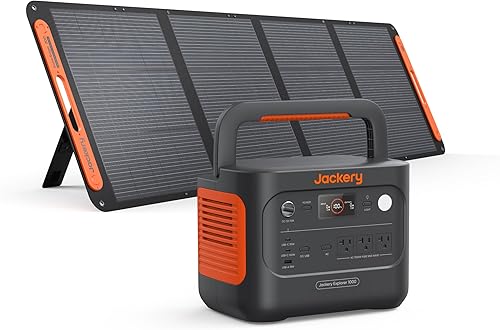
This bundle pairs a 1,070Wh Explorer 1000 v2 power station with a 200W solar panel. It suits buyers who want a complete portable solar power setup rather than a panel alone.
Pros
- Matched power station and panel bundle
- 1,500W AC output
- Multiple USB and AC ports
Cons
- Power station and panel ship separately
- Heavier than a panel-only setup
The Jackery Solar Generator 1000 v2 and 200W bundle is the easiest choice when you need a matched portable solar power system. The Explorer 1000 v2 has a 1,070Wh capacity and 1,500W AC output, while the included solar panel is rated at 200W.
The power station weighs 23.8 lb and measures 12.87 x 8.82 x 9.72 in. A foldable handle makes it easier to carry between a vehicle, campsite and emergency storage area.
Charging options include the 200W solar panel, AC charging and a 600W alternator charger. Jackery says the power station can reach 80% in 6 hours with the 200W panel, though sunlight angle, shade and the station's input limits affect real charging time.
The power station has 3 pure sine wave AC ports, 2 USB-C ports, 1 USB-A port and a DC car port. Its 100W USB-C output also supports direct charging for compatible devices.
Choose this bundle if you want the power station included. The generator and solar panel ship separately, so plan for separate packages.
2. Renogy 400W Portable Solar Panel
Renogy 400W Portable Solar Panel: Best for high-capacity charging
- 400W maximum power
- 23% efficiency
- Folds to 33.7 x 27.95 in
- IP67 waterproofing
The Renogy 400W panel is suited to larger power stations, RV trips and blackout backup. Its foldable suitcase format is easier to move than a rigid 400W panel, but it still weighs 30.2 lb.
Pros
- High 400W output
- Fiberglass and ETFE construction
- Carry case included
Cons
- Heaviest panel in this group
- MC4 output cables only
The Renogy 400W Portable Solar Panel is the strongest panel-only pick for high-capacity charging. Its 400W maximum power and 23% efficiency suit larger portable power stations, RV trips, off-grid cabins and home blackout backup.
The panel folds to 33.7 x 27.95 in and weighs 30.2 lb. That is a meaningful carrying load, but the suitcase format and carry case make transport more practical than moving a rigid 400W panel.
Fiberglass reinforcement, an ETFE coating, corner protection and an aluminum backsheet support outdoor use. The panel has IP67 waterproofing and is designed for rain, snow, heat and light hail, but connectors should not be submerged.
Renogy uses MC4 output cables only. Some stations need a separate adapter, so check the connector and solar input before ordering.
It is also compatible with 12V and 24V battery systems when paired with a compatible charge controller.
For a deeper look at panel output in real conditions, read our guide to portable solar panel efficiency and use.
3. ZOUPW 100W Portable Solar Panel for Power
ZOUPW 100W Portable Solar Panel for Power: Best for direct device charging
- 100W maximum power
- 23.5% efficiency
- Built-in USB-C and USB-A ports
- 5-in-1 connector cable
This compact 100W panel includes USB-C, USB-A and a 5-in-1 cable for several power station connector types. It fits campers who value low weight and simple device charging.
Pros
- Light 9.5 lb design
- USB-C and dual USB-A ports
- IP67 panel body
Cons
- Lower output than 200W and 400W panels
- USB hub and cables should stay dry
The ZOUPW 100W Portable Solar Panel is the best compact option for direct device charging. It weighs 9.5 lb, folds to 24.13 x 21.06 x 1.77 in and uses 23.5% efficient monocrystalline cells.
Its built-in charging hub has 1 USB-C port and 2 USB-A ports, so you can charge compatible phones, tablets, cameras and GPS devices without first connecting a power station. The panel also includes a 10 ft 5-in-1 cable.
The cable supports DC8020, XT60, Anderson, DC7909 and DC5521 connections. That gives this panel more connector flexibility than an MC4-only model, but you should still confirm the exact input requirements of your station.
The panel body is IP67 waterproof, and ETFE coating supports outdoor use. The USB hub and connection cables are not fully waterproof, so keep them dry in rain.
Choose this panel when low weight, direct USB charging and flexible connectors matter more than maximum charging capacity.
4. SOKIOVOLA N-Type 16BB 200W Portable Solar Panel
SOKIOVOLA N-Type 16BB 200W Portable Solar Panel: Best for high-efficiency 200W output
- 200W maximum power
- 25% efficiency
- N-Type 16BB cells
- IP68 waterproofing
SOKIOVOLA combines 200W output with 25% efficiency and a compact folded size. It suits RV and camping users who want more charging capacity than a 100W panel.
Pros
- 25% efficiency
- MC4 to 5-in-1 cable included
- IP68 waterproofing
Cons
- 16.3 lb may be heavy for backpacking
- Power station input limits still apply
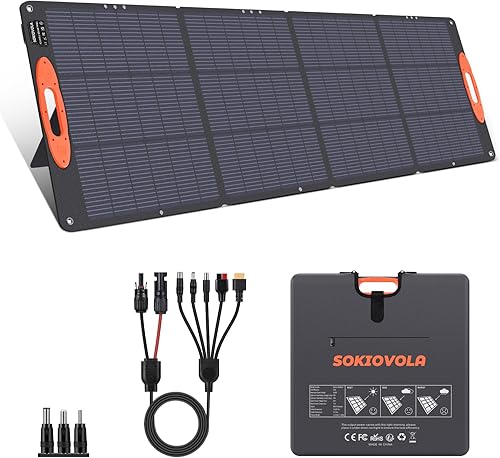
The SOKIOVOLA N-Type 16BB 200W Portable Solar Panel is a strong middle ground between portability and output. It delivers 200W maximum power with up to 25% efficiency and folds to 21 x 23 in.
At 16.3 lb, it is heavier than the lightest 200W option here but still manageable for RV trips and regular campsite use. A magnetic handle supports carrying, and 4 holes allow attachment to an RV.
The panel uses ETFE coating and has IP68 waterproofing. It includes an MC4 to 5-in-1 cable with XT60, DC5521, DC7909, DC8020 and Anderson connections.
SOKIOVOLA notes that the panel cannot exceed a power station's maximum input limit. That matters when connecting a 200W panel to a station that accepts less solar input.
Choose it if you want high efficiency, broad connector coverage and stronger weather protection in a 200W folding panel. For another N-Type comparison, see best portable solar panels n-type.
5. Renogy 200W Portable Solar Panel for Power
Renogy 200W Portable Solar Panel for Power: Best for a light 200W panel
- 200W maximum power
- 25% efficiency
- 13.9 lb weight
- USB-C PD 45W and dual USB-A
This Renogy panel keeps the 200W class manageable at 13.9 lb and adds direct USB charging. Its MC4 output requires a separate 4-in-1 adapter for some power stations.
Pros
- Lightest 200W panel here
- USB-C PD 45W output
- Four kickstand angles
Cons
- MC4 output only
- Adapter may be needed for some stations
The Renogy 200W Portable Solar Panel is the easiest 200W model to carry in this group. It weighs 13.9 lb, folds to 23.72 x 22.99 x 1.97 in and uses 16BB N-Type cells with 25% efficiency.
Its four kickstands support 40, 50 and 60-degree positioning, plus an additional setup angle. That gives you more ways to aim the panel at the sun during a campsite or RV setup.
This panel can charge devices directly through USB-C PD 45W and dual USB-A ports. It also has MC4 output, but the 4-in-1 adapter is sold separately for power stations that use another connector.
The accessory pouch, reinforced grommets and magnetic closure help with transport and setup. The panel is suited to camping, RV use, blackout backup and off-grid charging.
Pick this model when you want 200W output with a low carrying weight. See best portable solar panel kits if you need a panel, cables and power equipment together.
6. Ecosonique Technology 400W Portable Solar Panel for Power
Ecosonique Technology 400W Portable Solar Panel for Power: Best for a lighter 400W format
- 400W maximum power
- 23.5% conversion rate
- 6-fold design
- MC4 and adapter cables included
Ecosonique delivers 400W in a 22.9 lb folding format, lighter than the other 400W panel here. It includes MC4, XT60, Anderson and DC8020 cable connections.
Pros
- 400W output at 22.9 lb
- Six-angle kickstand
- Multiple cables included
Cons
- IP65 rather than IP67 or IP68 protection
- 40V output needs station compatibility
The Ecosonique Technology 400W Portable Solar Panel is the lighter 400W alternative. It weighs 22.9 lb and folds into a 6-fold design measuring 26.18 x 22.44 x 2.95 in.
Its 400W maximum power and 23.5% conversion rate suit larger power stations. The six-angle kickstand helps position the panel, while the Oxford fabric and CPC lamination support folding and transport.
The package includes a 3m MC4 cable and a 0.5m MC4 to XT60, Anderson and DC8020 cable. That makes setup simpler than a panel with only bare MC4 output, but confirm your power station solar input voltage first.
The panel is rated IP65 and has a stated temperature range from -4°F to 158°F. It is a practical choice for users who want 400W capacity without the 30.2 lb weight of the Renogy panel.
The 40V output needs careful checking against station limits. A station with a lower input ceiling may draw less than the panel rating, so real charging speed will depend on both devices.
For RV and campsite use, the foldable format helps with storage. The panel still needs a clear, sun facing position, so cable length and kickstand placement should be planned before setup.
Choose it when weight matters but 200W is not enough for your charging plan. It fits buyers who want high output in a more portable 400W format.
7. ZOUPW 480W Bifacial Portable Solar Panel N-Type
ZOUPW 480W Bifacial Portable Solar Panel N-Type: Best for large high-voltage power stations
- 480W maximum power
- 25%+ efficiency
- Bifacial design
- 42.5V output
The ZOUPW 480W panel is the highest-output option here and captures light from both sides. It suits large power stations that support its 42.5V architecture.
Pros
- Highest rated output here
- Bifacial design
- Ground stakes and cables included
Cons
- Needs a power station that supports the voltage
- Not recommended for permanent fixed installation
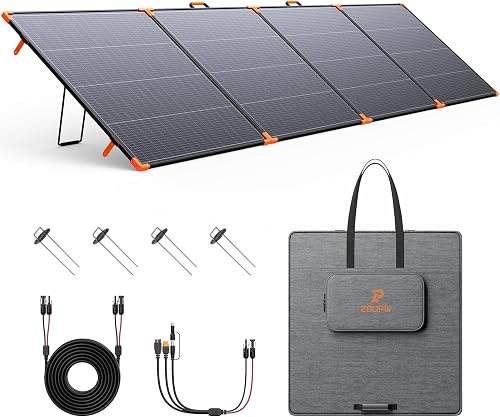
The ZOUPW 480W Bifacial Portable Solar Panel has the highest rated output in this roundup. Its 480W maximum power, 25%+ efficiency and 42.5V output make it a better fit for large power stations than small battery packs.
The bifacial design can capture light from both sides. ZOUPW says the panel can gain up to 30% on highly reflective surfaces such as snow or sand, but the result depends on the ground, sunlight and setup.
Despite its output, the panel weighs 22.5 lb. It includes a storage bag, ground stakes, a 2 ft 4-in-1 connector cable and a 13 ft extension cable.
IP68 waterproofing supports outdoor use, while the composite coating is designed for temperatures up to 140°F. ZOUPW does not recommend long-term fixed installation or operation under shade.
Check that your power station supports the panel's voltage before connecting it. For an EV-focused question, read portable solar panel for EV charging, but don't assume a portable panel can directly replace a vehicle charger.
8. BougeRV 200W Portable Solar Panel
BougeRV 200W Portable Solar Panel: Best for simple XT60 setups
- 200W maximum power
- 25% efficiency
- Fiberglass layer
- XT60 connector
BougeRV offers a 200W foldable panel with a fiberglass layer, XT60 connection and 8.2 ft extension cable. It fits compatible BougeRV batteries and power stations.
Pros
- 13.8 lb weight
- Fiberglass reinforcement
- 8.2 ft extension cable
Cons
- XT60 connector limits flexibility
- IP65 protection
The BougeRV 200W Portable Solar Panel suits buyers who already use compatible XT60 equipment. It offers 200W maximum power, 25% efficiency and a fiberglass layer in a foldable design.
The panel weighs 13.8 lb and includes an 8.2 ft extension cable. That cable helps you place the panel in direct sun while keeping a power station or portable fridge battery in a shaded spot.
Its XT60 connector supports compatible BougeRV portable fridge batteries and many power stations. The single connector is less flexible than the multi-connector cables included with some other panels here.
IP65 water and dust resistance supports outdoor use, but it is not the same protection level as IP67 or IP68. Keep connection points protected during wet weather.
The fiberglass layer is aimed at repeated setup and transport. It helps resist cracking and surface abrasion, which matters for a panel that will be folded, carried and opened often.
Direct sunlight and panel angle still affect output. The extension cable gives more freedom to position the panel, but it does not remove the need to check station input limits.
Choose it when you want a light 200W panel and your equipment already uses XT60. It is a simpler fit for users who do not need several connector options in the box.
9. Jackery HomePower 3600 Plus & 2x200W Solar
Jackery HomePower 3600 Plus & 2x200W Solar: Best for extended home backup
- 3,584Wh capacity
- 3,600W AC output
- Two 200W solar panels
- 120V and 240V in parallel
This Jackery bundle is designed around home backup, with a 3,584Wh power station and two 200W solar panels. Its 77.2 lb weight makes it less suited to frequent carrying.
Pros
- Large 3,584Wh capacity
- 3,600W AC output
- Two 200W panels included
Cons
- Heavy 77.2 lb power station
- Power station and panels ship separately
The Jackery HomePower 3600 Plus bundle is designed for extended home backup rather than frequent campsite carrying. It combines a 3,584Wh power station, 3,600W AC output and 2 solar panels rated at 200W each.
The system supports 120V and 240V in parallel. Jackery also states that the capacity can expand to 21kWh per unit or 43kWh with multiple units, which makes this the largest backup system in the roundup.
The HomePower 3600 Plus weighs 77.2 lb and measures 19.3 x 15.2 x 12.2 in. Wheels and a telescopic handle help move it, but the weight still calls for a planned storage location.
Charging options include AC, solar, a gas generator and hybrid AC plus DC charging. Jackery states that hybrid charging can reach 0 to 100% in 2 hours.
This is a home centred system, so setup should be planned around a fixed storage point. The luggage style design helps with moving it between rooms, a garage or a utility area.
The two 200W panels support solar replenishment, but their output will depend on sunlight and placement. They ship separately from the power station, so delivery and setup may need separate handling.
Choose this bundle when home outage capacity matters more than portability. It suits users who want a larger backup platform rather than a light campsite panel.
How to choose the right portable solar panel wattage
Choose panel wattage by matching the panel to your power station's solar input, not by choosing the largest number. A 480W panel cannot force 480W into a station that accepts less.
A 100W panel is easier to carry and works well for direct USB charging and small power stations. The ZOUPW 100W weighs 9.5 lb and includes USB-C and USB-A ports.
A 200W panel is the most flexible middle choice for camping and RV use. The Renogy 200W weighs 13.9 lb, while the BougeRV weighs 13.8 lb and the SOKIOVOLA weighs 16.3 lb.
A 400W panel suits larger stations and faster solar replenishment when conditions allow. The Renogy 400W is heavier, while the Ecosonique 400W lowers the weight to 22.9 lb.
The 480W ZOUPW panel is for large stations with suitable voltage support. Its 42.5V output means compatibility checks matter before purchase.
Which portable solar panel connector do you need?
The connector must match your power station solar input, or you need a suitable adapter. MC4 is common on panel output, but many portable stations use XT60, Anderson, DC7909 or DC8020 inputs.
ZOUPW 100W panel includes DC8020, XT60, Anderson, DC7909 and DC5521 connectors. SOKIOVOLA also includes a 5-in-1 cable, while Ecosonique includes MC4, XT60, Anderson and DC8020 connections.
The Renogy 400W and Renogy 200W panels use MC4 output. Renogy says the 4-in-1 adapter for the 200W panel is sold separately, so include that in your setup plan if your station does not use MC4.
BougeRV uses an XT60 connector, which can be simple when your station or fridge battery already matches it. The trade off is less flexibility if you later change stations or want to share a panel between devices.
Never connect a panel based only on the plug shape. Compare voltage, current, polarity and the station maximum solar input before connecting.
A multi-connector cable can reduce the need for extra adapters, but it does not make every panel compatible. The station input limit still controls how much power it will accept.
Check the manual or product details for your exact station model. That check takes a few minutes and can prevent a poor fit or an unsafe connection.
Are portable solar panels waterproof?
Portable solar panels have different protection ratings, and the rating may not cover every cable or charging hub. The panel body can handle rain while an exposed connector still needs protection.
The ZOUPW 480W and SOKIOVOLA 200W panels have IP68 protection. The Renogy 400W and ZOUPW 100W panels have IP67 protection, while the Ecosonique 400W and BougeRV 200W panels have IP65 protection.
A higher rating suggests stronger resistance to water and dust, but it does not mean every part of the setup can be left wet. Junction boxes, USB hubs, cables and the power station itself may need separate care.
ZOUPW notes that its 100W panel body is IP67 waterproof, while the USB hub and connection cables are not fully waterproof. That distinction is a useful reminder for other models as well.
Set the panel where it can receive direct sun without placing it in standing water. Keep USB hubs, cables and power stations dry unless their protection is confirmed.
Rain can also change placement. A panel may need to be moved or tilted so water does not collect around connectors, kickstands or ground contact points.
Dust and debris matter after storms as well. Wipe the surface gently when needed and inspect connectors before the next use, especially after heavy outdoor travel.
For home backup, do not assume a panel can stay outside unattended all season. Storage in a dry place after use helps protect cables, hinges and connection points.
Weather protection should be one factor among several. Wattage, connector fit, folded size and station input limits still decide whether a panel will work well for your setup.
How to set up and care for portable solar panels
Place the panel in direct, unshaded sunlight and aim it toward the sun. A tree shadow or cable position can reduce useful output even when the panel's rated wattage is high.
Use the kickstands or ground stakes where included, then connect the panel to a compatible station. Check the station's input display rather than assuming the panel is delivering its maximum rating.
Keep the surface free from dust, grass and debris. ZOUPW warns that partial obstruction can create heat buildup and reduce output, while SOKIOVOLA recommends a clear position aimed directly at the sun.
Fold the panel only after disconnecting it and keeping the cables clear of hinges. Store it in its case or bag when available, and inspect the surface and connectors after heavy outdoor use.
For a smaller setup, compare the options in our guide to best small portable solar panels. If you need a larger setup, see best 200 watt portable solar panel kit and best portable 400 watt solar panels.
Are folding and suitcase solar panels easier to use?
Folding and suitcase designs make portable panels easier to store than rigid panels, but the folded size and weight still matter. A 400W suitcase can supply more power while taking more room in a vehicle.
The Renogy 400W folds to 27.9 x 33.7 x 3.2 in and weighs 30.2 lb. The Ecosonique 400W folds to 26.18 x 22.44 x 2.95 in and weighs 22.9 lb.
For 200W options, the Renogy folds to 23.72 x 22.99 x 1.97 in and weighs 13.9 lb. The SOKIOVOLA folds smaller at 21 x 23 in but weighs 16.3 lb.
A suitcase design is a good fit when you set up at campsites, RV parks or a backup location. Check best folding solar panels and best 200 watt suitcase solar panel for more format-specific comparisons.
More guides on this topic
- Best Portable Solar Panel Chargers
- Best Portable Solar Panels with Charge Controllers
- Best Portable 200 Watt Solar Panels
These guides cover related choices for charging, control and panel size. They can help if you are comparing a panel alone with a charger, a controller or a full kit.
Use them alongside the connector and wattage checks in this roundup. A clear match between panel, station and cable is what makes a portable setup reliable in daily use.
Final verdict on the best portable solar panels
The Renogy 400W Portable Solar Panel is the best panel-only choice for high-capacity charging. Pick the Jackery Solar Generator 1000 v2 and 200W if you need a matched power station bundle, or choose the ZOUPW 100W for a lighter panel with direct USB charging.
Choose the Renogy 200W for the lightest high-efficiency 200W option, the Ecosonique 400W for lower weight at 400W, and the ZOUPW 480W for a compatible large power station.
For a wider backup plan, compare these panels with Best Portable Dual Fuel Generator For Home Offices and Best Portable Dual Fuel Generator For Power Outages. A solar panel is only as useful as the power station, connectors and placement plan supporting it.
Our top 3 picks at a glance
-
1
Best for a matched power station kit
Jackery Solar Generator 1000 v2 and 200W
9.6/10 our score
See it on Amazon -
2
-
3
Best for direct device charging
ZOUPW 100W Portable Solar Panel for Power
9.5/10 our score
See it on Amazon
Frequently asked questions
What is the best portable solar panel for most people?
The Renogy 400W Portable Solar Panel is the strongest general pick here because it combines high output, a foldable suitcase design, 23% efficiency and IP67 protection.
Choose a 200W panel if you need easier carrying, or the ZOUPW 100W model if direct USB charging matters more than recharge speed.
Is a 200W or 400W portable solar panel better?
A 400W portable solar panel can supply more rated power, so it suits larger power stations and faster charging when the sun and station input allow it.
A 200W panel is easier to carry and store. Check the power station's input limit because it may draw less than the panel's maximum.
Do portable solar panels work with every power station?
No. The panel's voltage, current and connector must match the power station's solar input requirements.
MC4 panels may need an adapter, while models such as the ZOUPW 100W and SOKIOVOLA 200W include several connector types.
Confirm the station model and maximum input before connecting.
Can portable solar panels charge devices directly?
Some portable solar panels include USB outputs for direct charging. The ZOUPW 100W has one USB-C port and two USB-A ports, while the Renogy 200W includes USB-C PD 45W and dual USB-A ports.
Other panels are designed to connect to a power station or charge controller.
Can portable solar panels stay outside in rain?
Weather protection varies by model and does not make every connection waterproof. The Renogy 400W is IP67, the SOKIOVOLA 200W and ZOUPW 480W are IP68, and the BougeRV 200W is IP65.
Keep connectors, hubs and connected devices dry unless their protection is confirmed.


