9 Best Flexible Solar Panels (November 2026)
The best flexible solar panels include the Renogy Flexible Solar Panel 100 Watt for curved RV roofs, the Renogy 200 Watt ShadowFlux Flexible Solar Panel for partial shade, and the BougeRV Arch Pro 200W Anti-Shading N-Type Fiberglass for ETFE fiberglass use.
On this page (10 sections)
- The best flexible solar panels, pick by pick
- How the best flexible solar panels compare
- How we compared these flexible solar panels
- What size flexible solar panel do I need?
- How flexible do flexible solar panels need to be?
- Which flexible solar panel handles shade best?
- ETFE, TPO or polymer: which face is best?
- How do you install flexible solar panels?
- Which flexible solar panel wattage should you buy?
- Our verdict on the best flexible solar panels
The best flexible solar panels for most buyers are the Renogy Flexible Solar Panel 100 Watt and the Renogy 200 Watt ShadowFlux. The 100 Watt wins for light weight and curved fit.
The 200 Watt wins when you need more power and shade tolerance.
Flexible panels solve a shape problem first. A rigid panel needs a flat mount.
A bendable panel can follow an Airstream curve, a boat deck or a van roof with no frame rails.
We have not tested these panels by hand. We compared wattage, size, weight, bend angle, efficiency and mounting from the product data.
Start with which solar panel size do i need. Then use our flexible solar panel installation guide.
For portable power, see best flexible portable solar panels.
Our picks at a glance
-
1

-
2
 Best for partial shade
Renogy 200 Watt ShadowFlux Flexible Solar Panel
9.6/10 our score
See it on Amazon -
3
 Best for ETFE fiberglass use
BougeRV Arch Pro 200W Anti-Shading N-Type Fiberglass
9.4/10 our score
See it on Amazon
- 4
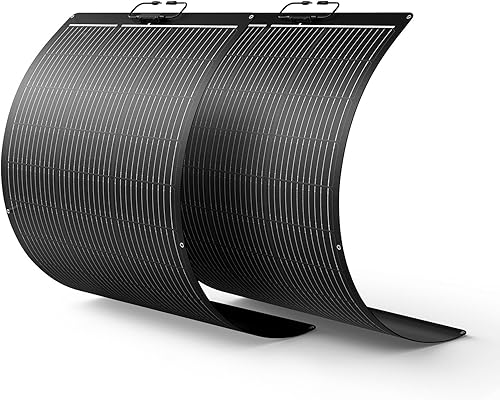
 Best two-panel bundleCheck it
- 5
 Check it
Callsun 400W Flexible Solar Panel
Best for high daily output - 6
 Check it
Callsun 200W Flexible Solar Panel
Best for stealth van setups - 7
 Check it
Callsun 400W Flexible Solar Panel System
Best four-panel system - 8
 Check it
LETSFAB 100W Flexible Solar Panels
Best for efficient 100W charging - 9
 Check it
Topunive 100W 12V Flexible Solar Panel 9BB
Best for 12V battery charging
The best flexible solar panels, pick by pick
The top picks lead on light weight, bend range and shade help. The lower picks trade efficiency or output for bundle size or a narrower shape.
Read the trade-off in each write-up before you compare wattage alone.
Renogy Flexible Solar Panel 100 Watt: Best for curved RV roofs
- 100 watts
- 240 degree bend
- 48 x 21.5 x 0.08 in
- 4 pounds
- 22% efficiency
- MC4 connectors
A light, thin 100W panel that bends to 240 degrees for curved roofs and uneven surfaces where rigid frames do not fit.
Pros
- Very light at 4 pounds
- Only 0.08 in thick
- Bends to 240 degrees
- Rated for wind and snow loads
Cons
- Only 100 watts per panel
- Large footprint for its output
This panel suits RVs, vans and boats with a curved or uneven roof. At 48 x 21.5 in and 4 pounds, it fits where a rigid 100W panel would need a raised rack.
The 0.08 in thickness keeps the profile low.
Renogy says it bends to 240 degrees and weighs 70% less than a conventional panel. That matters on load-sensitive roofs and on travel trailers where every pound counts.
It carries MC4 connectors and an IP68 rated junction box.
Efficiency is 22%, so you get less energy per square foot than the 25% N-Type panels below. For a small battery bank or a single panel install, that trade is often fine.
For a large bank, you may need two or three panels.
The trade-off is clear. You gain the lightest, thinnest fit here.
You give up the higher efficiency and anti-shading tech of the Renogy 200 Watt. If space is tight and loads are modest, this is the clean pick.
Renogy 200 Watt ShadowFlux Flexible Solar Panel: Best for partial shade
- 200 watts
- 270 degree bend
- 62.2 x 27.4 x 0.1 in
- 7.7 pounds
- 25% efficiency
- ShadowFlux anti-shading
A 200W N-Type panel with cell-level bypass help for shade from trees, vents and rigging, built for curved RV and marine roofs.
Pros
- Anti-shading bypass design
- 25% N-Type efficiency
- 270 degree bend
- Only 7.7 pounds
Cons
- One of the largest panels here
- Single panel, so you must plan wiring
This panel suits larger RV roofs and boats where shade from trees, vents or rigging is common. At 200 watts, 62.2 x 27.4 in and 7.7 pounds, it makes about twice the power of a 100W panel in one mount.
Renogy's ShadowFlux design uses up to 30 bypass diodes at cell level. That helps the panel keep more output when only part of it is shaded.
It is a real help on a roof with a vent or a tree shadow that moves through the day.
The panel uses N-Type cells at 25% efficiency and bends to 270 degrees along the long axis. The TPO face resists aging, and the IP68 rating covers rain and dust.
It fits 12V, 24V and 36V off-grid systems.
The trade-off is size. At over 5 feet long, it needs a clear run of roof.
If your roof is short or broken up by vents, two smaller panels may fit better. If you have the space, this is the strongest single panel here.
BougeRV Arch Pro 200W Anti-Shading N-Type Fiberglass: Best for ETFE fiberglass use
- 200 watts
- 270 degree bend
- 52.95 x 30.91 x 0.1 in
- 7.9 pounds
- 25% efficiency
- ETFE coating
A 200W fiberglass panel with ETFE coating and bypass diodes, aimed at curved roofs where a scratch resistant surface helps.
Pros
- ETFE anti-scratch surface
- Bypass diode shading help
- 270 degree bend
- Pre-attached cables
Cons
- Tape for adhesive mounting is not included
- Check power station voltage limits before use
This panel suits buyers who want a fiberglass build with an ETFE face. At 200 watts, 52.95 x 30.91 in and 7.9 pounds, it is a close match to the Renogy 200 Watt in power and weight.
BougeRV uses 16BB N-Type cells at 25% efficiency. Bypass diodes help with partial shade and low light.
The ETFE coating is anti-scratch and self-cleaning, which helps on a roof that sees branches and road grit.
It bends to 270 degrees and installs with hanging holes, adhesive backing or glass glue. The tape for adhesive mounting is not included, so plan for that cost and time.
Cables are 2.95 ft long and pre-attached.
Check voltage before you connect it to a power station. BougeRV notes the open circuit voltage may not fit some stations.
For a 12V or 24V battery system with a proper controller, it is a strong curved-roof pick.
ECO-WORTHY 2pcs 130 Watt: Best two-panel bundle
- 2 x 130 watts
- 37.8 x 27.1 x 0.1 in each
- 6.28 pounds per panel
- 25% efficiency
- 270 degree bend
Two 130W panels give 260W total in a smaller footprint per panel, which suits roofs that need two separate mounting spots.
Pros
- Two panels for flexible placement
- 130W per panel
- 270 degree bend
- Pre-drilled mounting holes
Cons
- You must wire two panels together
- 260W total is less than 400W arrays
This bundle suits roofs that need two smaller mounting spots instead of one large panel. You get two 130W panels, 260W total, each 37.8 x 27.1 in and 6.28 pounds.
Each panel bends to 270 degrees and is 0.1 in thick. That thin profile helps on a curved RV roof or a boat deck where a raised frame would catch wind.
The low weight also makes one person handling easier during set up.
ECO-WORTHY states up to 520Wh per panel under 4 hours of full sun, and up to 1040Wh with both panels. Real output will vary with sun, angle and temperature.
Treat those figures as a guide for planning, not a daily promise.
Efficiency is 25% with 18BB cells. At 6.5 A and 24.5 volts maximum, the panels aim at 12V, 24V or 36V style off grid set ups when wired to a matching controller.
Check your controller limits before you join the pair.
The junction box is IP68 rated, and each panel includes 2.9 ft cables for series or parallel wiring. Six pre drilled holes help with adhesive, tape or tie down mounting.
Seal every fixing point and keep cable runs short where you can.
The trade off is wiring. Two panels mean more cable runs and more mounts to seal.
If you want one clean panel, the Renogy 200 Watt is simpler. If your roof has two good spots, this bundle uses space well.
Callsun 400W Flexible Solar Panel: Best for high daily output
- 2 x 200 watts
- 62.1 x 31.7 x 0.1 in
- 9.3 pounds
- 23.5% efficiency
- 240 degree bend
- ETFE coating
A two-panel 400W set with a white heat-reflective backsheet, aimed at larger RVs, boats and sheds that need more daily energy.
Pros
- 400W total output
- White backsheet reflects heat
- ETFE coating
- Series or parallel options
Cons
- Large panels need clear roof space
- Two panels to mount and wire
This set suits large RVs, catamarans, sheds and cabins that need 400W in flexible form. You get two 200W panels, 400W total, each 62.1 x 31.7 in, with a combined weight of 9.3 pounds.
The white backsheet reflects heat, which helps efficiency in hot climates. It also gives a clean marine look on a white roof.
The ETFE face resists hail, yellowing and cracking, according to Callsun.
Each panel bends to 240 degrees and runs at 23.5% efficiency. Callsun states up to 2kWh of daily power under ideal conditions.
That is a guide, not a promise, since sun hours and panel angle drive real results.
The trade-off is roof space. Two large panels need a long, clear area.
This is not a pick for a small van. For a large boat or a shed roof, it is the simplest path to 400W without rigid frames.
Check our best 400 watt flexible solar panel kits and best flexible solar panel high wattage pages for more high output options.
Callsun 200W Flexible Solar Panel: Best for stealth van setups
- 2 x 100 watts
- 43.7 x 24.4 x 0.98 in
- 5.7 pounds
- 23% efficiency
- 240 degree bend
- ETFE coating
Two black 100W panels at 0.1 in thick sit nearly flush, which helps low clearance vans and a low profile look.
Pros
- All-black low profile
- Only 5.7 pounds total
- Two smaller panels fit more roofs
- ETFE coating
Cons
- 200W total limits daily harvest
- Wiring two panels takes more work
This set suits van life and low clearance setups where a low profile matters. You get two 100W black panels, 200W total, each 43.7 x 24.4 in, at 5.7 pounds total.
At 0.1 in thick, the panels sit nearly flush. That helps stealth camping and low garage clearance.
The all black face blends with a dark roof trim. On a small van roof, two mid size panels often fit better than one very long panel.
Efficiency is 23% with 11 busbar cells. At 18.61 volts maximum and 5.38 A, the set is aimed at 12V and 24V battery systems with a proper controller.
Check voltage limits before you wire in series.
The ETFE face resists hail, yellowing and cracking, according to Callsun. That matters for a panel that will see road grit, branches and wash cycles over time.
Clean the face with water and a soft cloth, and rinse first so dirt does not scratch the coating.
The set includes connection cables and a user manual. Callsun states a 5 year warranty.
Keep the paperwork with your other van records and check mount seals each season.
The trade off is total power. At 200W, this set suits a modest battery bank or a weekend trip.
For full time off grid living, the 400W Callsun sets above give more headroom. For a van, this is the cleaner footprint.
See best small flexible solar panel if your roof is very short.
Callsun 400W Flexible Solar Panel System: Best four-panel system
- 4 x 100 watts
- 43.7 x 24.4 x 0.98 in each
- 5.7 pounds
- 23% efficiency
- 240 degree bend
- ETFE coating
Four 100W black panels make a 400W array that can scale to 48V systems, for buyers who want room to expand later.
Pros
- 400W from four small panels
- Scales to 48V systems
- Fits around roof vents
- Connection cables included
Cons
- Four panels mean more wiring
- More mounting points to plan
This system suits buyers who want 400W but need panels that fit around vents and AC units. You get four 100W panels, 400W total, each 43.7 x 24.4 in.
Four smaller panels give you more placement choices than two large panels. You can split the array across a broken roof.
The all-black ETFE faces keep a low 0.1 in profile.
Efficiency is 23% with 11 busbar cells. The system is designed for series or parallel wiring and can scale to 48V systems.
Callsun states up to 2kWh of daily power under ideal conditions.
The trade-off is wiring time. Four panels mean more mounts, more seals and more cable.
If you want the fewest parts, the two-panel Callsun 400W set is simpler. If your roof is crowded, this system fits where large panels will not.
Compare it in our best flexible solar panel kit guide.
LETSFAB 100W Flexible Solar Panels: Best for efficient 100W charging
- 100 watts
- 44 x 14.5 x 0.07 in
- 4.4 pounds
- 25.4% efficiency
- 20BB N-Type cells
- MC4 connectors
A narrow 100W panel with 25.4% efficiency and an ETFE coating, useful where a long, slim shape fits better than a wide panel.
Pros
- Highest efficiency here at 25.4%
- Narrow 14.5 in width
- Only 4.4 pounds
- MC4 connectors
Cons
- Only 100 watts
- Long shape may not fit square roofs
This panel suits narrow roofs and boat decks where a long, slim shape fits. At 100 watts, 44 x 14.5 in and 4.4 pounds, it is the narrowest panel in this group.
LETSFAB uses 20BB N-Type cells at 25.4% efficiency, the highest efficiency here. That means more power per square foot, which helps when roof space is limited.
The ETFE coating gathers light from different angles, according to the brand.
It has a waterproof junction box, pre-installed MC4 connectors and reinforced mounting holes. At 18 volts maximum, it fits 12V battery charging with a proper controller.
The trade-off is output. At 100W, it suits a small battery or a single device load.
It will not run a large RV bank alone. If you need more, pair it with a second panel or choose a 200W pick.
For 12V focus, see best flexible solar panel 12v. For 100W focus, see best 100 watt solar panel flexible.
Topunive 100W 12V Flexible Solar Panel 9BB: Best for 12V battery charging
- 100 watts
- 36.22 x 23.22 x 0.12 in
- 4.4 pounds
- 23% efficiency
- 9BB cells
- MC4 connectors
A compact 100W 12V panel with a 17.7 in minimum bend radius, aimed at small trailers, boats and cabins.
Pros
- Compact footprint
- 12V output for battery charging
- Only 4.4 pounds
- ETFE front with TPT back
Cons
- Only 23% efficiency
- 100W limits larger loads
This panel suits small trailers, boats and cabins with a 12V battery. At 100 watts, 36.22 x 23.22 in and 4.4 pounds, it is the most compact footprint in this group.
Topunive states a minimum bend radius of 17.7 in. That is a useful limit to check against your curve before you buy.
The panel is 0.11 in thick and uses an ETFE front with a TPT back for heat dissipation.
It uses 9BB monocrystalline cells at 23% efficiency. The junction box is IP67 rated and includes 2 bypass diodes.
MC4 connectors support series and parallel expansion.
The trade-off is lower efficiency and 100W output. It is a good first panel for a small system.
For a larger bank, you will need more panels or a higher wattage pick. Measure your curve and your roof holes first.
For RV use, see best flexible solar panels for rv. For car roofs, see best flexible solar panel for car roof.
How the best flexible solar panels compare
The table below shows the key specs side by side. Use it to compare power, size and weight before you read the buying advice.
Start with total watts, then check each panel size against your clear roof area. A long panel needs a long clear run, while two smaller panels can fit around vents and roof units.
Weight is next. Light panels are easier to carry up a ladder and put less load on a fiberglass or boat roof.
Even a few pounds saved can matter on a small hull.
Also check bend angle and efficiency in the table. A higher bend range helps a curved roof, and higher efficiency gives more power per square foot of limited space.
| Product | Best for | Power | Size | Weight | Our score |
|---|---|---|---|---|---|
| Renogy Flexible Solar Panel 100 Watt | curved RV roofs | 100 watts | 48 x 21.5 x 0.08 in | 4 pounds | 9.7 |
| Renogy 200 Watt ShadowFlux Flexible Solar Panel | partial shade | 200 watts | 62.2 x 27.4 x 0.1 in | 7.7 pounds | 9.6 |
| BougeRV Arch Pro 200W Anti-Shading N-Type Fiberglass | ETFE fiberglass use | 200 watts | 52.95 x 30.91 x 0.1 in | 7.9 pounds | 9.4 |
| ECO-WORTHY 2pcs 130 Watt | two-panel bundle | 260 watts total | 37.8 x 27.1 x 0.1 in | 12.6 pounds total | 9.1 |
| Callsun 400W Flexible Solar Panel | high daily output | 400 watts total | 62.1 x 31.7 x 0.1 in | 9.3 pounds | 8.9 |
| Callsun 200W Flexible Solar Panel | stealth van setups | 200 watts total | 43.7 x 24.4 x 0.98 in | 5.7 pounds | 8.7 |
| Callsun 400W Flexible Solar Panel System | four-panel system | 400 watts total | 43.7 x 24.4 x 0.98 in | 5.7 pounds | 8.4 |
| LETSFAB 100W Flexible Solar Panels | efficient 100W charging | 100 watts | 44 x 14.5 x 0.07 in | 4.4 pounds | 8.2 |
| Topunive 100W 12V Flexible Solar Panel 9BB | 12V battery charging | 100 watts | 36.22 x 23.22 x 0.12 in | 4.4 pounds | 8.0 |
How we compared these flexible solar panels
We compared wattage, dimensions, weight, bend angle, efficiency and mounting for every panel. We also checked connector type, voltage and weather ratings.
We did not test panels by hand. A 270 degree bend helps an Airstream curve, but it does not help a short, flat roof where a 100W panel already fits.
Renogy ShadowFlux and BougeRV Arch Pro state bypass diode designs for partial shade. Shade still cuts output on every panel, so placement matters.
Weight matters on fiberglass RV roofs and small boats. The Renogy 100 Watt at 4 pounds is the lightest single panel here.
What size flexible solar panel do I need?
You need enough watts to refill your battery on a typical day. Start with battery capacity and daily use.
Then divide by average sun hours.
A 100W panel makes about 300 to 500Wh on a good day. A 200W panel makes about double that.
A 400W array makes about double again. These are planning guides, not guarantees.
Roof space sets the cap. Measure clear area after vents and antennas.
A 62 in panel needs a 62 in clear run. Two 44 in panels can fit a broken roof that one large panel cannot.
If unsure, start with which solar panel size do i need.
How to size for a 12V battery bank
Match panel voltage to your controller, not just to the battery. Panels here range from 12V to 44.1V open circuit.
A 100W panel suits a small 100Ah bank for light loads. A 200W panel suits a larger bank.
A 400W array suits a big bank drained daily.
Check controller limits before wiring in series. Series raises voltage.
Parallel raises current.
How to size for boats and vans
Boats and vans often have less roof space than an RV. Two 100W panels may fit better than one 200W panel.
Weight matters more on a small boat. A 4 pound panel is easier to handle than a 9 pound panel.
How flexible do flexible solar panels need to be?
You need enough bend to follow your curve without forcing the panel. Topunive states 17.7 in minimum radius.
Renogy and BougeRV state 270 degrees along the long axis.
Bending across the short axis can stress cells. Read the bend note for your panel before you mount it.
If your curve is tight, choose a smaller panel. It follows the curve with less stress.
Bendable panels for curves vs flat roofs
On a flat roof, flexibility is a bonus. Focus on watts per square foot and mounting holes.
On a curved roof, flexibility is the point. The Renogy 100 Watt at 240 degrees and the Renogy 200 Watt at 270 degrees are built for that job.
Adhesive vs screw mounting
Adhesive keeps a low profile and needs no holes. Screw mounting gives a strong hold and easier removal.
Adhesive needs a clean, dry surface and cure time. BougeRV states 48 hours.
Screw mounting needs sealed holes.
If you plan adhesive, read best flexible solar panel adhesive first.
Which flexible solar panel handles shade best?
Shade tolerance comes from bypass diodes. When a cell is shaded, a bypass diode lets current flow around it.
Renogy ShadowFlux uses up to 30 bypass diodes at cell level for shade from trees, buildings and leaves. BougeRV Arch Pro also states bypass help.
No panel makes full power in shade. Keep the panel in direct sun as much as you can.
For shade-prone roofs, the Renogy 200 Watt ShadowFlux is the top pick. The BougeRV Arch Pro is a close second.
How much shade cuts output
One shaded cell can cut a whole string in a basic panel. Bypass diodes reduce that loss, but do not erase it.
Renogy advises keeping over half the panel in direct sun. Plan your mount around noon sun and tree lines.
ETFE, TPO or polymer: which face is best?
ETFE is common on fiberglass panels. TPO is used on the Renogy ShadowFlux.
Polymer is used on the Renogy 100 Watt.
Each face material affects weight, toughness and how the panel ages in sun and rain. The cell type behind the face still drives efficiency, so match thickness and bend limits to your roof.
ETFE resists scratches and self cleans better than PET, according to BougeRV and Callsun. Road grit and branch hits are normal on an RV roof, so a scratch resistant face helps over time.
Rain also sheds dirt more easily from a smooth ETFE surface.
TPO offers moisture resistance and flexibility, according to Renogy. Renogy says TPO holds up well with repeated bending and outdoor use, with less risk of delamination.
That suits a panel that must follow a curved roof through heat, cold and vibration.
Polymer panels are light and thin, but may yellow faster than ETFE. The Renogy 100 Watt uses advanced polymer materials to stay very light at 4 pounds.
It still carries an IP68 rated junction box and IP67 rated connectors for outdoor use.
For daily care, all three faces want a gentle wash. Use water and a soft cloth, and rinse before wiping so grit does not grind into the coating.
Avoid harsh cleaners that can dull the surface.
Polymer gives the lowest profile and easiest handling. ETFE and TPO give a stronger long term outdoor story for most buyers.
For long term outdoor use, ETFE or TPO is a safer bet.
Match the face to your roof and your care habits. If you park under trees, pick a scratch resistant ETFE face.
If your roof has a tight curve, TPO flexibility may help more.
How do you install flexible solar panels?
Install starts with a clean, dry roof and a dry fit. Mark mount points and check cable runs.
Then mount, seal and wire.
Adhesive needs surface prep and cure time in strips with airflow gaps. Screw mounting needs sealed holes checked after first rain.
Our flexible solar panel installation guide has step by step detail. Read it before you drill or glue.
Wiring series vs parallel
Series raises voltage. Parallel raises current.
Your controller must accept the result.
Two panel bundles here state series or parallel options. Check voltage math before you connect.
A series pair can exceed a controller limit fast.
Safety and care
Work on a dry roof and use a ladder, not the panel, for support. Flexible panels are not steps.
Clean the face with water and a soft cloth. Rinse before wiping to avoid grinding dirt in.
Check mounts and seals each season. A small fix now prevents a leak later.
Which flexible solar panel wattage should you buy?
Buy the wattage that fills your battery on a normal day. More wastes roof space.
Fewer leaves the battery low in winter.
Start with your daily use in watt hours, then divide by your average sun hours. That gives a rough watt target before you look at panels.
Winter sun is weaker, so build in some headroom if you camp year round.
100W panels suit small banks. 200W panels suit a mid size bank.
400W arrays suit large banks and off grid cabins.
Roof space sets the hard cap. Measure clear area after vents, antennas and AC units.
Two smaller panels can fit a broken roof that one large panel cannot.
Wiring choices also matter at higher wattage. Series raises voltage, while parallel raises current.
Your controller must accept the result, so check limits before you join panels.
If you run a fridge, lights and fans each day, aim higher. If you mainly charge phones and small devices, a 100W panel may be plenty.
To compare wattages, see best 50w flexible solar panel, best 100 watt solar panel flexible, best 200 watt flexible solar panel and best 300w flexible solar panel.
Our verdict on the best flexible solar panels
Pick the Renogy 200 Watt ShadowFlux if you need more power and shade help in one panel. Pick the Renogy 100 Watt for the lightest fit.
Pick the BougeRV Arch Pro for ETFE fiberglass at 200W.
Pick the ECO-WORTHY two-pack if two smaller panels fit better. Pick a Callsun 400W set for high daily output.
Pick the LETSFAB or Topunive 100W if space is very tight.
Measure the roof, check the bend radius and size watts to daily use. Then mount with sealed holes or cured adhesive, and wire to a matching controller.
For next steps, read our flexible solar panel installation guide and our which solar panel size do i need guide.
Our top 3 picks at a glance
-
1
-
2
Best for partial shade
Renogy 200 Watt ShadowFlux Flexible Solar Panel
9.6/10 our score
See it on Amazon -
3
Best for ETFE fiberglass use
BougeRV Arch Pro 200W Anti-Shading N-Type Fiberglass
9.4/10 our score
See it on Amazon
Frequently asked questions
What are flexible solar panels best for?
Flexible solar panels work best on curved RV roofs, boat decks, van roofs and other uneven surfaces where a rigid frame cannot sit flat. They are thin and light, so roof load stays low.
Think in watts per square foot of usable roof, not peak watts alone.
How much wattage do I need for an RV?
Start with your daily battery use in watt-hours, then size the array for your sun hours and roof space. A 100W panel suits small loads, while 200W to 400W arrays suit larger battery banks.
Our size guide explains the math in plain steps.
Can flexible panels bend around a curve?
Yes, within the stated bend angle and radius. Renogy and BougeRV panels here bend to 270 degrees.
Topunive states a 17.7 in minimum radius.
Always bend along the long axis as directed and check the curve before you mount.
Do flexible solar panels handle shade better?
Some do, because bypass diodes help current flow around a shaded cell. Renogy ShadowFlux and BougeRV Arch Pro use that design.
Shade still cuts output, so keep vents, antennas and branches off the active cells when you can.
Are flexible panels durable in wind and rain?
The panels here use ETFE, TPO or polymer faces with IP68 or IP67 junction protection. Renogy states wind resistance to 2400 Pa and snow load to 5400 Pa for its 100W panel.
Mounting method and sealed edges matter as much as the rating.


