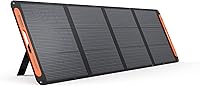
5 Best Solar Panels for Jackery Power Stations (November 2026)
The best best solar panels for Jackery power stations include the Jackery SolarSaga 200W Portable Solar Panel for high-output Jackery charging, the ZOUPW 100W Portable Solar Panel for Power for flexible connector matching, and the SOKIOVOLA N-Type 16BB 200W Portable Solar Panel for RV mounting flexibility.
On this page (5 sections)
The best solar panels for Jackery power stations are panels that match the station's input connector, voltage and maximum solar input. That match matters more than the headline wattage because a power station cannot draw more solar power than its input is designed to accept.
For most owners, the Jackery SolarSaga 200W is the strongest choice when a compatible Explorer model can use 200W input. It pairs 200W maximum power with bifacial conversion up to 26.7% and a DC8020 connection for the Explorer 1000 Plus, 2000 Pro, 2000 Plus and 3000 Pro.
The ZOUPW 100W and Jackery SolarSaga 100W Air suit lighter setups where carry weight and folded size matter more than reaching the highest charging ceiling. At 9.5 lb and 7.1 lb, those panels are easier to move between a vehicle, tent and campsite table.
We compared the listed wattage, connector choices, output voltage, folded size, weight, weather rating and direct-device ports across the picks in this guide. We also checked which cable types are included, because the right connector in the box can save you buying an extra adapter later.
A panel's rated output is a ceiling rather than a promise for every hour of the day. Sunlight angle, shade, clouds, panel temperature and the power station's input limit all affect the power you actually receive.
That is why a 200W panel can still charge slowly in weak sun, while a smaller panel in clear direct sun may feel more useful than expected. It also means positioning, cleanliness and a full unshaded view are part of getting the rating you paid for.
If you hike to your site, weight deserves extra attention before you choose a 200W model. If you mostly drive to a campsite or RV spot, the larger panels are easier to justify because the hardest carrying happens over short distances.
If you're unsure which solar panel size you need, start with your Explorer model and its solar input limit. Then use our guide on how to use Jackery solar panels for positioning and connection basics.
Our picks at a glance
-
1
 Best for high-output Jackery charging
Jackery SolarSaga 200W Portable Solar Panel
9.7/10 our score
See it on Amazon -
2
 Best for flexible connector matching
ZOUPW 100W Portable Solar Panel for Power
9.5/10 our score
See it on Amazon -
3
 Best for RV mounting flexibility
SOKIOVOLA N-Type 16BB 200W Portable Solar Panel
9.5/10 our score
See it on Amazon
- 4
 Check it
Jackery SolarSaga 100W Air Solar Panel
Best for lightweight Jackery kits - 5
 Check it
TWELSEAVAN 200W Portable Solar Panel for Power
Best for built-in device charging
The best solar panels for Jackery power stations
The Jackery SolarSaga 200W leads for high-output charging, but the best panel depends on your Explorer model and how you travel. A lighter 100W panel may be easier to carry, while a third-party 200W panel can offer more connector choices.
Our score weighs specs, features and buyer feedback against what you're shopping for. The products below are ordered from highest score to lowest.
Jackery SolarSaga 200W Portable Solar Panel: Best for high-output Jackery charging
- 200W maximum power
- Bifacial conversion up to 26.7%
- DC8020, USB-A and USB-C ports
- IP68 water and dust resistance
The SolarSaga 200W is the strongest match for Jackery owners who want high panel output and direct compatibility with several Explorer power stations. Its 14.3 lb weight is easier to manage at a campsite than on a long hike.
Pros
- Highest score in this roundup
- Bifacial design
- IP68 rating
Cons
- Heavier than the 100W Air
- Cable is not weatherproof
The Jackery SolarSaga 200W Portable Solar Panel is the best overall pick for Jackery owners who want a high-output panel from the same brand. It has a 200W maximum power rating and bifacial solar conversion with efficiency up to 26.7%.
Its DC8020 port works with the Jackery Explorer 1000 Plus, 2000 Pro, 2000 Plus and 3000 Pro. USB-A and USB-C ports also support direct charging for compatible devices.
The panel folds to 24 x 21.7 x 1.8 in and weighs 14.3 lb. That size is reasonable for a vehicle, RV or campsite, but it is less convenient for long walks than the 7.1 lb SolarSaga 100W Air.
Jackery gives this panel an IP68 water and dust resistance rating, with an operating temperature range from -4°F to 149°F. The included 9.8 ft cable has DC8020, DC7909, USB-A and USB-C connections, but the cable is not weatherproof.
Choose it when your power station can accept 200W and you want the highest rated output here. For a closer look at larger charging setups, see our guide to the best 400 watt solar panel for Jackery.
ZOUPW 100W Portable Solar Panel for Power: Best for flexible connector matching
- 100W maximum power
- 23.5% efficiency
- 5-in-1 connector cable
- IP67 waterproof panel body
ZOUPW is a practical pick when your Jackery model needs a specific connector and you also use other power stations. The 9.5 lb panel gives up some output compared with 200W models but includes several connection options.
Pros
- 5-in-1 connector cable
- USB-C and USB-A ports
- 9.5 lb weight
Cons
- Lower output than 200W picks
- USB hub and cables need protection from rain
The ZOUPW 100W Portable Solar Panel for Power is the most flexible pick when connector matching is your main concern. Its included 5-in-1 cable has DC8020, XT60, Anderson, DC7909 and DC5521 connections.
That combination covers several Jackery connections, including DC8020 for the Explorer 1000 v2, 2000, 1500 Pro and Plus series. It also includes Anderson for the original Jackery 1000 and DC7909 for the Jackery 240, 300 and 500.
The panel produces up to 100W and has 23.5% efficiency. Its 24.13 x 21.06 x 1.77 in folded size and 9.5 lb weight make it easier to move than the 200W models.
ZOUPW adds one USB-C port and 2 USB-A ports for direct device charging. The panel body is IP67 waterproof, but the USB hub and connection cables need to stay dry.
Choose it when you use more than one power station brand or need several adapter choices in one kit. Check your station's input limit because a lower limit will cap the charging draw.
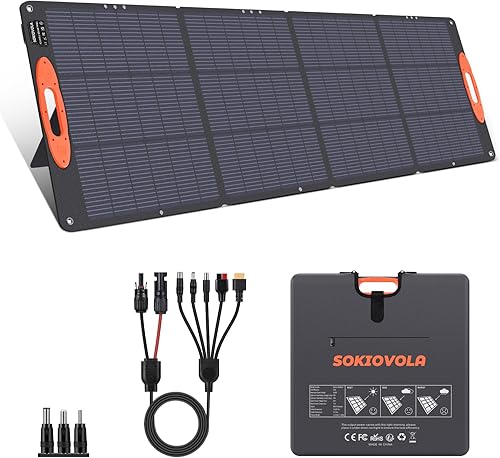
SOKIOVOLA N-Type 16BB 200W Portable Solar Panel: Best for RV mounting flexibility
- 200W maximum power
- 25% efficiency
- IP68 waterproof ETFE coating
- 4 holes for attaching it to an RV
SOKIOVOLA suits Jackery owners who want 200W output and several connector choices for different power stations. Its 16.3 lb weight and included panel bag make it better for RV trips and campsites than extended carrying.
Pros
- 200W output
- MC4 to 5-in-1 cable
- Included carrying bag
Cons
- Heaviest panel here
- 18V output needs a compatible station input
The SOKIOVOLA N-Type 16BB 200W Portable Solar Panel suits RV owners who want 200W output and broad connector coverage. It uses N-type 16BB monocrystalline cells with conversion efficiency up to 25%.
Its MC4 cable connects to XT60, DC5521, DC7909, DC8020 and Anderson inputs. That makes it useful when a Jackery power station is part of a wider outdoor power setup.
The panel folds to 21 x 23 in and weighs 16.3 lb. Four attachment holes can help with RV installation, while the magnetic handle and included panel bag help with transport between storage and the campsite.
SOKIOVOLA gives the panel an IP68 rating and uses ETFE coating. Its stated output voltage is 18V, so confirm that your Jackery accepts the panel's voltage before connecting it.
Choose it for RV travel, fixed campsite positioning or a mixed-brand setup. Its weight is the main trade-off, especially if you plan to carry it far from a vehicle.
Jackery SolarSaga 100W Air Solar Panel: Best for lightweight Jackery kits
- 100W maximum power
- 23% bifacial conversion efficiency
- 7.1 lb weight
- IP68-rated design
The SolarSaga 100W Air is the easiest panel here to carry. Its W-fold design, integrated stand and included storage bag suit camping kits where low weight matters more than a 200W charging ceiling.
Pros
- Lightest pick
- Bifacial generation
- Included storage bag
Cons
- Not compatible with Explorer 300 or 300 v2
- 100W maximum power
The Jackery SolarSaga 100W Air Solar Panel is the lightest pick in this roundup at 7.1 lb. It provides 100W maximum power, 23% bifacial conversion efficiency and a W-fold design that stores smaller than an A2 sheet of paper.
An integrated aluminum stand sets up without tools, and the included storage bag helps keep the panel with the rest of your camping gear. The panel also includes a DC8020 to DC7909 adapter and a multifunctional solar charging cable.
Its IP68-rated design is made for outdoor use across an operating range from -4°F to 149°F. The lower 100W rating means it will not match the charging ceiling of a 200W panel when both receive similar sunlight.
The key compatibility warning is clear: this panel is not compatible with the Jackery Explorer 300 or Explorer 300 v2 series. Using it with those models may trigger an F7 input voltage error.
Choose it for lightweight travel and smaller charging needs. If your Explorer 300 is the target, compare the options in our guide to the best solar panel for the Jackery Explorer 300.
TWELSEAVAN 200W Portable Solar Panel for Power: Best for built-in device charging
- 200W maximum power
- 24% efficiency
- 60W USB-C port
- 18W QC3.0 USB port
TWELSEAVAN combines 200W panel output with USB-C and USB charging ports for devices such as phones, cameras and tablets. At 15.7 lb, it is a campsite or RV panel rather than a light backpacking option.
Pros
- 200W output
- 60W USB-C charging
- 8-in-1 connector setup
Cons
- 15.7 lb weight
- IP65 rating is lower than the IP68 picks
The TWELSEAVAN 200W Portable Solar Panel for Power is the best match here for charging a power station while also using built-in USB ports. It has a 200W maximum power rating and 24% conversion efficiency.
Its ports include USB-C with up to 60W, QC3.0 USB with up to 18W and another USB port rated at 5V/3A. This arrangement can help you charge smaller devices without using every available power station outlet.
The panel folds to 23 x 22 in and weighs 15.7 lb. Four adjustable kickstands help you set the panel angle, while the 9.8 ft MC4 cable and adapters provide connection options for Jackery and other power stations.
TWELSEAVAN uses an ETFE laminated case and gives the panel an IP65 waterproof rating. The kit includes an MC4 cable with Anderson, XT60, 8020, 7909 and 5521 connections plus 3 DC adapters.
Choose it when direct USB-C charging matters as much as the panel's power rating. Its weight and lower IP rating than the IP68 choices are worth considering before RV or campsite use.
How do I match a solar panel to my Jackery?
Match the panel in this order: input connector, voltage range, maximum solar input and rated panel wattage. BLUETTI owners can compare compatible options in our solar panels for BLUETTI power stations guide.
A connector that fits does not prove that the voltage is safe or that the power station can use the panel's full output.
For example, the ZOUPW panel includes DC8020 for several newer Jackery series and DC7909 for the Jackery 240, 300 and 500. The SolarSaga 100W Air has a specific incompatibility with the Explorer 300 and 300 v2, so model checking matters even when both products carry the Jackery name.
Look for the Explorer model number on the power station or in its manual. Then compare that model's solar input details with the panel's connector and output voltage.
Owners choosing a larger system can also compare the best Jackery solar panel and battery bundles when a panel alone doesn't meet their backup plan.
Is a 200W solar panel better for every Jackery?
A 200W panel is better only when the Jackery power station can accept the available input and you can manage the panel's size and weight. The SolarSaga 200W, SOKIOVOLA and TWELSEAVAN all offer 200W ratings, but they weigh about 14.3 to 16.3 lb.
That weight range suits car camping, RV trips and base camp use well because the panel can travel in a vehicle and be carried a short distance at each stop. It is a poorer fit for backpacking, where every extra pound affects how much food, water and shelter gear you can carry alongside it.
A 100W panel is easier to store and carry. The SolarSaga 100W Air weighs 7.1 lb, while the ZOUPW weighs 9.5 lb.
The smaller panels also tend to feel less fussy at a tight campsite where space for unfolding and angling a large panel is limited. You may be able to find a sunny patch for a 100W panel when a folded 200W panel needs a wider clear area.
The station's input limit is the deciding factor. If a power station can draw only 60W, a 100W panel will not make it draw 100W, and a 200W panel will not make it draw 200W.
Voltage matters for the same practical reason, since the panel output has to sit inside the range your Explorer model accepts. A connector that physically fits the socket does not remove the need to check voltage, polarity and maximum input before you plug anything in.
Daily use also changes the value of extra wattage, because more headroom can help a compatible station recover charge after cooking, lighting or device use. In poor light, though, both panel sizes will produce less than their ratings and the larger panel simply has more surface catching what sun is available.
For outage planning, compare solar charging with fuel-based options in our guide to the best portable dual fuel generator for power outages. You can also read whether dual fuel or tri fuel generators are worth buying before building a larger backup plan.
How should you position a portable Jackery solar panel?
Point the panel toward direct sun, avoid shade and adjust the angle as the sun moves. Even a small shadow can reduce the panel's useful output, so keep nearby trees, roof edges and vehicle walls from crossing the panel.
The best spot is often a small open patch rather than the place closest to your tent or power station. A few extra feet of cable can let the panel sit in clear sun while the station and its ports stay in shade.
Use the built-in stands or kickstands on level ground. The ZOUPW has 2 adjustable kickstands, while TWELSEAVAN has 4 adjustable kickstands.
Set the panel low enough that wind cannot easily catch it, and angle it so the face points into the sun instead of lying flat at midday when the light is more direct. If the sun moves across the sky, a quick check every hour or so can keep the panel working closer to its peak.
Keep the power station and cable connections dry. A waterproof panel rating does not mean every port, hub or cable connection can sit in rain.
The SolarSaga 200W cable is listed as not weatherproof, and panel ratings for the ZOUPW and TWELSEAVAN do not make every connection point safe to leave wet. Keep plugs, hubs and the power station under cover, and route cables so puddles cannot collect at the ends.
Clean the panel face gently when dust or grit builds up, because a dirty surface blocks light before it reaches the cells. A soft cloth and plain water are enough for normal campsite dust, and grit should be rinsed away rather than wiped dry.
Fold the panel only when it is clean and dry. Store cables with the panel so the correct connector is available when you need to recharge.
Folding a damp panel can trap moisture inside the folded layers, so let it dry fully in shade before packing it away. Keeping the cable with the panel also prevents the common problem of arriving at a sunny spot with the panel but the wrong connector still at home.
Which Jackery solar panel should you choose?
Pick the SolarSaga 200W if your Jackery accepts 200W and you want the strongest rated output. It combines 200W maximum power, bifacial conversion up to 26.7% and a DC8020 connection for several larger Explorer models.
Pick the ZOUPW 100W when several connector types matter, because its 5-in-1 cable covers DC8020, XT60, Anderson, DC7909 and DC5521 connections. That makes it a sensible choice when one panel may need to serve more than one power station over time.
Choose the SolarSaga 100W Air when low weight is the priority, since it weighs 7.1 lb and folds to a compact size for camping kits. Remember that it is not compatible with the Explorer 300 or Explorer 300 v2, so that model check comes before anything else.
Choose SOKIOVOLA for RV attachment options and a 200W panel bag, with IP68 rating and 25% efficiency in a 16.3 lb package. Its four attachment holes and included bag suit vehicle based use, while its weight makes long carries a clear trade-off.
Choose TWELSEAVAN when built-in 60W USB-C charging is useful, since it also has an 18W QC3.0 port and a 5V/3A USB port for phones, tablets and cameras. That direct charging can reduce how often you need to run small devices from the power station itself.
For shorter trips with a small Explorer model, a 100W panel may offer the better balance of carry weight, storage space and charging speed. For base camp or RV use with a larger station, a 200W panel gives more headroom when the station can accept the input.
Before buying the best solar panel for Jackery, confirm your Explorer model, input voltage, connector and maximum solar input. For model-specific comparisons, see the best solar panel for the Jackery Explorer 1000, the Jackery SolarSaga 200W solar panel review, the best Jackery solar panel bag and the best solar panel for the Jackery 1000 v2.
Our top 3 picks at a glance
-
1
Best for high-output Jackery charging
Jackery SolarSaga 200W Portable Solar Panel
9.7/10 our score
See it on Amazon -
2
Best for flexible connector matching
ZOUPW 100W Portable Solar Panel for Power
9.5/10 our score
See it on Amazon -
3
Best for RV mounting flexibility
SOKIOVOLA N-Type 16BB 200W Portable Solar Panel
9.5/10 our score
See it on Amazon
Frequently asked questions
What is the best solar panel for a Jackery power station?
The Jackery SolarSaga 200W is the best overall match in this roundup because it combines 200W output, bifacial conversion up to 26.7% and a DC8020 connection. Check your Explorer model's input voltage and maximum solar input before ordering.
A 100W panel can be a better choice when weight or storage space matters more than charging speed.
Can I use any solar panel with a Jackery?
No. The panel must match your Jackery's input connector, voltage range and maximum solar input.
ZOUPW and SOKIOVOLA include several connector options, but a cable that fits physically does not guarantee electrical compatibility.
Check your exact Explorer manual before connecting a third-party panel.
Is a 100W or 200W solar panel better for Jackery?
A 200W panel is better when your Jackery can accept that input and you want faster charging in strong sunlight. A 100W panel is easier to carry and may suit smaller Explorer models or shorter outdoor trips.
The power station's input limit controls how much energy it can actually draw.
Can Jackery solar panels charge other power stations?
Some can, if the connector and electrical limits match. The SolarSaga 200W includes DC8020, USB-A and USB-C connections, while several third-party panels include MC4, XT60, Anderson, DC7909, DC8020 or DC5521 options.
Confirm voltage and polarity before connecting another brand's power station.