How to Use RV Solar Panels
To use RV solar panels, position them in clear sunlight, connect them through the correct charge controller, and check battery voltage and charging status each day. Clean shading, secure connections, and realistic power use help your battery bank stay charged.
On this page (9 sections)
- How do you set up RV solar panels?
- How should you position RV solar panels during the day?
- How do you check daily RV solar charging?
- How do you monitor the RV battery?
- How much power should you use overnight?
- When is a small RV solar panel enough?
- How do you keep RV solar panels clean?
- Do RV solar panels work on cloudy days?
- Should you use portable or fixed RV solar panels?
To use RV solar panels, place them in unobstructed sunlight, connect them through a suitable charge controller, and check the battery and charging readings each day. Your goal is to replace the energy your RV uses while leaving enough battery capacity for overnight and low-sun periods.
Before setting up, confirm the panel voltage, controller type, battery voltage, cable connections, and power station input limits. If you need help choosing a system, start with which solar panel size do i need and compare the main options in best rv solar panels.
How do you set up RV solar panels?
Set the panel where it receives the clearest sunlight, then connect the panel, controller, and battery in the order recommended by the equipment instructions. Keep the controller and battery connections dry, secure, and protected from sharp edges.
For a roof-mounted system, park where trees, roof equipment, and nearby vehicles create as little shade as possible. A small shadow across part of a panel can reduce useful output, so check the roof at different times of day.
For a portable system, place the panel away from the RV if the cable allows it. This can help you find better sunlight while keeping the controller or power station in a shaded location.
If you're building a wired system, follow how to wire solar panels on an rv before making connections. Don't guess at polarity or connect components in a different order from the instructions.
What should you check before connecting?
Check the battery voltage, controller rating, connectors, cable condition, and mounting points. A panel's maximum wattage does not tell you how much power your RV will receive in every hour.
Inspect the cable insulation for cuts or crushed sections. Make sure connectors are fully seated and that mounting hardware does not rub against the cable.
A controller helps manage the energy moving into the battery. It does not make a shaded panel perform like one in full sun, and it cannot overcome a battery, cable, or input limit that is not suitable for the system.
How should you position RV solar panels during the day?
Aim the panel toward the strongest available sunlight and move portable panels when shade reaches them. A clear view of the sky usually matters more than leaving a panel in a convenient but shaded spot.
Roof panels cannot be moved while parked, so location matters before you settle in. Look for shade from trees, buildings, awnings, roof vents, and satellite equipment.
Portable panels give you more control. The DOKIO 200W Portable Foldable Solar Panel Kit weighs 9.7 lb, folds to 20 x 27 in, and has a 9.84 ft cable, so it suits RV users who want to move the panel while keeping the controller or power station farther away.
DOKIO includes a standalone PWM controller and dual USB ports. Its stated 12V battery use makes it a better fit for readers who need a portable setup, but check a power station's input limit first because some accept only 100–150W even when a panel can produce more.
Compare 12V RV solar panel kits with your battery and power station limits.
How do you check daily RV solar charging?
Check solar input during the brightest part of the day, then check the battery later after loads have been running. These two readings show whether the system is producing power and whether your daily use is outpacing the charge.
Record the controller reading at a similar time each day. Note the weather, shade, major appliances, and battery reading so you can compare useful patterns instead of judging the system from one cloudy afternoon.
If solar input is low, inspect the panel for shade, dirt, loose connectors, and cable damage. If input looks normal but the battery does not recover, review your loads and battery condition.
Avoid judging charging by panel wattage alone. Sun angle, clouds, heat, wiring, controller limits, battery state, and power use all affect the energy that reaches the battery.
The U.S. Department of Energy's solar photovoltaic basics explains why sunlight conditions affect output.
How do you monitor the RV battery?
Use the battery monitor or controller display to watch charging status, voltage, and warning indicators. Check the battery when charging is active and again after the RV has rested, because a temporary surface reading may not show the battery's true condition.
Use the battery manufacturer's guidance for safe voltage ranges and charging limits. Do not keep adding panels or changing controller settings without confirming that the battery and controller can handle the new arrangement.
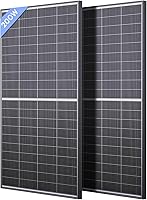
The ECO-WORTHY 200 Watts 12 Volt/24 Volt Solar Panel Kit includes 2 100W monocrystalline panels, a 30A PWM charge controller, 2 sets of Z mounting brackets, 16.4 ft 10 AWG solar cables, 2-in-1 connectors, and a 4.92 ft tray cable. Its panels can be connected in series for 24V or parallel for 12V, so it suits an RV owner whose system is designed for one of those arrangements.
The panels use monocrystalline cells and have corrosion-resistant aluminum alloy frames. Their stated dimensions are 35.2 x 23.1 x 1.3 in, so measure your roof space and plan cable routing before mounting.
How much power should you use overnight?
Use less power than your solar system can replace during the day, with extra battery capacity for clouds and shade. Start by listing overnight loads such as lights, fans, refrigerators, inverters, water pumps, and device chargers.
An inverter can draw power even when the connected appliance is small. Turn it off when you don't need AC power, and unplug idle chargers where practical.
A 200W panel system may suit higher daily use than a 20W maintainer, but real output depends on sunlight and system limits. Match panel size to your battery bank and daily energy needs instead of assuming the largest panel is always the best choice.
When is a small RV solar panel enough?
A small panel is useful for maintaining a 12V battery or supporting low, steady loads, not for replacing the energy used by a full RV electrical system. Confirm your goal before choosing the panel size.
The SOLPERK Solar Panel Kit 20W 12V Solar Battery Charger Trickle Maintainer includes a 20W monocrystalline panel, smart MPPT controller, adjustable mounting bracket, alligator clip, O-ring, and mounting accessories. Its 12V design suits battery maintenance for an RV, trailer, boat, car, or other compatible 12V rechargeable battery.
SOLPERK's controller uses a three-stage charging design and has indicator lights for charging status. The kit also includes a 360° adjustable bracket, which helps you change the panel angle when the mounting position allows it.
This panel is not the right match for quickly replenishing a heavily used RV battery bank. Choose a larger system when your daily loads include several appliances or extended inverter use.
How do you keep RV solar panels clean?
Clean the panel when dirt, dust, bird droppings, or campsite residue blocks sunlight, and inspect it during your regular setup routine. For off-season protection, see RV solar panel winter covers.
Use the panel and vehicle manufacturer's care guidance before applying any cleaner.
Turn off or isolate the system as instructed before cleaning. Use soft materials and avoid scratching the surface, forcing water into connections, or pulling on cables.
For cleaning supplies, see best rv solar panel cleaner. Cleaning cannot remove shade or fix a damaged cable, so inspect the full system if output remains low.
Do RV solar panels work on cloudy days?
RV solar panels can still produce some power in cloudy weather, but output usually falls and may not cover your RV's full demand. Check your controller rather than assuming the battery is charging at its normal rate.
Reduce optional loads during several cloudy days. Use a generator or another approved charging method only when it suits your RV's equipment and operating rules.
These guides cover do solar panels work on cloudy days and Top 7 Watt Dual Fuel Generator For RV Use.
If you are comparing another generator option, review Top 7 Watt Dual Fuel Generator For RV Use as well. Keep fuel-powered equipment outside and follow its safety instructions.
Should you use portable or fixed RV solar panels?
Choose fixed panels for a repeatable roof setup, or portable panels when you want to chase better sunlight and store the equipment when traveling. The best choice depends on parking habits, roof space, storage room, and how much daily power you need.
Compare RV solar panel kits once you know which setup suits your travel routine.
Fixed panels are convenient after installation, but the RV's position determines their exposure. Portable panels need setup and storage each time, but you can move them away from shade.
For portable options, compare best suitcase solar panels. Measure storage space, check cable length, and confirm that the controller and connectors match your battery or power station.
Using RV solar panels well comes down to a daily routine: place them in clear sunlight, check the controller, monitor the battery, reduce unnecessary loads, and inspect the cables and panel surface. Choose ECO-WORTHY for a larger 12V or 24V kit, DOKIO for portable 12V charging, or SOLPERK for 12V battery maintenance.
Frequently asked questions
How long should RV solar panels charge each day?
Charge time depends on panel size, sunlight, shade, battery condition, controller limits, and your RV's power use. Check the controller during the brightest part of the day, then monitor battery voltage and state of charge according to your battery manufacturer's guidance.
Can RV solar panels charge batteries while appliances are running?
Yes, the solar system can charge the battery while the RV uses power, but the net battery gain depends on whether solar output is higher than the RV's current draw. Turn off unnecessary loads when you want the fastest recovery.
Should RV solar panels face the sun?
Yes, panels produce more useful power when their surface faces unobstructed sunlight. Portable panels can be repositioned during the day, while roof panels depend on the RV's parking direction, nearby shade, and the fixed mounting angle.
Can cloudy weather stop RV solar charging?
Clouds usually reduce solar output rather than making every panel useless, but the amount of charging can vary widely. Use the controller's reading and battery monitor to see what your system is actually receiving, and plan extra charging for long periods of poor weather.