6 Best RV Solar Panel Kits for 12 Volt Systems (November 2026)
The best rv solar panel kits for 12 volt systems include the Renogy 200W 12V N-Type RV Solar Panel for permanent roof setups, the Renogy 100W Portable Solar Panel for portable camping power, and the ECO-WORTHY 400 Watt 12 Volt Premium Solar for high daily output.
On this page (8 sections)
- Best RV solar panel kits for 12 volt systems compared
- How we compared these 12 volt RV solar kits
- What size 12 volt solar kit does an RV need?
- PWM or MPPT controller: which should you choose?
- Roof mounted or portable: which style fits your RV?
- How do I install a 12 volt RV solar kit safely?
- How do I care for RV solar panels and batteries?
- Which kit should you buy for a 12 volt RV?
The best rv solar panels kit for 12 volt system for most RV owners is the Renogy 200W 12V N-Type RV Solar Panel at 9.4, because 200 watts and a 30A controller fit common 12 volt RV batteries well. We compared six kits from 100 to 400 watts, with and without batteries, to match different RV sizes and camping styles.
Our score weighs specs, features and buyer feedback against what you are shopping for. A larger wattage helps only when your battery and roof space can use it.
A complete kit helps when you want solar power without hiring an installer.
Start with your battery size and daily loads, not with panel wattage alone. Our guide on which solar panel size do i need helps you work through that math before you buy.
For a wider view of panel types, see our best rv solar panels guide.
Our picks at a glance
-
1
 Best for permanent roof setups
Renogy 200W 12V N-Type RV Solar Panel
9.4/10 our score
See it on Amazon -
2
-
3
 Best for high daily output
ECO-WORTHY 400 Watt 12 Volt Premium Solar
8.8/10 our score
See it on Amazon
- 4
 Check it
ECI Power 100W 12V Solar Power Kit
Best for a battery included starter - 5
 Check it
ZOUPW 220 Watt Solar Panel Kit for
Best for expandable 12 and 24 volt use - 6
 Check it
ECO-WORTHY 200 Watt 12V Complete Solar Panel
Best for battery and inverter bundle
Best RV solar panel kits for 12 volt systems compared
The Renogy 200W kit leads for permanent RV use, while the Renogy portable kit leads for no drill camping power. The ECO-WORTHY 400 watt kit leads for high output, and the battery included kits lead for simple starter setups.
We checked panel wattage, controller amperage, battery inclusion, mounting needs and stated daily output. We also checked included cables, brackets and protections so you can see what is in the box.
Renogy 200W 12V N-Type RV Solar Panel: Best for permanent roof setups
- 200 watts maximum power
- Adventurer 30A PWM charge controller
- 22% high solar cell efficiency
- Corrosion-resistant aluminum frame
A 200 watt roof kit with a 30A flush mount controller for RVs, campers and caravans that need steady 12 volt charging.
Pros
- 200 watts for larger 12 volt loads
- 30A controller with multiple protections
- Pre-drilled holes for mounting
Cons
- Permanent mounting required
- Daily output depends on sunlight
This kit suits RV owners who want a permanent roof setup with room to grow. It has 200 watts maximum power and a 30A Adventurer PWM controller for 12 volt charging.
Renogy says the kit can produce 800Wh daily output with 4 hours of sunlight availability. That figure depends on sun, angle, shade and panel cleanliness in real use.
The controller offers protection against overcharging, overload, short circuit and reverse polarity. It is made for flush mounting on RV or camper walls.
You get pre-drilled holes and plug and play cables for faster mounting. The kit supports lithium, lead acid and gel batteries.
Three pairs of Y branch connectors help with parallel wiring.
The trade-off is permanent installation. You will drill mount holes and run cables through a roof entry housing.
That is fine for a rig you keep for years, but not for a rental or a rig you do not want to modify.
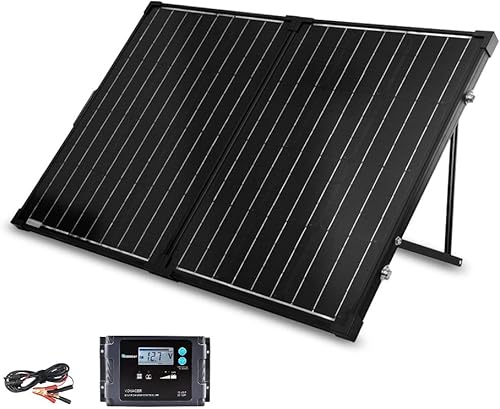
Renogy 100W Portable Solar Panel: Best for portable camping power
- 100 watts maximum power
- 25% high efficiency
- 20A PWM charge controller
- Foldable design with kickstand
A foldable 100 watt suitcase with a 20A controller for charging 12 volt batteries and power stations at camp.
Pros
- No roof installation needed
- Adjustable kickstand for sun angle
- Alligator clips for quick connection
Cons
- Lower wattage than roof kits
- Needs sun tracking by placement
This portable kit suits campers who want solar power without roof work. It has 100 watts maximum power with 25% high efficiency N-Type cells.
Renogy says it can deliver up to 500Wh per day with 5 hours of sunlight. The adjustable aluminum alloy kickstand lets you tilt the panel toward the sun as the day changes.
It folds into a suitcase sized case and weighs 17.4 pounds. That makes it easy to carry, store and set up at a campsite, cabin or off road stop.
The pre-installed 20A PWM controller and alligator clip cables make it plug and play. It works with 12 volt portable power stations and gel, AGM, flooded and lithium batteries.
The trade-off is lower wattage and manual placement. You will need to move or tilt it to chase sun, and 100 watts will not match a roof kit on a roof.
For shared driveways or shaded sites, that portability is often worth more than extra watts.
ECO-WORTHY 400 Watt 12 Volt Premium Solar: Best for high daily output
- 400 watts maximum power
- 40A MPPT charge controller
- Bluetooth module
- Four 100W solar panels
A 400 watt premium kit with four panels and a 40A MPPT controller for RVs with large 12 volt demand.
Pros
- Highest wattage in this group
- MPPT controller for efficiency
- Bluetooth monitoring
Cons
- Four panels need more roof space
- More complex wiring than smaller kits
This premium kit suits RVs with high daily 12 volt demand. It has 400 watts maximum power from four 100W monocrystalline panels.
ECO-WORTHY says the kit can produce an average of 1.6KWH per day depending on sunlight. That is the highest daily output claim in this group.
The 40A MPPT charge controller tracks the maximum power point for better efficiency than PWM. ECO-WORTHY says tracking efficiency is as high as 99% and peak conversion efficiency is 98%.
A BT-02 Bluetooth module sends real time data to your phone from up to 82 feet. You can check solar panel, battery and load data without opening a compartment.
The trade-off is roof space and complexity. Four panels, Z brackets and Y branch cables need careful layout.
This kit makes sense for larger roofs and larger battery banks, not for a small camper van with limited space.
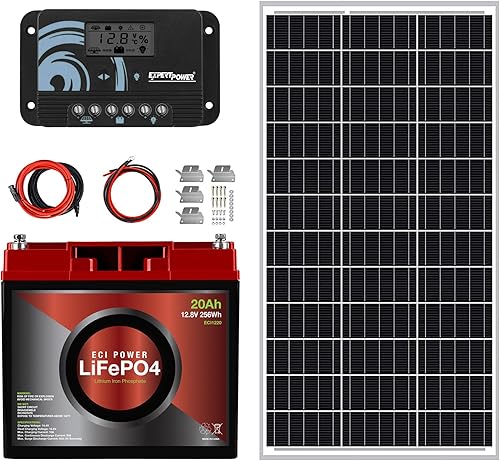
ECI Power 100W 12V Solar Power Kit: Best for a battery included starter
- 100 watts maximum power
- 12V 20Ah LiFePO4 battery
- 10A PWM charge controller
- Mounting brackets included
A 100 watt kit that includes a 12V 20Ah LiFePO4 battery and a 10A controller for small RV and off grid loads.
Pros
- Battery included
- Simple 12 volt setup
- Cables and brackets included
Cons
- Small 20Ah battery capacity
- 100 watts limits larger loads
This kit suits beginners who want a battery included starter system. It has 100 watts maximum power and a 12V 20Ah LiFePO4 battery.
The 10A PWM controller automatically recognizes 12 volt and 24 volt systems. It uses a CC-CV charging algorithm made for LiFePO4 battery life.
ECI Power says the battery is lab tested for a minimum of 2000 cycles at 80% depth of discharge. It can reach a maximum of 5000 cycles at 50% depth of discharge.
The kit includes 10 foot MC4 solar cables, 6 foot battery cables and mounting brackets. The controller display shows state of charge and battery health data.
The trade-off is small capacity. A 20Ah battery stores limited energy for lights, fans or device charging.
Choose it for small RV loads, sheds or backup lighting, not for running a fridge all day.
ZOUPW 220 Watt Solar Panel Kit for: Best for expandable 12 and 24 volt use
- 220 watts maximum power
- Two 110W N-Type panels
- 30A PWM charge controller
- 25% high efficiency
A 220 watt kit with two 110W panels and a 30A controller that auto senses 12 volt and 24 volt systems.
Pros
- Expandable wiring options
- 30A controller for 220 watts
- N-Type panels for low light
Cons
- Controller must stay dry
- Two panels need roof space
This kit suits RV owners who want expandable 12 volt and 24 volt options. It has 220 watts maximum power from two 110W N-Type panels.
ZOUPW says it can generate up to 1.1kWh daily power with 5 hours of full sunlight. The N-Type cells have 25% high efficiency and a 16 busbar structure.
The 30A PWM controller auto senses 12 volt and 24 volt systems. It works with lithium, gel, sealed and flooded batteries and has an LCD monitor with dual USB ports.
The kit includes Y connectors, Z brackets, PV cables and battery cables. You can wire panels in parallel for 12 volt systems or in series for 24 volt systems.
The trade-off is controller placement. The panels are IP68 waterproof, but the controller is not waterproof and must stay indoors or in a dry compartment.
Plan dry storage before you mount the panels.
ECO-WORTHY 200 Watt 12V Complete Solar Panel: Best for battery and inverter bundle
- 200 watts maximum power
- 12V 50Ah LiFePO4 battery
- 600W pure sine wave inverter
- 30A charger
A complete 200 watt kit with a 50Ah LiFePO4 battery and 600W inverter for RV power without separate parts.
Pros
- Battery and inverter included
- Larger 50Ah battery
- Complete starter bundle
Cons
- Bundle costs more than panels alone
- Inverter size limits AC loads
This complete kit suits RV buyers who want panels, battery and inverter in one bundle. It has 200 watts maximum power and a 12V 50Ah LiFePO4 battery.
ECO-WORTHY says the kit can produce 800Wh daily output with 4 hours of sunlight availability. The N-Type solar panel has 25% high efficiency and can capture reflected light for up to 15% extra output.
The bundle includes a 600W pure sine wave inverter and a 30A charger. The charger has 3 stage charging and 5A to 40A adjustable current with app or button control.
The 50Ah LiFePO4 battery can be recharged 4000 to 15000 times in deep cycle use. ECO-WORTHY compares that with lead acid batteries at roughly 300 to 400 cycles.
The trade-off is bundle size. You get more parts to place and wire, and the 600W inverter limits AC loads.
It is a strong choice when you want to power USB devices and small AC loads from solar without buying parts separately.
How we compared these 12 volt RV solar kits
We compared kits by wattage, controller type and amperage, battery inclusion and stated daily output. We treated maker output claims as claims that depend on sun hours, not as guarantees.
We also compared mounting type, because roof kits and portable kits solve different problems. A roof kit charges while you drive and park.
A portable kit lets you place the panel in sun while the RV sits in shade.
Our broader best rv solar panel kits guide covers more kit types. If you want a bundle with storage and AC power, compare the best rv solar panel kit with battery and inverter picks.
What size 12 volt solar kit does an RV need?
Start with daily watt hours, then add a safety factor of 1.5 to 2 for real world sun and battery losses. A 100 watt kit suits small loads, a 200 watt kit suits many RVs and a 400 watt kit suits large battery banks.
List your 12 volt loads in watts and multiply by hours of use. Add lights, fans, water pump, fridge and device charging.
Then divide by your realistic sun hours, often 4 to 5 hours.
100 watt kits for small loads
A 100 watt kit suits a camper van, small trailer or weekend camping loads. It can charge a small battery bank and run lights and fans with care.
The ECI Power kit includes a 20Ah battery, so its storage will fill before a larger battery would. That is fine for small loads, but it will not support a full day of fridge use.
200 watt kits for most RVs
A 200 watt kit is the middle ground for many RVs. The Renogy 200W and ECO-WORTHY 200W kits both claim 800Wh daily output with 4 hours of sun.
That output can replace a typical day of 12 volt use for lights, fans and a water pump. It will not replace a large AC load through an inverter.
400 watt kits for large battery banks
A 400 watt kit suits motorhomes with large 12 volt demand and enough roof space. The ECO-WORTHY premium kit claims 1.6KWH daily output depending on sun.
You need a larger battery bank to store that energy. Panels without storage can waste midday power when the battery is already full.
PWM or MPPT controller: which should you choose?
Choose MPPT for larger systems and PWM for simple starter kits. MPPT controllers cost more but track power more efficiently, especially in cold weather or with mismatched panels.
The ECO-WORTHY 400 watt kit uses a 40A MPPT controller. That matches its higher wattage and helps it use panel power more fully.
The other kits here use PWM controllers at 10A, 20A or 30A. PWM is simpler and works well for standard 12 volt panels in warm sun.
Check controller amperage against panel wattage before you buy. A 30A controller suits the 200 watt and 220 watt kits here, while a 10A controller suits the 100 watt ECI Power kit.
Roof mounted or portable: which style fits your RV?
Choose roof mounted for daily automatic charging and portable for flexible camp setups. Roof kits need drilling and wiring, while portable kits need you to set them up and move them.
Roof kits from Renogy, ECO-WORTHY and ZOUPW mount with brackets and pre-drilled holes. They charge while you park, drive and camp without daily setup.
The Renogy 100W portable folds into a suitcase and uses alligator clips. You can place it in sun even when your RV is under trees.
Learn setup steps in our guide to how to use rv solar panels. That guide covers tilt, shade, cleaning and safe wiring in plain steps.
Roof kit trade-offs
Roof kits give steady power and no daily setup. They need roof space, sealant, cable entry and a dry place for the controller.
Check roof material and walkable areas before you drill. Keep panels away from vents, AC units and antennas that cast shade.
Portable kit trade-offs
Portable kits avoid roof work and let you chase sun. They need storage space, careful handling and manual placement each day.
Foldable panels also need protection from wind. Use the kickstand on firm ground and store the panel flat when not in use.
How do I install a 12 volt RV solar kit safely?
Mount panels with sealed holes, keep the controller dry and connect batteries before panels. That order helps you check voltage and avoid wiring errors.
Mount panels with Z brackets or the supplied brackets. Seal every roof hole with RV rated sealant and check seals each season.
Run cables through a roof entry housing to keep water out. Keep the controller in a dry, ventilated compartment inside the RV.
Connect the battery cables first, then the panel cables, following the controller manual. Use the included Y connectors for parallel wiring on 12 volt systems.
Do not use a generator interlock kit for solar wiring. That is a different system, as explained in What Is a Generator Interlock Kit and How Does It Work?.
Solar safety also depends on correct fusing and clean connections.
How do I care for RV solar panels and batteries?
Clean panels with water and a soft cloth, check mounts each season and keep battery terminals clean. Dirt and shade are common causes of low output.
Wash panel glass gently and avoid harsh chemicals. Renogy notes that dirt and stains on the top glass can reduce power output.
Check brackets, cable seals and Y connectors for looseness after rough roads. Tighten hardware and replace cracked sealant before water gets in.
For lithium batteries, use the correct charging profile in the controller. The ECI Power and ZOUPW controllers support lithium profiles for that reason.
Store portable panels folded and dry. Keep the Renogy suitcase closed when you transport it to protect the glass and kickstand.
Which kit should you buy for a 12 volt RV?
Pick the Renogy 200W kit for a permanent roof setup, the Renogy 100W portable for camping without drilling and the ECO-WORTHY 400W kit for high output. Pick a battery included kit when you want a complete starter system.
Choose the ECI Power 100W kit for a small battery included starter. Choose the ECO-WORTHY 200W complete kit when you also want a 50Ah battery and 600W inverter.
Choose the ZOUPW 220W kit when you want expandable wiring and 12 volt or 24 volt flexibility. Its controller must stay dry, so plan its location first.
If you plan generator backup for cloudy weeks, compare the Best Generator Interlock Kit For Dual Fuel Generators separately from your solar setup. Solar and generator systems work best when each part is sized for its own job.
Our score reflects how each kit matches a 12 volt RV search, from wattage and controller fit to battery inclusion and mounting needs. Use the best rv solar panels kit for 12 volt system that fits your roof, battery and camping style, then size your battery before you add more panels.
Our top 3 picks at a glance
-
1
Best for permanent roof setups
Renogy 200W 12V N-Type RV Solar Panel
9.4/10 our score
See it on Amazon -
2
-
3
Best for high daily output
ECO-WORTHY 400 Watt 12 Volt Premium Solar
8.8/10 our score
See it on Amazon
Frequently asked questions
How many watts does a 12 volt RV solar system need?
Start with your daily watt hour use, then size panels to replace that energy in your available sun hours. A 200 watt kit suits many RVs, while 100 watts suits small loads and 400 watts suits larger use.
Check battery capacity before adding more panels.
Can I use a 12 volt solar kit with a lithium battery?
Yes, many kits here support lithium batteries through their charge controller. The Renogy 200W kit supports lithium, lead acid and gel batteries.
The ZOUPW controller also supports lithium, gel, sealed and flooded types.
Confirm the controller profile matches your battery before wiring.
Do I need a charge controller for RV solar panels?
Yes, a charge controller regulates power from panels to a 12 volt battery and protects against overcharging. Every kit in this guide includes a PWM or MPPT controller sized for its panel wattage.
Do not connect panels directly to a battery without a controller.
Is a portable solar panel better than a roof mounted kit?
A portable panel is better when you cannot drill into the roof or want to move the panel with the sun. A roof kit is better for daily automatic charging while you travel.
The Renogy 100W portable suits camp use, while roof kits suit permanent RV power.


