8 Best Solar Generators for a Refrigerator and Freezer (November 2026)
The best solar generators for a refrigerator and freezer include the Jackery Solar Generator 1000 v2 and 200W for quick emergency recharging, the EF ECOFLOW Solar Generator Delta 3 Classic for high AC output in a compact class, and the Jackery Solar Generator 300 and 40W Solar for brief single appliance use.
On this page (6 sections)
- How we chose solar generators for a refrigerator and freezer
- The best solar generators for two cold appliances
- What capacity do two cold appliances need?
- How much AC output and surge capacity should you check?
- How should you plan solar recharging?
- Which solar generator should you choose for a refrigerator and freezer?
The BLUETTI Elite 400 is the strongest solar generator fit for a refrigerator and freezer together, with 3,840Wh capacity and 2,600W output. For a lower capacity and easier recharge planning, consider the 2,048Wh AFERIY AF-P210 with its 400W panel.
Two cold appliances need both enough running power and enough stored energy. Check their labels and manuals for watts, startup needs, and daily energy use before choosing a station.
For a single refrigerator, compare our best solar generators for refrigerators. If you need broader household coverage, see our best solar generators for home backup and portable solar generator picks.
Our picks at a glance
-
1
 Best for quick emergency recharging
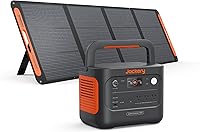
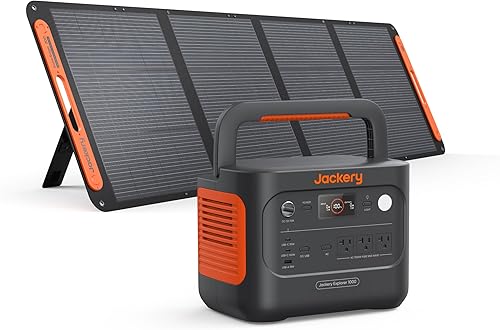
Jackery Solar Generator 1000 v2 and 200W
9.6/10 our score
See it on Amazon -
2
 Best for high AC output in a compact class
EF ECOFLOW Solar Generator Delta 3 Classic
9.4/10 our score
See it on Amazon -
3
 Best for brief single appliance use
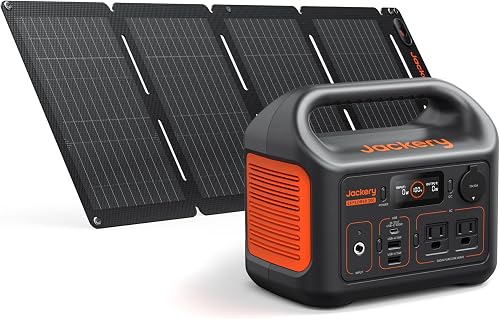
Jackery Solar Generator 300 and 40W Solar
9.3/10 our score
See it on Amazon
- 4
 Check it
OUPES Mega 1 Solar Generator with 100W
Best for expandable mid-size backup - 5
 Check it
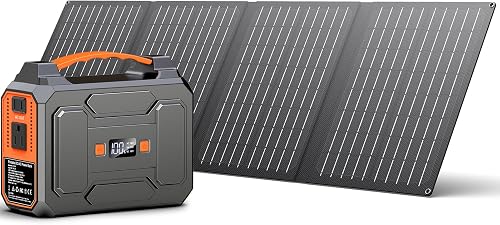
Apowking Solar Powered Generator 100W
Best for small electronics alongside backup - 6
 Check it
BLUETTI Solar Generator Elite 400 with 2x200W
Best for running two appliances longer - 7
 Check it
PECRON Portable Power Station F3000LFP with Cart
Best for large loads and cart mobility - 8
 Check it
AFERIY Portable Power Station AF-P210 2048Wh
Best for a balanced home backup kit
How we chose solar generators for a refrigerator and freezer
We compared battery capacity, AC output, surge ratings, and included solar panels for the job of supporting two cold appliances. Our score weighs specs and features against the needs of this search.
Capacity matters because a fridge and freezer cycle throughout the day, while output matters when a compressor starts. The watt-hour figures here are not promised runtimes; actual use depends on appliance age, settings, room temperature, door openings, and other loads.
A solar generator cannot be sized from appliance names alone. Our guide to solar panels vs generator for home backup explains the tradeoffs between recharge sources and stored power.
| Product | Best for | Capacity | AC output | Solar panel | Our score |
|---|---|---|---|---|---|
| Jackery Solar Generator 1000 v2 and 200W | quick emergency recharging | 1,070Wh | 1,500W, 3,000W surge peak | 200W included | 9.6 |
| EF ECOFLOW Solar Generator Delta 3 Classic | high AC output in a compact class | 1,024Wh | 1,800W, 3,600W surge | 220W included | 9.4 |
| Jackery Solar Generator 300 and 40W Solar | brief single appliance use | 292Wh | 300W, 600W peak | 40W included | 9.3 |
| OUPES Mega 1 Solar Generator with 100W | expandable mid-size backup | 1,024Wh, expandable to 5,120Wh | 2,000W, 4,500W surge | 100W included | 9.1 |
| Apowking Solar Powered Generator 100W | small electronics alongside backup | 146Wh | 100W, 200W peak | 40W included | 9.1 |
| BLUETTI Solar Generator Elite 400 with 2x200W | running two appliances longer | 3,840Wh | 2,600W, 3,900W surge | 8.9 | |
| PECRON Portable Power Station F3000LFP with Cart | large loads and cart mobility | 3,072Wh | 3,600W | 8.7 | |
| AFERIY Portable Power Station AF-P210 2048Wh | a balanced home backup kit | 2,048Wh | 2,400W | 400W included | 8.1 |
The best solar generators for two cold appliances
For the longest potential buffer, the BLUETTI Elite 400 has the largest capacity here. The other picks suit different priorities, from faster charging to a smaller portable setup.
Jackery Solar Generator 1000 v2 and 200W: Best for quick emergency recharging
- 1,070Wh capacity
- 1,500W AC output
- 3,000W surge peak
- 200W solar panel included
A 1,070Wh battery and 1,500W AC output make this a portable option for a single cold appliance or shorter backup periods. Its included panel can recharge the station, but its capacity is modest for running two appliances for long.
Pros
- 1,500W AC output
- 3,000W surge peak
- Emergency charging option through the app
Cons
- Less capacity than the larger home backup picks
- The solar panel and station may ship separately
The Jackery Solar Generator 1000 v2 pairs a 1,070Wh battery with 1,500W AC output and a 3,000W surge peak. Those ratings make it a reasonable candidate for one refrigerator or a shorter outage, provided the appliances' combined draw stays within its limits.
Jackery includes a 200W panel, and says it can recharge the station to 80% in 6 hours under its stated conditions. The station also supports emergency charging through the app, but that mode must be enabled before charging.
The capacity is the main limit for a refrigerator and freezer together. Treat this as a compact backup option and check both compressor startup demands before connecting appliances.
EF ECOFLOW Solar Generator Delta 3 Classic: Best for high AC output in a compact class
- 1,024Wh capacity
- 1,800W output
- 3,600W surge
- 220W solar panel included
The DELTA 3 Classic pairs 1,024Wh with 1,800W output and a 3,600W surge rating. It has higher stated output than several similarly sized options, though its battery still limits how long it can run two cold appliances.
Pros
- 1,800W output
- 3,600W surge rating
- 220W panel included
Cons
- 1,024Wh capacity may limit longer backup
- Station and panel may arrive separately
The DELTA 3 Classic raises AC output to 1,800W, with a 3,600W surge rating, while its capacity is 1,024Wh. That balance may fit appliances whose startup demands need more headroom but whose backup window can stay relatively short.
A 220W solar panel is included, and EcoFlow says the station can recharge from 0 to 80% in 45 minutes through AC charging. It also has a UPS feature that switches in under 10 milliseconds.
Its energy reserve is close to the Jackery 1000 v2 class, so estimate daily consumption before counting on both appliances through an extended outage. EcoFlow notes the station and panel may arrive separately.
Jackery Solar Generator 300 and 40W Solar: Best for brief single appliance use
- 292Wh capacity
- 300W rated output
- 600W peak surge
- 40W panel included
This small battery is a portable choice for a low-draw appliance or short use, if its power needs stay within the 300W rating. Its 292Wh capacity is not suited to extended backup for a refrigerator and freezer together.
Pros
- Compact 292Wh capacity
- 300W rated output
- 40W solar panel included
Cons
- Low capacity for two appliances
- 300W output limits appliance choices
The Jackery Solar Generator 300 has 292Wh capacity and 300W rated output, with a 600W peak surge. That makes it more appropriate for small electronics than for powering two cold appliances.
It includes a 40W panel and has two AC outlets, plus USB ports and a car port. The capacity and output put a clear ceiling on its role: it may support a very low-draw appliance briefly, but it is not a whole-home refrigerator and freezer backup choice.
Check the refrigerator or freezer's label before considering this station. If its running demand is above 300W or its startup need exceeds 600W, the station is outside the stated limits.
OUPES Mega 1 Solar Generator with 100W: Best for expandable mid-size backup
- 1,024Wh capacity
- 2,000W AC output
- 4,500W surge
- Expandable to 5,120Wh
The Mega 1 combines a 1,024Wh base battery with 2,000W output and room to expand capacity to 5,120Wh with extra batteries. That expansion makes it more adaptable for longer outages, though the included panel is 100W.
Pros
- 2,000W AC output
- Expandable capacity
- 100W solar panel included
Cons
- Base capacity is 1,024Wh
- Expansion requires extra batteries
OUPES Mega 1 offers 1,024Wh at its base capacity, with 2,000W output and a 4,500W surge rating. Its standout feature for outage planning is expansion: OUPES says capacity can grow to 5,120Wh with two extra batteries.
The included solar panel is 100W, while the station supports up to 800W solar input. The maker also gives a 20ms UPS switching feature, which may matter if other sensitive electronics share the backup.
As configured, its battery capacity is still in the 1,000Wh range. Consider expansion if you want the higher output and a path to more stored energy for longer combined appliance use.
Apowking Solar Powered Generator 100W: Best for small electronics alongside backup
- 146Wh capacity
- 100W rated output
- 200W peak
- 40W solar panel included
Apowking's 146Wh station is designed for small loads such as phones, lights, and fans. Its 100W rated output makes it unsuitable for most refrigerators or freezers, so consider it only for accessories.
Pros
- 40W solar panel included
- Seven output ports
- Light 3.3 lb station
Cons
- 100W rated output
- 146Wh capacity is far too small for two cold appliances
The Apowking 100W station is the smallest option here at 146Wh capacity and 100W rated output. It is useful as a compact source for phones, lights, or other small devices, not as a refrigerator and freezer power source.
Its included 40W panel can help recharge the station in suitable sunlight. The two AC outlets are rated for appliances within 100W, so many refrigerators and freezers will exceed its output limit.
Keep it in the backup plan for communication and lighting if those needs matter. Choose a different station for compressor appliances.
BLUETTI Solar Generator Elite 400 with 2x200W: Best for running two appliances longer
- 3,840Wh capacity
- 2,600W AC output
- 3,900W surge
- Two 200W solar panels included
With the largest stated capacity in this group, the Elite 400 is the clearest fit when you want to back up a refrigerator and freezer together. Its rolling trolley helps move the 86 lb station, and two included panels support solar recharging.
Pros
- Largest capacity in this group
- 2,600W output and 3,900W surge
- Two 200W solar panels included
Cons
- Heavy at 86 lb
- Panels may ship separately
The BLUETTI Elite 400 is the top choice when battery capacity is the priority. Its 3,840Wh reserve and 2,600W output give more room for a refrigerator and freezer together than the smaller stations in this roundup.
It includes two 200W solar panels and has a 3,900W surge rating. BLUETTI describes a 15ms switchover for backup, and the wheeled trolley helps move the 86 lb unit around a home.
The large capacity does not guarantee a set number of hours. Appliance energy use varies, so use the station's capacity as a comparison point and leave room for inverter losses and solar conditions.
PECRON Portable Power Station F3000LFP with Cart: Best for large loads and cart mobility
- 3,072Wh capacity
- 3,600W output
- Cart included
- AC and solar charging
The F3000LFP has 3,072Wh capacity and 3,600W output, so it offers substantial room for two appliances and startup loads. Its cart helps with movement, but the station itself weighs 63.3 lb.
Pros
- 3,072Wh capacity
- 3,600W output
- Cart kit included
Cons
- Heavy at 63.3 lb
- Solar panels are not included
PECRON's F3000LFP has 3,072Wh capacity and 3,600W output, giving it substantial headroom for combined appliances and startup loads. A cart kit is included, which helps with a station weighing 63.3 lb.
It supports up to 1,600W solar input, but the kit does not include solar panels. PECRON says AC charging can take the battery from empty to full in 2 hours with 1,800W input.
This is a strong capacity and output option if you already have compatible panels or plan to add them. The unit uses 120V AC input and output, so it is not a 240V backup source.
AFERIY Portable Power Station AF-P210 2048Wh: Best for a balanced home backup kit
- 2,048Wh capacity
- 2,400W output
- 400W solar panel included
- LiFePO4 battery
The AF-P210 offers 2,048Wh and 2,400W output with a 400W solar panel in the kit. It sits between the smaller 1,024Wh stations and larger multi-kilowatt-hour choices for capacity.
Pros
- 2,048Wh capacity
- 2,400W output
- 400W solar panel included
Cons
- Station weighs 71.5 lb
- The stated panel charging time assumes full load
The AFERIY AF-P210 sits between the 1,000Wh class stations and the largest backup units, with 2,048Wh capacity and 2,400W output. The kit includes a 400W solar panel, giving it a more substantial solar input accessory than several smaller bundles here.
AFERIY says the panel can fully charge the station in 6 hours under full load conditions. The power station weighs 71.5 lb, so plan where it will sit and how you'll move it before an outage.
For a household that wants meaningful reserve without moving to a 3,000Wh or larger unit, this is a balanced option. Confirm the two appliances' total startup demand against the 2,400W rating.
What capacity do two cold appliances need?
A larger battery generally gives a longer buffer, but your appliances' measured energy use determines the useful runtime. Start with each unit's energy label or measure consumption over a typical day.
The 1,024Wh to 1,070Wh stations are compact options for shorter use or one appliance at a time. The AFERIY, PECRON, and BLUETTI offer 2,048Wh or more, which gives more stored energy for a two-appliance plan.
Keep the battery away from loads that do not need backup. Running lights, routers, or kitchen devices from the same station reduces the energy available to keep food cold.
How much AC output and surge capacity should you check?
The station must handle both continuous running watts and compressor startup demand. Compare the fridge and freezer separately, then check whether their simultaneous startup could exceed the generator's rated or surge output.
The Apowking's 100W rating and Jackery 300's 300W rating make them small-load choices. The higher output stations here range from 1,500W to 3,600W, but the appliance labels still decide whether a particular setup fits.
If you plan to run a freezer from a fuel generator instead, compare our best dual fuel generators for freezers and best dual fuel generators for refrigerators.
How should you plan solar recharging?
Use the included panel rating as a starting point, then account for sunlight, season, placement, and the station's solar input limits. A panel's rated watts do not mean it will deliver that amount all day.
The Jackery 1000 v2 includes a 200W panel, the DELTA 3 Classic includes 220W, and the BLUETTI kit includes two 200W panels. The PECRON supports up to 1,600W input but needs separately sourced panels.
A battery provides power after sunset and during cloudy periods, while panels can replenish it when conditions allow. Check that any added panel voltage and connectors are compatible with the station.
Which solar generator should you choose for a refrigerator and freezer?
Choose the BLUETTI Elite 400 if your priority is the largest built-in battery reserve in this group. Pick the PECRON F3000LFP for higher output and a cart, or the AFERIY AF-P210 for a 2,048Wh station with a 400W panel included.
For shorter, lighter backup needs, compare the Jackery 1000 v2 and EcoFlow DELTA 3 Classic by output and recharge preferences. Before you buy, check both appliances' running watts, startup demand, and daily energy use, then compare them with the station's limits.
For fuel-powered home backup, compare diesel generators for home backup.
Our top 3 picks at a glance
-
1
Best for quick emergency recharging
Jackery Solar Generator 1000 v2 and 200W
9.6/10 our score
See it on Amazon -
2
Best for high AC output in a compact class
EF ECOFLOW Solar Generator Delta 3 Classic
9.4/10 our score
See it on Amazon -
3
Best for brief single appliance use
Jackery Solar Generator 300 and 40W Solar
9.3/10 our score
See it on Amazon
Frequently asked questions
What size solar generator can run a refrigerator and freezer?
Choose by the appliances' measured energy use and startup demand, then compare those figures with the station's watt-hour capacity, rated output, and surge rating. A 3,000Wh or larger battery gives more reserve than a 1,000Wh class unit, but runtime still depends on the actual loads and conversion losses.
Check each appliance label or manual before choosing.
Can a 1,000Wh solar generator run a refrigerator and freezer?
It may run both if their combined running and startup needs fit the station's output limits, but 1,000Wh is a limited energy reserve for two appliances. Use a watt meter or the appliances' energy labels to estimate consumption, and plan for cycling, warm conditions, and recharge access.
A larger battery can provide a longer buffer.
How do I estimate refrigerator and freezer runtime?
Multiply the station's watt-hour capacity by an allowance for inverter losses, then divide by the appliances' measured average watts. For example, a 1,000Wh battery does not provide 1,000Wh of usable AC energy, and refrigerator compressors cycle on and off rather than drawing the same power all day.
Treat the result as an estimate.
Do solar panels keep a refrigerator and freezer running?
Panels can recharge a compatible station when sunlight and panel conditions allow, but output changes with shade, angle, weather, and season. Size the battery to cover periods without useful sun, and confirm the station's solar input limits before adding panels.
A larger panel rating does not guarantee a fixed daily yield.