9 Best Gas Generators with Electric Start (November 2026)
The best gas generators with electric start include the Westinghouse 5000 Peak Watt Super Quiet Portable for RV-ready inverter power, the WEN for flexible household backup, and the Westinghouse 14500 Peak Watt Tri-Fuel Home Backup for high-output home backup.
On this page (8 sections)
- The best gas generators with electric start for different uses
- How do electric start gas generators work?
- How much power do you need from an electric start generator?
- Is a gas generator or dual-fuel model better?
- How should you use an electric start gas generator safely?
- Electric start or recoil start: which is better?
- Final verdict on the best gas generator with electric start
- Check the transfer switch, outlet type and fuel connections before you buy. That planning step helps you match the generator to your home or RV instead of finding a mismatch during an outage.
The best gas generator with electric start for most RV and home users is the Westinghouse iGen5000. It combines 5000 peak watts, 3900 rated watts, remote start, inverter power and an RV-ready outlet.
That mix suits travel trailers and moderate home backup where you want clean power for everyday electronics. The TT-30R outlet simplifies the RV connection, while the household outlet and USB ports cover phones, lights and a television.
The LED data center shows fuel level, output, remaining runtime, voltage and lifetime hours. That detail helps you plan refueling and maintenance instead of guessing.
Economy mode can stretch runtime for light loads. The 3.4-gallon tank supports up to 18 hours under the stated conditions, which helps with overnight RV use.
At 104.7 lb with a telescoping handle and wheels, one person can move it short distances on a flat path. It is not a carry-anywhere unit.
Large home loads need a bigger class of generator. The Westinghouse tri-fuel model reaches 11500 running watts on gasoline, while the Oxseryn is much easier to move at 56 lb.
If you want a shorter list of push-button models, compare these best push button start generators. For a broader portable comparison, see the best electric start portable generator.
The iGen5000 is gasoline only. It suits buyers who already store that fuel, while a dual-fuel model may fit better if fuel choice matters more.
Our picks at a glance
-
1
 Best for RV-ready inverter power
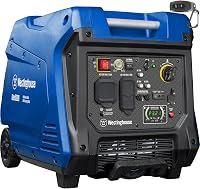
Westinghouse 5000 Peak Watt Super Quiet Portable
9.7/10 our score
See it on Amazon -
2

-
3
 Best for high-output home backup
Westinghouse 14500 Peak Watt Tri-Fuel Home Backup
9.7/10 our score
See it on Amazon
- 4
 Check it
Oxseryn Power Equipment 4400 Watts Inverter Generator
Best for lighter portable power - 5
 Best for large dual-fuel loadsCheck it
- 6
 Check it
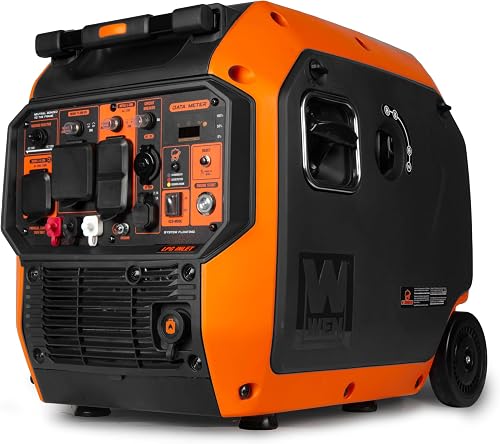
WEN 6800-Watt Dual Fuel RV-Ready Electric Start
Best for quiet RV and EV backup - 7
 Check it
Champion 8125-Watt Electric Start Tri Fuel Portable
Best for three-fuel flexibility - 8
 Best for extended dual-fuel runtimeCheck it
- 9
 Check it
Honda EM6500S Generator w/ Electric Start
Best for a simple gasoline setup
The best gas generators with electric start for different uses
The best electric start gas generator depends on the load, fuel access and how often you need to move it. The picks below are ordered by score, with each model matched to a different use.
We compared output, fuel options, starting controls, portability, outlets and stated runtime. Our score weighs specs, features and buyer feedback against what you're shopping for.
Westinghouse 5000 Peak Watt Super Quiet Portable: Best for RV-ready inverter power
- 5000 peak watts and 3900 rated watts
- Remote electric start with key fob
- RV-ready TT-30R outlet
- Up to 18 hours on a 3.4-gallon gas tank
The iGen5000 combines electric, recoil and remote start with inverter power, an RV-ready outlet and a compact wheel-and-handle design.
Pros
- Remote start
- RV-ready outlet
- Low stated noise output
Cons
- Gasoline only
- 104.7 lb portable format
The Westinghouse iGen5000 is the strongest all-around fit for travel trailers and moderate home backup. Its 5000 peak watts and 3900 rated watts give you a clear starting point for matching appliances and RV loads.
The inverter design produces less than 3% THD, and the unit has a TT-30R RV outlet, a 5–20R household outlet and 2 USB outlets. Remote start with the included key fob adds convenience when the generator is already positioned outdoors.
A 3.4-gallon gasoline tank supports up to 18 hours of runtime under the stated conditions. The LED data center shows fuel level, power output, remaining runtime, voltage and lifetime hours.
That display helps you plan refueling and maintenance instead of guessing from a basic gauge. Economy mode can also help when you only need light loads for a long stretch.
At 104.7 lb, it is portable, but it is not the lightest choice here. Pick it when clean inverter power, RV access and remote starting matter more than dual-fuel operation.
WEN: Best for flexible household backup
- Gasoline and propane operation
- 120V and 240V selection
- 4750 surge and 3800 running watts on gasoline
- Electric start with wheel and handle kit
This WEN gives you gasoline or propane fuel choice, a 120V/240V selector and transfer-switch-ready connections in a portable steel-bodied format.
Pros
- Dual-fuel operation
- 120V/240V selection
- Includes LPG hose
Cons
- Heavier than the lightest inverter pick
- Lower output than large home-backup models
The WEN DF475T is a practical electric start gas generator when you want propane as a second fuel. Gasoline produces 4750 surge watts and 3800 running watts, while propane produces 4350 surge watts and 3500 running watts.
Its voltage selector switches between 120V and 240V, and the NEMA L14-30R connection suits transfer-switch-ready setups. Two 120V GFCI outlets and a 12V DC outlet cover common household and charging needs.
The 4-gallon tank provides up to 11 hours at half load. The wheel and handle kit helps with movement, while the included 47-inch LPG hose supports propane setup.
Propane can be easier to store for some households, but the lower wattage on propane is worth noting when you add up your loads. Check which fuel you are likely to use most before you commit to a load list.
Choose this model when fuel flexibility and 240V access are more important than inverter operation. If you need to compare inverter choices, see the best inverter generator with electric start.
Westinghouse 14500 Peak Watt Tri-Fuel Home Backup: Best for high-output home backup
- 14500 peak and 11500 running watts on gasoline
- Gasoline, propane and natural gas
- Remote and push-button electric start
- 50A and 30A transfer-switch-ready outlets
The WGen11500TFc is the high-output choice for major home loads, with tri-fuel flexibility, remote start and connections for transfer equipment.
Pros
- Highest output here
- Three fuel choices
- CO sensor
Cons
- 230 lb weight
- Transfer switch sold separately
The Westinghouse WGen11500TFc is the best gas powered generator with electric start here for major home backup loads. On gasoline, it produces 11500 running watts and 14500 peak watts, with propane and natural gas as alternatives.
Its 550cc engine and 9.5-gallon tank support up to 19 hours at 25% load. Remote and push-button start make the large open-frame unit easier to operate from a distance.
The 30A and 50A outlets are designed for transfer-switch, interlock-kit or compatible automatic transfer switch setups. The automatic transfer switch is sold separately, so plan the electrical connection before buying.
Fuel choice matters here because natural gas can remove refueling worries, while gasoline gives the highest stated output. Most homes will need an electrician to match the transfer equipment to the panel.
This generator weighs 230 lb and measures 27.2 x 26.1 x 26.5 in. Choose it when home backup capacity is the priority and you have a safe, permanent outdoor storage and operating area.
Oxseryn Power Equipment 4400 Watts Inverter Generator: Best for lighter portable power
- 4400 peak and 3400 running watts
- 56 lb weight
- Up to 14 hours at 25% load
- RV port and ECO mode
Oxseryn stands out for its 56 lb weight, inverter design, RV port and stated 14-hour runtime at 25% load.
Pros
- Lightest listed model
- Inverter design
- Fuel gauge
Cons
- Gasoline only
- Lower running output than larger picks
Oxseryn is the lightest option in this roundup at 56 lb, making it easier to move for camping, outdoor events or smaller backup tasks. It produces 4400 peak watts and 3400 running watts from gasoline.
The inverter generator has 2 120V AC ports, a 12V DC port and an RV port. ECO mode and a 2-gallon tank support up to 14 hours at 25% load, while the fuel gauge helps you check the remaining fuel.
Its stated noise output is under 72 dBA from 23 ft away. The open-frame design gives it a different portability and noise profile than the enclosed Westinghouse iGen5000.
That lighter weight is the main trade-off to weigh against the lower running output. It suits a fridge, lights, phones and a few other essentials, but it is not built for whole-home loads.
Pick Oxseryn when weight matters most and 3400 running watts covers your planned load. It is gasoline-only, so it does not offer the fuel choice found on the WEN models.
DuroStar DS13000MX: Best for large dual-fuel loads
- 13000 watts
- Gasoline and propane operation
- Remote electric start
- 50A transfer-switch-ready outlet
The DS13000MX pairs high output with gasoline or propane operation, a 50A outlet and remote electric start for home, RV or jobsite backup.
Pros
- High output
- Dual-fuel operation
- CO alert
Cons
- 220 lb weight
- Large footprint
The DuroStar DS13000MX is a large dual-fuel electric start generator for home, jobsite or RV backup. It produces 13000 watts and uses gasoline or propane, with gasoline selected when maximum output is the priority.
A 50A outlet supports transfer-switch-ready home connections. The CO alert can automatically shut down the generator when dangerous carbon monoxide levels are detected.
Remote electric start and a front-facing fuel selector simplify operation. The included wheel and handle kit, remote control, propane regulator and tool set help with initial setup and movement.
The 500cc engine and all-metal build point to a machine meant for heavy use rather than weekend camping trips. Storage space and a firm outdoor surface need planning before delivery.
At 220 lb, this is a substantial machine. Choose it when 13000 watts and dual-fuel access justify the size, rather than for frequent carrying.
Its footprint of 29.75 x 27.5 x 25.75 inches also affects where you can store it and how you move it into position. A ramp, a low threshold or a second pair of hands will make setup far easier.
Propane operation can suit buyers who prefer to store fuel in cylinders, while gasoline remains the option for maximum output. You should decide which fuel you will use most before you build your load list.
Low oil shutdown helps protect the 4-stroke engine during longer runs. Regular oil checks and keeping the steel frame clear of debris will help it cope with repeated outdoor use.
WEN 6800-Watt Dual Fuel RV-Ready Electric Start: Best for quiet RV and EV backup
- 6800 surge and 5100 rated watts on gasoline
- Gasoline and propane operation
- RV-ready TT-30R outlet
- Bonded-neutral 240V configuration
This WEN inverter generator targets RV users who want dual-fuel operation, electric start, 240V capability and a CO shutdown sensor.
Pros
- Dual-fuel inverter
- RV-ready outlet
- Fuel shutoff
Cons
- Heavier than the Oxseryn
- Propane output is lower than gasoline output
The WEN DF680iX suits RV owners who want inverter power, dual-fuel operation and a 240V configuration. On gasoline, it produces 6800 surge watts and 5100 rated watts, while propane produces 6000 surge watts and 4500 rated watts.
Its outlets include an L14-30R 120V/240V receptacle, 2 three-prong 120V receptacles, a TT-30R RV receptacle, a 12V DC receptacle and 2 USB ports. A tool-free LPG connector and 6 ft regulator hose simplify propane connection.
The WEN Watchdog CO shutdown sensor adds automatic shutdown protection. Fuel shutoff uses remaining carburetor fuel before shutdown, which can help limit stagnant fuel inside the carburetor.
That fuel shutoff is a small detail that can reduce carburetor maintenance if you store the generator between trips. The inverter design also makes it a better fit for laptops and other sensitive electronics.
At 99.2 lb, it is lighter than the larger open-frame home backup models. It is a strong choice when RV access and inverter power matter more than the lowest possible weight.
Champion 8125-Watt Electric Start Tri Fuel Portable: Best for three-fuel flexibility
- 8125 starting and 6500 running watts on gasoline
- Gasoline, propane and natural gas
- CO Shield auto shutoff
- Natural gas and propane hoses included
Champion offers three fuel choices, electric start, output monitoring and included LPG and natural gas hoses for residential backup.
Pros
- Tri-fuel operation
- Hoses included
- Output monitoring
Cons
- 197 lb weight
- Less output than the largest picks
Champion's 8125-Watt Tri Fuel Portable Generator is for residential buyers who want gasoline, propane and natural gas choices. See Champion generators with electric start for more models.
Gasoline produces 8125 starting watts and 6500 running watts, while natural gas produces 6875 starting watts and 5500 running watts. Propane sits between those figures at 7500 starting watts and 6000 running watts.
The rocker switch controls electric start, and the Intelligauge tracks voltage, frequency, session runtime and total runtime. CO Shield provides automatic carbon monoxide shutoff.
Champion includes a propane hose, a natural gas hose with NPT adapter, engine oil and a wheel kit. That included fuel hardware makes this a useful option when you want more than gasoline without separately sourcing both hoses.
Daily use will depend on which fuel you connect most often, since output changes with each one. Homes with a natural gas line nearby may value that option most.
At 197 lb, it needs a planned storage spot. Choose it when three-fuel flexibility is more valuable than inverter portability.
Pulsar: Best for extended dual-fuel runtime
- 10000 peak and 8000 rated watts on gasoline
- Gasoline and LPG operation
- Switch & Go fuel transition
- Up to 12 hours at half load
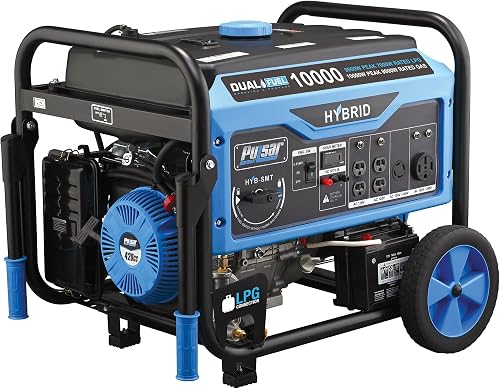
The Pulsar combines strong gasoline output, a 6.6-gallon tank and Switch & Go fuel transition with electric start and recoil backup.
Pros
- High gasoline output
- Fuel transition technology
- Large tank
Cons
- 209 lb weight
- Non-CARB approved model
The Pulsar PG10000B16 combines electric start with gasoline and LPG operation. It produces 10000 peak and 8000 rated watts on gasoline, or 9000 peak and 7000 rated watts on LPG.
Its 6.6-gallon tank supports up to 12 hours at half load on gasoline. Switch & Go technology lets you transition between LPG and gasoline while the generator is operating, according to the product information.
A 420cc 4-stroke engine sits inside a powder-coated steel frame. Never-flat wheels and drop-down handles help with storage and movement, although the unit weighs 209 lb.
That fuel transition feature is useful if a tank runs low during an outage and you have the other fuel ready. It does not remove the need to plan total fuel storage for longer events.
Pick the Pulsar for extended dual-fuel operation and strong gasoline output. The model is marked non-CARB approved, so check local requirements before choosing it.
Honda EM6500S Generator w/ Electric Start: Best for a simple gasoline setup
- 7500 starting and 6500 running watts
- Electric start
- 6.2-gallon tank
- Up to 10 hours runtime
The Honda EM6500S is a gasoline-powered electric-start generator with 6500 running watts, a 6.2-gallon tank and included wheel kit.
Pros
- 6500 running watts
- Electric start
- Wheel kit included
Cons
- 234 lb weight
- No dual-fuel or tri-fuel option
The Honda EM6500S is a straightforward gasoline generator with electric start and 6500 running watts. It produces 7500 starting watts and has a 6.2-gallon tank with up to 10 hours of runtime.
The included wheel kit helps move the 234 lb unit, while the steel, aluminum, plastic and rubber construction is built around a traditional generator format. It does not offer the dual-fuel or tri-fuel flexibility found on several newer picks here.
That simplicity suits buyers who already store gasoline and want a familiar setup. It also means there is no propane option to fall back on if gasoline is hard to get during an emergency.
Care follows the usual pattern of fresh fuel, correct oil and regular exercise under load. Battery care matters too, since electric start depends on a charged battery.
Choose the Honda when you want a simple gas-powered setup with electric start and enough output for substantial backup loads. Its weight makes placement planning especially important.
How do electric start gas generators work?
Electric start gas generators use a battery-powered starter motor to turn the engine. You normally switch on the fuel supply, confirm the controls and press a button or turn a key instead of pulling a recoil cord.
The battery adds a maintenance point. Keep it charged according to the instructions, and use the recoil backup when the model includes one.
A remote electric start adds distance between you and the generator. The Westinghouse iGen5000 and WGen11500TFc include remote starting, while other models here use a control-panel start.
Remote start does not change the basic checks you still need to do. Fuel, oil and placement need to be right before you press start from a distance.
Most owners find the button start easier on a large or heavy generator. It also helps when the unit is stored outside and you do not want to crouch beside it in bad weather.
Cold weather and long storage can still make any generator harder to start. Following the manual for battery care and fuel storage gives the starter the best chance to work when you need it.
How much power do you need from an electric start generator?
You need enough running watts for the equipment that will operate together, plus enough starting capacity for motors and compressors. Refrigerators, pumps, air conditioners and power tools can create a higher startup demand than their normal running load.
Write down each device's running and starting watts before choosing. The Oxseryn provides 3400 running watts, while the Westinghouse WGen11500TFc provides 11500 running watts on gasoline.
A realistic load list matters more than the peak watt number on the box. Peak watts help with motor starts, but running watts decide what can stay on together.
It helps to sort your loads into must-run, nice-to-run and leave-off groups. That way you can shed load in steps instead of overloading the generator during an outage.
A larger generator is not automatically better if the extra weight and fuel use make it hard to place or operate safely. Match the output to a realistic load plan.
Transfer equipment also needs to match the generator and your electrical system. A generator that can produce the power is only useful if the outlets and transfer switch can deliver it safely.
Is a gas generator or dual-fuel model better?
A gasoline-only generator is simpler when gasoline is your normal fuel. A dual-fuel model gives you propane as an alternative when gasoline storage or availability is a concern.
The WEN DF475T, DuroStar DS13000MX, WEN DF680iX and Pulsar all support gasoline and propane. The Champion and Westinghouse WGen11500TFc add natural gas for tri-fuel flexibility.
For more detail on fuel selection, read How to Start a Dual Fuel Generator on Gasoline?. If you prefer inverter models, compare the best inverter generator dual fuel electric start.
Fuel choice changes output, runtime, storage and refueling during a long outage. Gasoline usually gives the highest stated output on dual-fuel models here.
The WEN DF475T is listed at 4750 surge and 3800 running watts on gasoline, compared with 4350 surge and 3500 running watts on propane. Base your load list on the fuel you are most likely to use.
Propane can be easier for some households to store and handle. You still need to store cylinders safely and check the regulator and hose before use.
Natural gas adds a third option for homes that already have a line nearby. The Champion includes propane and natural gas hoses, and the Westinghouse WGen11500TFc runs on gasoline, propane and natural gas.
That flexibility can reduce refueling, but it adds connection checks before startup. You need the right hose, adapter and shutoff arrangement for the fuel you select.
Runtime depends on fuel and load, not just tank size. A propane cylinder will last based on its size and how much power you draw.
Setup is also a trade-off. A gasoline-only model has fewer choices, while a dual-fuel model needs the fuel selector, hose and cylinder connections to be correct.
Care is similar across fuel types. Fresh fuel, correct oil, a charged starter battery and regular exercise under load all matter.
Match the fuel decision to your outlets and transfer equipment. Safe, dry storage for gasoline cans and propane cylinders should be part of the decision.
How should you use an electric start gas generator safely?
Operate the generator outdoors, keep exhaust away from doors and windows, and connect household circuits only through equipment designed for generator use. Never connect a portable generator directly to a wall outlet.
Check the fuel, oil, battery and cables before starting. Keep the generator on a stable outdoor surface, allow ventilation around it and follow the manual for grounding and transfer equipment.
CO sensors on the Westinghouse WGen11500TFc, DuroStar DS13000MX, WEN DF680iX and Champion add automatic shutdown features. They do not make indoor operation safe.
Placement matters even with a CO sensor because exhaust can still build up in enclosed or sheltered areas. Keep the exhaust side pointed away from people and pets.
Fuel handling needs the same care as placement. Refuel only when the generator is cool and follow local rules for storing gasoline or propane.
Cords and transfer equipment should be rated for generator use and checked for damage before use. A damaged cable or loose connection can create a risk even when the generator itself is running well.
Electric start or recoil start: which is better?
Electric start is better when you want quick button or key operation, especially with a large generator or a unit stored outdoors. Recoil start remains useful as a backup if the battery is low or the electric system needs attention.
Some models include both. The Westinghouse iGen5000 has electric, remote and recoil start, while the WEN DF680iX includes a recoil starter as backup.
Battery care is the main extra task with electric start. A discharged battery can leave you pulling the cord anyway, so follow the charging and storage guidance in the manual.
Recoil start is simple and does not depend on power from a battery. It can be harder to use on a large engine, though, and it requires you to stand close to the generator.
For most home and RV users, having both options is the most practical setup. You get easy starts most of the time and a fallback when the battery needs attention.
For a direct comparison of the two starting methods, read Which Is Better Electric Start or Recoil Start Generator?.
Final verdict on the best gas generator with electric start
The Westinghouse iGen5000 is the best gas generator with electric start for most RV users and moderate home backup because it combines remote starting, inverter power, an RV outlet and manageable portability.
Pick the Westinghouse WGen11500TFc for the largest home loads, the Oxseryn when low weight matters most, or the WEN DF475T when propane and 120V/240V flexibility are useful. Choose the Champion or WGen11500TFc when natural gas access is part of your backup plan.
The right pick comes down to your load list, fuel access and storage space. A lighter inverter generator suits camping and small backup tasks, while a large tri-fuel model suits whole-home use with transfer equipment.
Check the transfer switch, outlet type and fuel connections before you buy. That planning step helps you match the generator to your home or RV instead of finding a mismatch during an outage.
Our top 3 picks at a glance
-
1
Best for RV-ready inverter power
Westinghouse 5000 Peak Watt Super Quiet Portable
9.7/10 our score
See it on Amazon -
2
-
3
Best for high-output home backup
Westinghouse 14500 Peak Watt Tri-Fuel Home Backup
9.7/10 our score
See it on Amazon
Frequently asked questions
What is the best gas generator with electric start?
The Westinghouse iGen5000 is the best gas generator with electric start for many RV and home users because it combines 5000 peak watts, 3900 rated watts, remote start, inverter power and an RV-ready outlet.
Choose a larger model if you need transfer-switch connections or more home loads.
Are electric-start gas generators reliable?
Electric-start gas generators can make startup easier, but the battery and fuel system still need care. Keep the battery maintained, use fresh fuel, follow the oil instructions and exercise the generator according to the manual.
A recoil starter is useful backup when a model includes one.
What size gas generator should you buy?
Choose generator size by adding the running watts of the equipment you need and allowing for startup demand from motors. The models here range from 3400 running watts on gasoline to 11500 running watts.
A transfer switch or interlock also needs to match the generator output and your electrical system.
Is an inverter generator better for sensitive electronics?
An inverter generator is often the better fit for electronics when its stated power quality matches your needs. The Westinghouse iGen5000 is rated at less than 3% THD, while the WEN DF680iX description states under 0.3% at no load and under 1.2% at full load.
Use the generator's published limits when choosing.
Can you run a gas generator indoors?
No. Run a gasoline generator outdoors and away from doors, windows and vents because exhaust contains carbon monoxide.
A CO sensor can add a safety feature, but it does not make indoor operation safe.
Follow the placement and connection instructions for the exact generator.