8 Best Inverter Generators with Electric Start (November 2026)
The best inverter generators with electric start include the Westinghouse 5000 Peak Watt Super Quiet Portable for broad backup coverage, the PowerSmart 4800 Watt Electric Start Portable Inverter for lighter home backup, and the Genkins 4500W Portable Gas Inverter Generator for portable camping power.
On this page (4 sections)
- The best inverter generators with electric start
- How to choose an inverter generator with electric start
- Which electric start inverter generator should you buy?
- If you are deciding between push-button and pull-cord operation, our guide to Which Is Better Electric Start or Recoil Start Generator? explains the trade-offs before you choose. Use it alongside the specs above, then pick the model that fits your loads, fuel access and carrying plan.
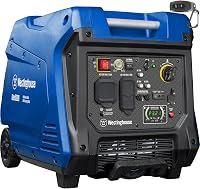
The best inverter generator with electric start is the Westinghouse 5000 Peak Watt Super Quiet Portable. It combines 3,900 rated watts, remote and push-button starting, an RV-ready outlet, clean inverter power and up to 18 hours of runtime.
That mix suits households that need backup power for a fridge, lights and phones, and RV users who want one unit to handle trailer loads without a separate charger.
PowerSmart is a lighter gasoline alternative with 3,800 rated watts. It suits buyers who need to lift and move a generator more often, but it loses remote starting and dual fuel choice.
WEN is the high-output choice when you want dual-fuel operation and up to 5,100 rated watts on gasoline. That extra capacity fits larger RV loads and workshop tools, but it brings more weight.
Genkins and BILT HARD sit at the light end of this group, which helps when storage space is tight or a vehicle boot is the main carrying place.
An inverter generator can produce power with less than 3% THD on several picks here, which is useful for electronics that need stable power. That clean output matters for laptops, tablets, televisions and phone chargers.
Electric starting also removes much of the effort from startup, although some models still include recoil starting as a backup. A backup method is handy if the battery is flat or the unit has sat unused for a while.
Remote start changes daily use more than the spec sheet suggests. You can start power from inside a house or RV, which is useful during rain, cold or late night outages.
Rated watts should guide your shortlist before peak watts. Peak watts only cover brief starting surges, while rated watts show what can run together once motors are up to speed.
Fuel choice shapes where and how you store the generator. Gasoline is simple to find, while propane can suit users who prefer sealed tanks for storage and transport.
Runtime figures need context because load changes the result. A generator rated for many hours at a light load will run for less time when an air conditioner or heater is connected.
Weight is a practical limit rather than a minor detail. A heavier unit may need a ramp, a truck bed or help from a second person, even with wheels and a handle.
Outlets decide whether a model fits your setup without adapters. RV users should check for a TT-30R outlet, while home users often need standard household sockets for appliances.
Safety features such as low oil shutdown and carbon monoxide protection support longer use. They work best when the generator is still placed outdoors with clear airflow around it.
If you want a broader look at portable models, compare these picks with our best electric start portable generator guide. That wider view can help if portability matters more than maximum output.
Our picks at a glance
-
1
 Best for broad backup coverage
Westinghouse 5000 Peak Watt Super Quiet Portable
9.7/10 our score
See it on Amazon -
2
 Best for lighter home backup
PowerSmart 4800 Watt Electric Start Portable Inverter
9.2/10 our score
See it on Amazon -
3
 Best for portable camping power
Genkins 4500W Portable Gas Inverter Generator
9.0/10 our score
See it on Amazon
- 4
 Check it
Westinghouse 4000 Peak Watt Super Quiet Dual
Best for compact dual-fuel use - 5
 Check it
LIFAN 4800W Gas Inverter Generator
Best for quiet remote starting - 6
 Check it
WEN 6800-Watt Dual Fuel RV-Ready Electric Start
Best for high dual-fuel output - 7
 Best for 50-state fuel flexibilityCheck it
- 8
 Check it
BILT HARD 5500W Dual Fuel Inverter Generator
Best for lighter dual-fuel hauling
The best inverter generators with electric start
The best choice depends on your rated-wattage target, fuel preference, outlet needs and carrying plan. A model that suits home backup may be too heavy for regular camping trips, and a compact unit may not cover several large appliances at once.
Westinghouse leads for overall coverage because it pairs high rated output with remote starting and RV ready power. The smaller and dual-fuel models solve different needs, such as easier transport or a choice between gasoline and propane.
Our score weighs specs, features and buyer feedback against what you're shopping for. That approach helps separate models with similar wattage but different starting systems, tanks or outlet layouts.
We checked the stated output, starting methods, fuel options, runtime information, outlet layouts, safety features and portability details. Each item affects daily use, from starting the unit in bad weather to moving it into a stored position.
Care also matters when comparing models. Oil checks, battery upkeep, fuel storage and airflow around the unit can shape how reliable a generator feels over time.
Use the picks below as starting points, then match the specs to the devices you actually plan to run. That keeps the choice focused on your loads, space and fuel access rather than headline numbers alone.
| Product | Best for | Rated output | Fuel | Runtime | Our score |
|---|---|---|---|---|---|
| Westinghouse 5000 Peak Watt Super Quiet Portable | broad backup coverage | 3900 watts | Gasoline | Up to 18 hours | 9.7 |
| PowerSmart 4800 Watt Electric Start Portable Inverter | lighter home backup | 3800 watts | Gasoline | 9.2 | |
| Genkins 4500W Portable Gas Inverter Generator | portable camping power | 3800 watts | 9.0 | ||
| Westinghouse 4000 Peak Watt Super Quiet Dual | compact dual-fuel use | 3300 watts | Gasoline or propane | 8.9 | |
| LIFAN 4800W Gas Inverter Generator | quiet remote starting | 3800 watts | 8.8 | ||
| WEN 6800-Watt Dual Fuel RV-Ready Electric Start | high dual-fuel output | 5100 watts on gasoline | Gasoline or propane | 8.7 | |
| Generac | 50-state fuel flexibility | 3900 watts | Gasoline or propane | 8.6 | |
| BILT HARD 5500W Dual Fuel Inverter Generator | lighter dual-fuel hauling | 4000 watts on gasoline | Gasoline or LPG | 8.4 |
Westinghouse 5000 Peak Watt Super Quiet Portable
Westinghouse 5000 Peak Watt Super Quiet Portable: Best for broad backup coverage
- 5000 peak watts and 3900 rated watts
- Remote, electric and recoil start
- RV-ready TT-30R outlet
- Up to 18 hours on a 3.4-gallon tank
This gasoline inverter generator combines high rated output with remote, electric and recoil starting. Its RV outlet, USB ports, wheels and data display suit home backup and travel trailers.
Pros
- Highest score in this roundup
- Remote start with included key fob
- Long stated runtime
Cons
- Gasoline only
- Heavier at 104.7 lb
The Westinghouse 5000 Peak Watt Super Quiet Portable is the strongest overall pick because it offers 3,900 rated watts and 5,000 peak watts. That gives you more running capacity than most models in this roundup for home backup, camping or a travel trailer.
Starting options are unusually flexible. You can use the push-button electric start, the included remote key fob or the recoil start if needed.
The control panel includes a 120V duplex household outlet, a 30-amp TT-30R RV outlet and 2 USB outlets. Its LED data center cycles through fuel level, power output, remaining runtime, voltage and lifetime hours.
The 3.4-gallon gasoline tank supports up to 18 hours of runtime, and Economy Mode adjusts engine speed for lighter loads. The unit weighs 104.7 lb and includes wheels and a telescoping handle, so measure your storage area and doorway before moving it into position.
Choose it when you want one generator to cover home essentials and RV use. Its main trade-off is that it runs on gasoline only and is heavier than the compact picks.
PowerSmart 4800 Watt Electric Start Portable Inverter
PowerSmart 4800 Watt Electric Start Portable Inverter: Best for lighter home backup
- 4800 peak watts and 3800 rated watts
- Electric start
- Up to 18 hours at 25% load
- CO protection and parallel ports
PowerSmart offers a strong rated output in a lighter package than the Westinghouse 5000. Its RV outlet, USB ports, CO protection and parallel ports add flexibility.
Pros
- 18-hour stated runtime at 25% load
- Lighter than several higher-output picks
- Electric start
Cons
- Gasoline only
- No remote start listed
PowerSmart is the best fit if you want 3,800 rated watts in an 89 lb gasoline generator. It gives you a useful balance between output and portability, with electric start and folding-handle transport.
Its 3.43-gallon tank supports up to 18 hours at 25% load. The control panel has four 120V 20A outlets, a 120V 30A RV-ready outlet, a 12V DC outlet and 2 USB ports.
CO protection, overload protection and low-oil shutdown add safety controls for backup use. Parallel ports also allow 2 compatible 4800-watt inverter generators to be connected for more output.
The 223cc 4-stroke engine produces 4,800 peak watts and 3,800 rated watts. The stated noise level is 59 dB at 23 ft at full load.
Choose PowerSmart when the 89 lb weight matters but you still need near-4,000-watt running capacity. It does not offer the gasoline and propane flexibility of the dual-fuel models.
Genkins 4500W Portable Gas Inverter Generator
Genkins 4500W Portable Gas Inverter Generator: Best for portable camping power
- 4500 peak watts and 3800 rated watts
- 62 lb portable design
- Electric and recoil start
- Parallel capable
Genkins is the lightest gasoline pick in this group. Its 3,800-watt rated output, electric start, wheels and handle fit camping and portable backup use.
Pros
- Lightest listed weight
- 3800 rated watts
- Electric and recoil starting
Cons
- Shorter stated runtime than the largest tanks
- Gasoline only
Genkins is the best option for buyers who need 3800 rated watts in a 62 lb gasoline generator. Its built-in wheels and handle make it easier to move than the heavier home-backup models.
The 174cc 4-stroke OHV engine produces 4,500 peak watts and 3,800 rated watts. Pure sine wave output with THD of 3% or less suits sensitive electronics, home appliances and RV devices.
Electric and recoil starting give you 2 ways to start the generator. A 1.9-gallon fuel tank supports up to 8 hours at half load, while the stated operating noise is 63 dB at 23 ft.
Low-oil automatic shutdown, overload protection and a circuit breaker support safe operation. Genkins also includes a CO sensor and parallel capability.
Choose it for camping, occasional backup and jobs where one-person transport matters. Its smaller tank means less stated runtime than the largest gasoline picks.
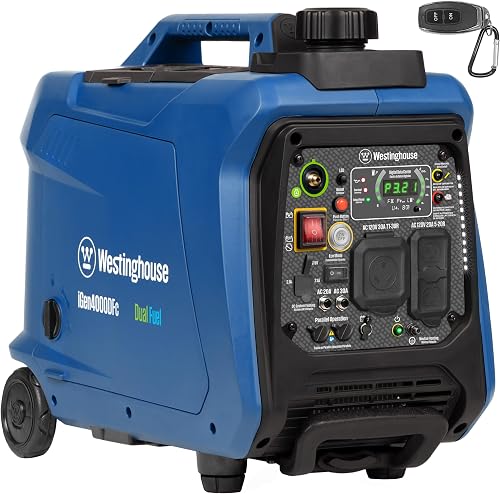
Westinghouse 4000 Peak Watt Super Quiet Dual
Westinghouse 4000 Peak Watt Super Quiet Dual: Best for compact dual-fuel use
- 4000 peak watts and 3300 rated watts
- Gasoline or propane operation
- Remote and electric start
- RV-ready outlet and CO shutdown
This Westinghouse dual-fuel model gives you gasoline or propane choice in a compact 62.8 lb design. Remote and electric starting make it easier to operate around an RV or home.
Pros
- Gasoline and propane flexibility
- Remote and electric start
- RV-ready outlet
Cons
- Lower rated output than the top 3 picks
- Gas runtime is stated at up to 7 hours
This Westinghouse is the best compact choice when propane flexibility matters more than maximum rated output. It produces 3,300 rated watts and 4,000 peak watts on a 62.8 lb frame.
You can run it on gasoline or propane, then start it with the push button, remote key fob or recoil system. That combination is useful when the generator will stay near an RV, garage or emergency supply area.
The panel includes a 120V duplex household outlet, an RV-ready TT-30R 30A outlet and 2 USB outlets. Its LED display cycles through fuel level, power output, remaining runtime, voltage and lifetime hours.
The 1.69-gallon gasoline tank supports up to 7 hours of runtime. Economy Mode helps reduce fuel use at lighter loads, and automatic low-oil and CO shutdown provide additional protection.
Choose it when a smaller dual-fuel generator is more useful than the extra capacity of a 3,900-watt model. Read our best inverter generator dual fuel electric start guide for more dual-fuel comparisons.
LIFAN 4800W Gas Inverter Generator
LIFAN 4800W Gas Inverter Generator: Best for quiet remote starting
- 4800 starting watts and 3800 running watts
- Remote and electric start
- 58 dB at 25% load
- Up to 10 hours at 25% load
LIFAN pairs a 3,800-watt running output with remote starting, a CO sensor and a stated 58 dB noise level at 25% load. Its suitcase-style portability suits RV and home backup use.
Pros
- Remote key-fob start
- 3800 running watts
- CO sensor and low-oil shutoff
Cons
- Gasoline only
- Noise figure is tied to 25% load
LIFAN suits buyers who want remote starting and 3,800 running watts in a portable gasoline generator. Its included key fob can start or stop the unit from up to 50 ft away, and push-button electric start is also available.
The generator produces 4,800 starting watts and 3,800 running watts. Pure sine wave output with less than 3% THD is designed for laptops, phones and other sensitive electronics.
Its 2.64-gallon tank provides up to 10 hours at 25% load. Smart Eco-Mode adjusts engine speed to demand, and the stated noise level is 58 dB at 25% load.
The 66.1 lb unit includes a telescopic handle and rugged wheels. A CO sensor, low-oil shutoff and overload protection support use for camping, construction, emergency power, home backup and RVs.
Choose LIFAN when remote starting is more useful than dual-fuel operation. Its noise figure is tied to a 25% load, so do not treat it as a full-load measurement.
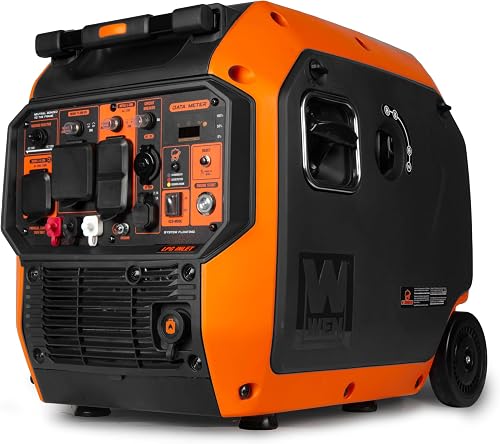
WEN 6800-Watt Dual Fuel RV-Ready Electric Start
WEN 6800-Watt Dual Fuel RV-Ready Electric Start: Best for high dual-fuel output
- 6800 surge watts on gasoline
- 5100 rated watts on gasoline
- 240V configuration
- Gasoline or propane operation
WEN is the high-output choice, with 5,100 rated watts on gasoline and 4,500 rated watts on propane. Its RV outlets, 240V configuration and electric start suit larger loads.
Pros
- Highest rated output here
- Dual-fuel operation
- RV-ready and 240V receptacle
Cons
- Heavier than compact picks
- Propane output is lower than gasoline output
WEN is the high-output choice, with 5,100 rated watts on gasoline and 4,500 rated watts on propane. Its 224cc engine also produces 6,800 surge watts on gasoline and 6,000 surge watts on propane.
The bonded-neutral 240V configuration supports low-power Level 2 charging for battery and hybrid electric vehicles. The control panel includes a 120V/240V L14-30R outlet, 2 120V outlets, an RV TT-30R outlet, a 12V DC outlet and 2 USB ports.
Electric start is backed by a recoil starter. Fuel shutoff uses remaining carburetor fuel before shutdown, which can help limit stale fuel buildup during storage.
The WEN Watchdog CO sensor shuts the generator down if dangerous carbon monoxide levels are detected. The unit weighs 99.2 lb and includes wheels and a telescoping pull handle.
Choose it for larger RV, home backup or vehicle-related loads. Its larger output comes with more weight, and its propane output is lower than its gasoline output.
For remote-start alternatives, see our best inverter generator dual fuel remote start guide.
Generac
Generac: Best for 50-state fuel flexibility
- 5200 starting watts and 3900 running watts
- Gasoline or propane operation
- 50-state CARB compliance
- Push-button electric start
Generac combines 3,900 running watts with gasoline or propane operation and 50-state CARB compliance. Its COsense protection, LED display and electric start support home and RV use.
Pros
- 50-state CARB-compliant model
- Gasoline and propane flexibility
- Up to 15 hours at 25% load on gas
Cons
- Heaviest listed model
- Large 37.2-inch length
Generac is the best match for buyers who need dual-fuel power with 50-state CARB compliance. The iQ5200 DF produces 3,900 running watts and 5,200 starting watts on gasoline or propane.
Gasoline runtime reaches up to 15 hours at 25% load or 9 hours at 50% load with Economy Mode. The LED display shows real-time output and fuel consumption, while the fuel selector switch supports changing between gasoline and propane.
Push-button electric start uses an included 12V battery. COsense technology monitors carbon monoxide and shuts the unit down automatically before levels reach a dangerous threshold.
The control panel has a 120V 30A L5-30R outlet, 2 120V 20A GFCI outlets, USB-A and USB-C ports. Built-in wheels and a folding handle help move the 107 lb generator.
Choose Generac when nationwide fuel and emissions compliance matters. Its 37.2-inch length and 107 lb weight require more storage and moving space than the compact models.
BILT HARD 5500W Dual Fuel Inverter Generator
BILT HARD 5500W Dual Fuel Inverter Generator: Best for lighter dual-fuel hauling
- 5500 starting watts and 4000 running watts on gasoline
- Gasoline or LPG operation
- 61.7 lb weight
- CO auto-shutoff and parallel connectors
BILT HARD gives you dual-fuel operation and 4,000 running watts on gasoline at a listed weight of 61.7 lb. It uses recoil start, so it suits buyers who value lighter hauling over push-button starting.
Pros
- Lightest dual-fuel pick
- 4000 running watts on gasoline
- Parallel-ready design
Cons
- Recoil start rather than electric start
- Small 1.14-gallon tank
BILT HARD is the lightest dual-fuel pick, weighing 61.7 lb while producing 4,000 running watts on gasoline. It produces 3,600 running watts on LPG and uses gasoline or LPG as fuel.
Its 160cc 4-stroke OHV engine has a 1.14-gallon tank. Economy Mode lowers engine speed under lighter loads, while the digital display cycles through volts, frequency, amps, watts, runtime hours and fuel level.
The panel includes 120V 20A outlets, a 120V 30A RV TT-30R outlet, a 12V DC 8A output, a USB-C/USB-A adapter and parallel connectors. CO auto-shutoff, overload indicators, breakers and low-oil protection help monitor operation.
The main difference is the starting system. BILT HARD uses recoil start, so it does not deliver the push-button convenience that defines the other products in this roundup.
Choose it if dual-fuel operation, 4,000 gasoline running watts and low carrying weight matter more than electric start. For a gasoline-only comparison, see the best gas generator with electric start guide.
How to choose an inverter generator with electric start
Choose rated watts before peak watts because rated watts describe the load the generator can support continuously. Peak watts cover short starting surges from equipment such as air conditioners, refrigerators and power tools.
Make a list of the devices you plan to run together. Add their running watts, then leave room for starting demand instead of sizing the generator exactly to the total.
Which inverter generator electric start features matter most?
The most useful starting setup depends on where you operate the generator. Push-button electric start helps when the generator is beside your home or campsite, while remote start is useful when you want to start it from inside an RV or nearby shelter.
A recoil starter is still valuable as a backup. Westinghouse, Genkins, LIFAN and WEN include more than one starting method, while BILT HARD uses recoil start.
Electric start also depends on the battery and starting circuit staying ready. Follow the generator's maintenance instructions and keep the unit accessible for inspection.
Should you choose gasoline or dual fuel?
Choose gasoline for the widest selection of gasoline-focused models and the rated output those models provide. Choose dual fuel if propane storage gives you another way to operate during an outage or trip.
Dual-fuel output can change by fuel. WEN produces 5,100 rated watts on gasoline and 4,500 on propane, while BILT HARD produces 4,000 on gasoline and 3,600 on LPG.
If you plan to use a freezer during an outage, compare startup demand and fuel flexibility in our best electric start dual fuel generator for freezers guide.
What outlet should an RV user check?
RV users should confirm that the generator has the outlet type their trailer requires. A TT-30R outlet is included on several models here, including Westinghouse, PowerSmart, LIFAN, WEN and BILT HARD.
An outlet alone does not tell you whether the generator can support every appliance at once. Compare the RV's air conditioner, microwave, refrigerator and charging loads with the generator's rated watts.
How should you set up and care for an electric-start inverter generator?
Operate a fuel-powered generator outdoors and keep exhaust away from doors, windows and other openings. Carbon monoxide sensors and automatic shutdown features add protection, but they do not replace safe placement and ventilation.
Place the unit on level ground with space on all sides for airflow. Blocked vents can cause overheating, and a slope can make oil and fuel readings less reliable.
Before the first use, read the model's instructions for oil, battery connection, fuel and grounding. Do not skip the oil step, because many portable generators ship without oil or with only a small amount for factory testing.
Check the battery and starting circuit before you need the generator in an outage. Electric start is convenient, but it still depends on a charged battery and clean connections.
Keep the generator level, allow airflow around it and avoid overloading the outlets. Start with the most important loads connected, then add other devices one at a time.
Use fresh fuel and follow the manufacturer's storage steps. Old fuel can make starting harder and can leave deposits in the carburetor, especially after long periods without use.
Models with fuel shutoff, such as WEN, are designed to use remaining carburetor fuel before shutdown, but you should still follow the stated maintenance schedule. That feature helps during storage, yet it does not remove the need for regular checks.
Inspect cords, plugs and outlet covers for damage before each outing. Cracked insulation or loose connections can create a fault even when the generator itself is running well.
Never connect a portable generator directly to home wiring unless the setup uses the correct transfer equipment installed by a qualified professional. Backfeeding can endanger utility workers and damage household equipment.
Plug appliances into the generator using suitable cords and avoid exceeding the outlet ratings. Heavy extension cords can overheat, so use the right gauge and length for the load.
Keep children, pets and loose items away from the operating unit. Hot surfaces and moving parts remain hazards even on quiet inverter models.
Let the generator cool before refueling or moving it. Fueling a hot engine creates a fire risk, and lifting a heavy unit without help can cause injury.
Store the generator dry, upright and out of reach of young children. A clear storage spot also makes it easier to check oil, battery charge and fuel before the next trip.
Which electric start inverter generator should you buy?
Choose the Westinghouse 5000 Peak Watt Super Quiet Portable if you want the best mix of rated output, runtime, RV support and starting options. It is the safest all round pick for buyers who want home backup and travel trailer power from one machine.
Choose PowerSmart or Genkins when lower weight matters more than remote starting or dual-fuel operation. PowerSmart keeps rated output close to the top pick, while Genkins is easier to carry for camping and short trips.
Choose Westinghouse 4000, Generac or WEN if propane flexibility is central to your backup plan. Dual fuel can help when gasoline storage is not ideal, although output and runtime can differ by fuel.
Choose LIFAN for remote start in a lighter gasoline unit. That helps when you want to start power from inside a shelter without walking out to the generator in poor weather.
Choose BILT HARD only if recoil start is acceptable. It offers light dual-fuel hauling and strong rated output, but it gives up the push-button convenience that many buyers want from this category.
For RV use, match the TT-30R outlet and rated watts to your trailer before you buy. Check the air conditioner, fridge, microwave and battery charger loads together rather than sizing for one appliance alone.
For home backup, list the essentials you need during an outage and add their running watts. Leave room for starting surges from motors, then compare that total with each model's rated output.
If space is limited, measure the storage area and doorway before choosing a heavier model. Wheels and handles help, but a larger frame still needs room to move, store and service.
If you are deciding between push-button and pull-cord operation, our guide to Which Is Better Electric Start or Recoil Start Generator? explains the trade-offs before you choose. Use it alongside the specs above, then pick the model that fits your loads, fuel access and carrying plan.
Our top 3 picks at a glance
-
1
Best for broad backup coverage
Westinghouse 5000 Peak Watt Super Quiet Portable
9.7/10 our score
See it on Amazon -
2
Best for lighter home backup
PowerSmart 4800 Watt Electric Start Portable Inverter
9.2/10 our score
See it on Amazon -
3
Best for portable camping power
Genkins 4500W Portable Gas Inverter Generator
9.0/10 our score
See it on Amazon
Frequently asked questions
What is the best inverter generator with electric start?
The Westinghouse 5000 Peak Watt Super Quiet Portable is the strongest overall match because it combines 3,900 rated watts, remote and push-button electric starting, an RV-ready outlet and up to 18 hours of runtime.
Choose PowerSmart if its 89 lb weight is easier to move, or WEN if you need higher dual-fuel output.
What does electric start mean on an inverter generator?
Electric start uses a battery-powered ignition system or push button instead of requiring you to pull a recoil cord. Some generators also include recoil starting as a backup.
Check which starting methods are included, and keep the generator battery maintained according to its instructions.
Are inverter generators with electric start good for RVs?
Yes, models with an RV-ready TT-30R outlet can fit many 30-amp RV setups. Westinghouse, PowerSmart, Genkins, LIFAN, WEN, Generac and BILT HARD include RV-oriented outlet features or descriptions.
Match the generator's running watts and outlet type to your RV loads before connecting it.
Is dual fuel better than gasoline only?
Dual fuel gives you gasoline or propane as operating choices, which can help when one fuel is easier to store or find. It does not guarantee the same output or runtime on both fuels.
WEN, Generac, Westinghouse and BILT HARD state different output figures for gasoline and propane.
How many watts do I need from an electric-start inverter generator?
Add the running watts of the devices you plan to use, then allow extra capacity for appliances with starting surges. The picks here range from 3,300 to 5,100 rated watts, so the right size depends on your largest load and how many items run together.
Check each appliance's label before choosing.