8 Best Portable Generators with Wheels (November 2026)
The best portable generators with wheels include the WEN for versatile home backup, the Westinghouse 12500 Watt Dual Fuel Home Backup for whole home backup, and the Oxseryn Power Equipment 4400 Watts Inverter Generator for lighter RV trips.
On this page (9 sections)
- How to pick a portable generator with wheels
- The best portable generators with wheels for home backup and travel
- Side by side: portable generators with wheels compared
- How many watts do you need for a portable generator on wheels?
- Dual fuel, gasoline or tri fuel: which fuel is best?
- What size wheeled generator fits your space and vehicle?
- What outlets and safety features should you look for?
- How do you set up and care for a wheeled portable generator?
- Verdict: which wheeled portable generator should you buy?
The best portable generator with wheels for most buyers is the WEN DF475T, because it gives you dual fuel choice, electric start and 120V/240V output in a 105.8 lb frame. That mix suits home backup, camping and job site use where you need to move the unit more than once.
Wheels matter more than they sound. A generator that weighs 100 lb or more is hard to carry, and a wheel kit turns a short move across a yard into a simple pull.
For heavier models near 220 lb, wheels help only on smooth ground, so plan where you will park and store them.
Our score weighs specs, features and buyer feedback against what you are shopping for. Higher scores here reflect useful wattage, fuel flexibility, outlets and moving hardware, not a hands on test.
If you want a smaller unit for light loads, our guide to best smallest portable generators covers that different job. This roundup focuses on factory wheeled models for heavier portable power equipment.
Our picks at a glance
-
1

-
2
 Best for whole home backup
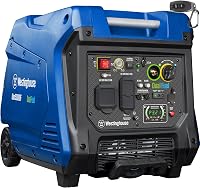
Westinghouse 12500 Watt Dual Fuel Home Backup
9.7/10 our score
See it on Amazon -
3
 Best for lighter RV trips
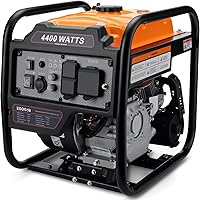
Oxseryn Power Equipment 4400 Watts Inverter Generator
9.5/10 our score
See it on Amazon
- 4
 Check it
Westinghouse 6500 Watt Dual Fuel Home Backup
Best for RV and transfer switch use - 5
 Best for maximum home powerCheck it
- 6
 Best for tri fuel flexibilityCheck it
- 7
 Check it
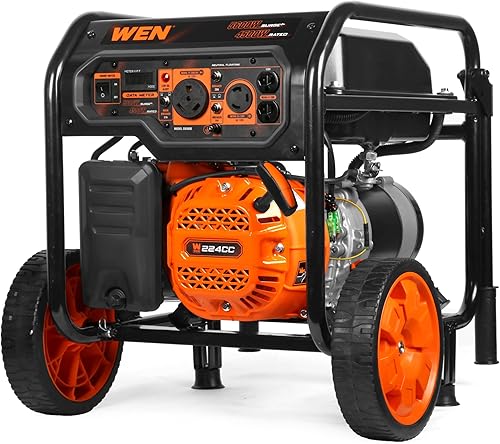
WEN 5600-Watt Portable Generator
Best for RV ready gasoline power - 8
 Best for budget home useCheck it
How to pick a portable generator with wheels
Start with the load you need to run, not the biggest wattage you can find. Add up running watts for items that stay on, then allow extra for motors that need surge power to start.
Next, check the outlets. A transfer switch ready L14-30R outlet helps at home.
An RV ready TT-30R or 14-50R outlet helps with a travel trailer. A mix of household outlets helps with tools and campsite gear.
Then check fuel. Dual fuel models let you use gasoline for more power or propane for storage convenience.
Tri fuel adds natural gas where a line is already in place. Gasoline only models keep things simple but limit your fuel options.
Finally, check weight and wheel type. Never flat wheels avoid flat tires.
A folding handle helps you steer. Even so, a 220 lb unit will test you on grass or gravel.
We compared wattage on gas and propane, tank size and stated runtime, outlet types, start method, CO protection, weight and included wheel kits. We looked at the specs for each model and grouped them by the job they do best.
The best portable generators with wheels for home backup and travel
These eight models cover light RV use up to whole home backup. Each one ships with wheels or a wheel kit, so you can move it without lifting the full weight.
WEN: Best for versatile home backup
- 4,750 surge watts on gasoline and 4,350 on propane
- 120V to 240V voltage selector
- Electric start with 224cc engine
- 4 gallon tank, up to 11 hours at half load
- Wheel and handle kit included
A mid size dual fuel generator with electric start, 120V/240V output and a wheel kit for moving it around the house or campsite.
Pros
- Dual fuel with simple dial selection
- Transfer switch ready L14-30R outlet
- Wheel and handle kit included
Cons
- Heavier than small inverter models
- Recoil backup style start is not the focus here
The WEN DF475T suits buyers who want one generator for home backup and occasional camping. It gives 3,800 running watts on gasoline and 3,500 on propane, which covers a fridge, lights, TV and small tools in most homes.
The 120V to 240V selector is the key feature. You can switch voltage for a transfer switch or keep it at 120V for household outlets.
The panel has two GFCI 5-20R outlets, an L14-30R twist lock and a 12V DC plug.
Electric start makes daily use easier than recoil start. The 4 gallon tank gives up to 11 hours at half load on gasoline, according to WEN.
The wheel and handle kit is included, not an extra purchase.
The trade off is weight. At 105.8 lb, it is still a two person lift onto a truck bed.
It also gives less power than the Westinghouse and DuroStar models for whole home loads. For most homes, that trade makes sense.
Westinghouse 12500 Watt Dual Fuel Home Backup: Best for whole home backup
- 12,500 peak watts and 9,500 running watts on gasoline
- Remote start with key fob
- 6.6 gallon tank, up to 12 hours
- Heavy duty never flat wheels and handle
- L14-30R and 14-50R outlets
A large dual fuel home backup generator with remote start and enough output for major appliances through a transfer switch.
Pros
- High running wattage for whole home use
- Remote start from a distance
- 50A RV ready outlet included
Cons
- Large frame needs clear storage space
- Too powerful for small campsite needs
The Westinghouse 12500 Watt model suits whole home backup. It gives 9,500 running watts and 12,500 peak watts on gasoline.
On propane, output drops to 8,500 running watts, which is normal for dual fuel models.
Remote start is a real help here. You can start it from inside the house rather than walking out in bad weather.
The 6.6 gallon tank gives up to 12 hours of runtime, according to Westinghouse.
The outlet mix is strong. You get GFCI household outlets, an L14-30R transfer switch outlet and a 14-50R 50A outlet for an RV or large loads.
Rubber covers help protect the outlets.
The trade off is size. This is a large, heavy frame that needs storage space and a flat path to its parking spot.
It is more generator than you need for a tent or small RV. Choose it for the house first.
Oxseryn Power Equipment 4400 Watts Inverter Generator: Best for lighter RV trips
- 4,400 peak watts and 3,400 running watts
- Under 72 dBA from 23 ft, maker says
- 2 gallon tank, up to 14 hours at 25% load
- Only 56 lb
- ECO mode and RV port
A light inverter generator for RV camping and home backup, with low noise claims and a long runtime at light load.
Pros
- Lightest option in this group
- ECO mode for light loads
- Fuel gauge included
Cons
- Gasoline only, no dual fuel
- Lower output than the home backup picks
The Oxseryn inverter generator suits RV camping and light home backup. It gives 3,400 running watts and 4,400 peak watts in a frame that weighs only 56 lb, according to Oxseryn.
No wheels are listed, so you carry it by hand.
That light weight is the main benefit. You can load it into an RV storage bay or a car trunk without help.
ECO mode helps reduce engine speed and noise at light loads.
Oxseryn says noise stays under 72 dBA from 23 ft. The 2 gallon tank gives up to 14 hours at 25% load with ECO mode.
That suits overnight use where you run a few items at a time.
The trade off is fuel and power. It runs on gasoline only and gives less output than the dual fuel home backup picks.
It also lacks a wheel kit, so it does not fit a strict wheeled parked spot, but its weight makes wheels less needed.
Westinghouse 6500 Watt Dual Fuel Home Backup: Best for RV and transfer switch use
- 6,500 peak watts and 5,300 running watts on gasoline
- 4.7 gallon tank, up to 14.5 hours
- CO sensor with auto shutdown
- Wheel kit and never flat wheels
- TT-30R RV and L14-30R transfer switch outlets
A dual fuel generator that balances home backup and RV power, with a CO sensor and 120/240V selector for flexible hookups.
Pros
- Long stated runtime on gasoline
- CO sensor included
- Both RV and transfer switch outlets
Cons
- Heavier than the WEN DF475T
- Magneto ignition, not electric start
The Westinghouse 6500 Watt model suits buyers who want both RV and home backup power. It gives 5,300 running watts on gasoline and 4,800 on propane.
That output runs more than a fridge and lights for most homes.
The 4.7 gallon tank gives up to 14.5 hours of runtime, according to Westinghouse. A 120/240V selector lets you choose the voltage you need.
The panel has a household outlet, an RV ready TT-30R outlet and a transfer switch ready L14-30R outlet.
CO sensor protection is a plus. It shuts the generator down if carbon monoxide rises to dangerous levels.
The wheel kit and never flat wheels help you move the 135.6 lb frame.
The trade off is start method and weight. It uses magneto ignition, so you pull to start.
It is also heavier than the WEN DF475T. If electric start matters to you, the WEN may suit you better.
DuroStar DS13000MX: Best for maximum home power
- 13,000 peak watts and 10,500 running watts
- 500cc dual fuel engine
- CO alert with auto shutdown
- Remote electric start
- Wheel and handle kit included
- 50A transfer switch ready outlet
The most powerful pick here for whole home backup, with remote start and a rugged steel frame that rewards a fixed parking spot.
Pros
- Highest running watts in this group
- CO alert included
- 50A outlet for transfer switch use
Cons
- 220 lb makes moving it harder, even on wheels
- Large footprint for storage
The DuroStar DS13000MX suits whole home backup where you want maximum power. It gives 13,000 peak watts and 10,500 running watts from a 500cc dual fuel engine, according to DuroStar.
That is the most power in this group.
Remote electric start and a front fuel selector make starting simple. The 50A outlet is transfer switch ready for home use.
CO alert protection shuts the unit down if dangerous CO levels are detected.
The included wheel and handle kit helps, but at 220 lb, you still need a smooth path. This is a park it in one spot model, not a unit you load into a vehicle each weekend.
The trade off is storage and moving effort. It has the largest footprint here at 29.75 x 27.5 x 25.75 inches.
Choose it if home backup power matters more than easy transport.
Generac: Best for tri fuel flexibility
- 12,500 starting watts and 9,500 running watts on gas
- Gasoline, propane or natural gas
- 500cc engine with AVR
- COsense auto shutdown
- 9.5 inch never flat wheels and folding handle
- 7.5 gallon tank
A tri fuel generator for buyers who want natural gas as a long runtime option, with electric start and a steel tube frame.
Pros
- Natural gas option for long outages
- COsense protection
- 50A and 30A outlets on one panel
Cons
- 219 lb is heavy to move
- Natural gas hookup needs proper setup
The Generac tri fuel model suits buyers who want natural gas as an option. It gives 9,500 running watts and 12,500 starting watts on gasoline.
It also runs on propane or natural gas with a dial turn.
Natural gas is the main draw. Where a gas line is in place, runtime can be far longer than any tank.
The 7.5 gallon tank gives up to 9.5 hours at 50% load on gasoline, according to Generac.
COsense technology monitors CO and shuts the unit down before dangerous levels. Electric start, AVR, a steel tube frame, 9.5 inch never flat wheels and a folding handle round out the package.
The trade off is weight at 219 lb. Wheels and a handle help, but this is still a heavy unit to steer.
It also costs more and needs proper setup for natural gas use. Choose it for fuel choice and home backup.
WEN 5600-Watt Portable Generator: Best for RV ready gasoline power
- 5,600 starting watts and 4,500 running watts
- 224cc gasoline engine
- 4.3 gallon tank, up to 12.5 hours at half load
- Wheel and handle kit
- TT-30R RV and L5-30R outlets
A gasoline generator built for RV and transfer switch use, with a wheel kit and a data meter for voltage and runtime.
Pros
- RV ready 30A outlet
- Three year limited warranty from WEN
- Data meter shows runtime
Cons
- Gasoline only
- No 240V output like the dual fuel picks
The WEN 5600-Watt model suits RV and home backup use on gasoline. It gives 5,600 starting watts and 4,500 running watts from a 224cc engine.
That output covers a fridge, lights, TV and power tools for many buyers.
The panel is RV friendly. It has two household outlets, an RV ready TT-30R outlet and a transfer switch ready L5-30R outlet.
The data meter shows voltage, frequency and runtime.
A wheel and handle kit is included. The 4.3 gallon tank gives up to 12.5 hours at half load, according to WEN.
At 112.4 lb, one person can move it on wheels but may need help lifting it.
The trade off is fuel choice. It runs on gasoline only and has no 240V output.
If you want dual fuel or 240V for a transfer switch, the WEN DF475T or Westinghouse models fit better.
Aceup Energy: Best for budget home use
- 4,350 peak watts and 3,600 running watts
- 4 gallon tank, up to 10 hours at half load
- 208cc engine with recoil start
- Wheel kit and handle included
- 30A locking outlet and voltmeter
A lower cost gasoline generator with wheels for home essentials and power tools, at a lighter weight than most home backup models.
Pros
- Lightest home style frame on wheels here
- Voltmeter on the panel
- Two year limited warranty
Cons
- Recoil start only
- Lowest running watts among the wheeled home picks
The Aceup Energy model suits budget home use. It gives 3,600 running watts and 4,350 peak watts from a 208cc engine.
That covers home essentials and many power tools at a lower output level.
Wheels and a handle are included. At 96 lb, it is the lightest wheeled home style model in this group, so moving it around a yard is easier.
The 4 gallon tank gives up to 10 hours at half load.
The panel has two household outlets, a 30A locking outlet and a voltmeter. The voltmeter helps you check output at a glance.
Aceup Energy backs it with a 2 year limited warranty.
The trade off is start method and power. It uses recoil start and gives less running watts than the WEN and Westinghouse picks.
Choose it for price and lighter weight, not for whole home loads.
Side by side: portable generators with wheels compared
| Product | Best for | Running watts | Fuel | Weight | Our score |
|---|---|---|---|---|---|
| WEN | versatile home backup | 3,800 on gasoline | Gasoline or propane | 105.8 lb | 9.7 |
| Westinghouse 12500 Watt Dual Fuel Home Backup | whole home backup | 9,500 on gasoline | Gasoline or propane | 9.7 | |
| Oxseryn Power Equipment 4400 Watts Inverter Generator | lighter RV trips | 3,400 | Gasoline | 56 lb | 9.5 |
| Westinghouse 6500 Watt Dual Fuel Home Backup | RV and transfer switch use | 5,300 on gasoline | Gasoline or propane | 135.6 lb | 9.2 |
| DuroStar DS13000MX | maximum home power | 10,500 | Gasoline or propane | 220 lb | 8.9 |
| Generac | tri fuel flexibility | 9,500 | Gasoline, propane, natural gas | 219 lb | 8.6 |
| WEN 5600-Watt Portable Generator | RV ready gasoline power | 4,500 | Gasoline | 112.4 lb | 8.3 |
| Aceup Energy | budget home use | 3,600 | Gasoline | 96 lb | 8.1 |
Use this table to spot the gaps fast. The DuroStar and Westinghouse 12500 Watt models lead on power.
The Oxseryn leads on weight. The WEN DF475T sits in the middle on both.
Running watts
Running watts matter more than peak watts for daily use. Peak watts help motors start, but running watts tell you what you can keep on.
The DuroStar gives 10,500 running watts. The Westinghouse 12500 Watt and Generac give 9,500 each.
The Westinghouse 6500 Watt gives 5,300. The WEN models, Oxseryn and Aceup fall between 3,400 and 4,500.
If you need to run central air, add up loads first. A smaller model may still start a fridge, but it may not run a large air conditioner plus other items at once.
Our best 4000 watt portable generator guide helps if you want more detail on mid size output. Our best 3500 watt generator guide covers a smaller step down.
How many watts do you need for a portable generator on wheels?
Most homes need 3,500 to 5,300 running watts for essentials. That range runs a fridge, lights, TV, fans and a sump pump for many buyers, if you stagger large motor loads.
Whole home backup with air conditioning often needs 9,500 running watts or more. That is where the Westinghouse 12500 Watt, Generac and DuroStar earn their size.
RV use is different. A travel trailer with air conditioning can need 3,500 running watts or more, depending on the unit.
Check your RV air conditioner and other loads before you choose.
H3: Small loads
For lights, phones, a TV and a fridge, look at models near 3,400 to 3,800 running watts. The Oxseryn and WEN DF475T fit that range.
H3: Medium loads
For a fridge, sump pump, power tools and more, look at 4,500 to 5,300 running watts. The Westinghouse 6500 Watt and WEN 5600-Watt fit that range.
H3: Large loads
For whole home backup through a transfer switch, look at 9,500 running watts or more. The Westinghouse 12500 Watt, Generac and DuroStar fit that range.
Dual fuel, gasoline or tri fuel: which fuel is best?
Dual fuel gives you a choice. Gasoline gives more power.
Propane gives cleaner storage and longer shelf life for the fuel itself. You trade a little power for that flexibility.
Gasoline only models are simpler. The WEN 5600-Watt, Oxseryn and Aceup run on gas only.
That suits buyers who already store gasoline for other equipment.
Tri fuel adds natural gas. The Generac can run on gas, propane or natural gas.
That suits long outages where a gas line is already in place, but the hookup must be done correctly.
If runtime matters most, our best portable dual fuel generator for long runtime guide compares tank and runtime claims in more detail.
H3: Fuel storage
Propane tanks store well and do not go stale the way gasoline can. That helps if you keep a generator for emergencies and use it only a few times a year.
Gasoline gives more watts in most dual fuel models here. The drop is often 300 to 1,000 running watts on propane, so check the specs for the model you pick.
H3: Noise and campsite use
Inverter models with ECO mode can run quieter at light loads. The Oxseryn claims under 72 dBA from 23 ft.
That matters more at a campsite than in a garage.
If low noise is your top need, our best portable dual fuel generator for low noise guide covers that angle in more detail.
What size wheeled generator fits your space and vehicle?
Size and weight decide if you will actually use the generator. A 220 lb model with wheels is still hard to load.
A 56 lb model is easy to carry but gives less power.
Check the dimensions before you buy. The DuroStar is 29.75 x 27.5 x 25.75 inches.
The Oxseryn is 19 x 15.6 x 19.1 inches. That size gap shows up fast in a garage or RV bay.
Wheel type also matters. Never flat wheels on the Westinghouse and Generac models avoid flat tires.
A wheel kit on the WEN and Aceup models helps you pull the unit, but you still lift it into a truck.
If you want a lighter step down, our best 3000 watt portable generator guide covers smaller wheeled and carry options.
H3: Storage
Measure your storage space with the handle up and down. A folding handle helps, but the frame size stays the same.
Leave room to open the fuel cap and reach the outlets. A tight space makes setup harder, even if the generator fits.
H3: Moving it
Plan a flat path from storage to where you will run it. Grass, gravel and steps add effort for any model over 100 lb.
Two people can move a 135 lb model more safely than one. For 219 to 220 lb models, ask for help and use the lift points where provided.
What outlets and safety features should you look for?
Outlets decide what you can plug in without extra adapters. A transfer switch ready outlet is key for home backup.
An RV ready outlet is key for a travel trailer.
Safety features protect you and the generator. CO sensors shut the unit down if carbon monoxide rises.
The Westinghouse 6500 Watt, DuroStar and Generac include CO protection.
Low oil shutdown protects the engine. GFCI outlets protect people from shock.
Overload protection in the specs list helps protect the generator itself.
H3: Home backup outlets
Look for an L14-30R or 14-50R outlet and a 120/240V selector if you plan to use a transfer switch. The WEN DF475T, Westinghouse models, DuroStar and Generac offer those options.
H3: RV outlets
Look for a TT-30R or 14-50R outlet for a travel trailer. The Westinghouse 6500 Watt, WEN 5600-Watt and Westinghouse 12500 Watt models offer RV ready outlets.
H3: CO protection
Run any generator outdoors only, away from doors and windows. A CO sensor is a backup safety feature, not a reason to run it indoors or in a garage.
How do you set up and care for a wheeled portable generator?
Set up starts with placement. Run the generator outdoors on level ground, with exhaust pointed away from people and buildings.
Keep it dry and away from wet grass where you can.
Check oil and fuel before the first start. Add oil from the included bottle or funnel where provided.
Check fuel level with the gauge, and use fresh fuel that is stored correctly.
Start with no load connected. Let the engine warm up for a minute, then plug in equipment one item at a time.
That helps the generator handle motor surge loads more smoothly.
H3: Break in and oil
Follow the oil change schedule in your manual. Generac notes a first oil change at 20 hours, then every 100 hours.
Other brands may differ, so check your own manual.
H3: Storage care
Run the generator every few months to keep seals lubricated, as the brand directs. Store it with the fuel type and level the manual recommends for that model.
H3: Moving care
Lock the handle and wheels for transport where the design allows. Do not tip a fueled generator on its side.
Carry or wheel it in the upright position the maker specifies.
Verdict: which wheeled portable generator should you buy?
The best portable generator with wheels for most buyers is the WEN DF475T, because it balances power, fuel choice, electric start and a 105.8 lb wheeled frame. It handles home essentials and campsite loads without the bulk of a whole home model.
Pick the Westinghouse 12500 Watt or DuroStar if you need whole home backup. Pick the Generac if you want natural gas as a fuel option.
Pick the Westinghouse 6500 Watt if you want RV and transfer switch outlets with CO protection.
Pick the WEN 5600-Watt for RV ready gasoline power on a budget. Pick the Aceup Energy for the lightest wheeled home style frame.
Pick the Oxseryn if you want the lightest unit overall and can carry it by hand.
Before you order, match running watts to your real loads, check outlet types, and measure your storage space. That short check will do more than any badge to help you pick the right wheeled generator for your home, RV or job site.
Our top 3 picks at a glance
-
1
-
2
Best for whole home backup
Westinghouse 12500 Watt Dual Fuel Home Backup
9.7/10 our score
See it on Amazon -
3
Best for lighter RV trips
Oxseryn Power Equipment 4400 Watts Inverter Generator
9.5/10 our score
See it on Amazon