Best 4000-Watt Portable Generators: Top 7 Picks (November 2026)
The best 4000-watt portable generators include the Oxseryn Power Equipment 4400 Watts Inverter Generator for lighter RV and backup loads, the Champion 4000-Watt Dual Fuel RV Ready Portable for gasoline or propane, and the PowerSmart 4000 Watt Portable Inverter Generator for quiet campsite power.
On this page (6 sections)
The best 4000-watt portable generator for most buyers is the Oxseryn Power Equipment 4400 Watts Inverter Generator, with 3400 running watts, an RV port and a stated weight of 56 lb. Choose Champion if you want to switch between gasoline and propane, or WEN if your priority is 4000 rated watts.
For a wider comparison, see portable generator brands.
These generators span different designs and power ratings. Some reach about 4000 watts only at startup, while the WEN supplies 4000 rated watts; compare running output with your actual load before you buy.
Our picks at a glance
-
1
 Best for lighter RV and backup loads
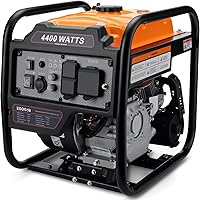
Oxseryn Power Equipment 4400 Watts Inverter Generator
9.5/10 our score
See it on Amazon -
2
 Best for gasoline or propane
Champion 4000-Watt Dual Fuel RV Ready Portable
9.4/10 our score
See it on Amazon -
3
 Best for quiet campsite power
PowerSmart 4000 Watt Portable Inverter Generator
9.3/10 our score
See it on Amazon
- 4
 Check it
Evernexta 4000W Gas-Powered Inverter Generator
Best for an open-frame RV setup - 5
 Check it
WEN Quiet and Lightweight 4800-Watt RV-Ready Portable
Best for 4000 rated watts - 6
 Check it
Pulsar PGD40ISCO Ultra Light Quiet 4000W Portable
Best for low carry weight - 7
 Check it
Aceup Energy 4000 Watt Gas Inverter Generator
Best for a built-in readout
Which 4000-watt portable generator fits your use?
The Oxseryn is the strongest all-round fit in this group, while Champion adds fuel choice and WEN provides the most rated output. Our score weighs specs and features against what shoppers seeking a 4000-watt portable generator need.
Oxseryn Power Equipment 4400 Watts Inverter Generator: Best for lighter RV and backup loads
- 4400 peak watts, 3400 running watts
- 56 lb open-frame design
- Up to 14 hours at 25% load in ECO mode
- Two 120V AC ports and one RV port
A 56 lb open-frame inverter with 3400 running watts and an RV port. Its stated runtime reaches up to 14 hours at 25% load in ECO mode.
Pros
- 3400 running watts
- Fuel gauge and ECO mode
- RV port
Cons
- Gasoline only
- Open-frame design
Oxseryn pairs 3400 running watts with a 56 lb weight, a useful balance for RV trips and limited home backup. It is an open-frame inverter, with two 120V AC ports, a 12V DC port and an RV port.
The 2-gallon fuel tank has a gauge, and ECO mode supports a stated runtime of up to 14 hours at 25% load. Actual runtime depends on the appliances connected and how much power they draw.
The brand lists noise under 72 dBA from 23 ft away. That figure gives a distance for comparison, but sound can still carry through a campsite or neighborhood.
Choose Oxseryn when you want inverter features and 3400 running watts without carrying the heaviest option in this group. It runs on gasoline, so it won't give you Champion's propane choice.
Champion 4000-Watt Dual Fuel RV Ready Portable: Best for gasoline or propane
- 4000 starting watts, 3000 running watts on gasoline
- 2700 running watts on propane
- CO Shield auto shutoff
- 64 dBA from 23 ft
This inverter offers a choice of gasoline or propane and includes a CO Shield auto shutoff system. It has a TT-30R RV outlet and a household duplex outlet.
Pros
- Two fuel options
- CO Shield auto shutoff
- TT-30R outlet
Cons
- Lower running output on propane
- Parallel kit sold separately
Champion stands out for buyers who want gasoline and propane as fuel options. It provides 3000 running watts on gasoline or 2700 on propane, with 4000 starting watts on either fuel.
Its control panel includes a 120V 25A TT-30R outlet, a 120V household duplex outlet and a 12V automotive-style outlet. The CO Shield system automatically shuts off the generator when it detects carbon monoxide, and Champion includes a 3-year limited warranty with lifetime technical support.
Champion gives different runtime figures by fuel: up to 10 hours on gasoline and up to 25 hours on propane, each at 25% load. Those figures rely on different fuel supplies, so plan around the fuel you expect to carry.
This model suits an RV owner who values fuel flexibility and a dedicated RV outlet. For more choices focused on that design, see our best 4000-watt inverter generator guide.
PowerSmart 4000 Watt Portable Inverter Generator: Best for quiet campsite power
- 4000 peak watts, 3200 rated watts
- 59 dBA at 25% load from 23 ft
- Under 3% THD
- Up to 8 hours at 25% load
A gasoline inverter with 3200 rated watts and a stated noise level of 59 dBA at 25% load. Its outlets include a 30A twist-lock and USB ports.
Pros
- 59 dBA at 25% load
- Under 3% THD
- Digital display
Cons
- 1.3-gallon tank
- Parallel kit not included
PowerSmart is a compact-output option for buyers who care about its stated 59 dBA noise level at 25% load from 23 ft away. It supplies 3200 rated watts and less than 3% total harmonic distortion, according to its specifications.
The panel has a 120V 30A L5-30R twist-lock outlet, a household duplex outlet, a 12V DC port and two USB ports. The 1.3-gallon tank supports up to 8 hours at 25% load.
PowerSmart is parallel capable, but the kit is sold separately. If you plan to combine generators, check compatibility and the added equipment cost before relying on the extra capacity.
Pick it for quiet operation claims and a mix of outlets in a 50.7 lb package. Its 3200 rated watts put it below WEN's 4000-watt running capacity.
Evernexta 4000W Gas-Powered Inverter Generator: Best for an open-frame RV setup
- 4000 starting watts, 3400 running watts
- 30A outlet and two 120V AC outlets
- 2-gallon fuel tank
- Under 3% THD
The 55 lb open-frame inverter combines 3400 running watts with a 30A outlet. It has a 2-gallon tank and ECO mode.
Pros
- 3400 running watts
- 30A outlet
- Under 3% THD
Cons
- Gasoline only
- Runtime varies with load
Evernexta combines 3400 running watts with a 30A outlet in a 55 lb open-frame inverter. Its panel also has two 120V AC outlets and one 12V DC port, which covers several common campsite connections.
The 2-gallon tank and ECO mode support up to 9 hours of runtime, with a separate claim of 6.5 hours at 50% load. It also has overload protection, an AC breaker and low-oil shutdown.
Evernexta specifies less than 3% THD and says the generator is EPA compliant. Its stated noise level is under 72 dBA from 23 ft, so it may be more noticeable than quieter enclosed designs.
Consider it if you want a 30A outlet and 3400 running watts in an open-frame package. It uses gasoline only, and the stated runtime will change with load.
WEN Quiet and Lightweight 4800-Watt RV-Ready Portable: Best for 4000 rated watts
- 4800 surge watts, 4000 rated watts
- Onboard wheels and telescoping handle
- TT-30R RV receptacle
- CO shutdown sensor
WEN's inverter provides 4000 rated watts, which is at the high end of this group. Onboard wheels and a telescoping handle help move its 72.7 lb frame.
Pros
- Highest rated output here
- Wheels and telescoping handle
- CO shutdown sensor
Cons
- Heaviest pick here
- Gasoline only
WEN is the clearest choice when your load calls for 4000 rated watts. It also has 4800 surge watts, clean power for sensitive electronics, and a CO shutdown sensor.
The 72.7 lb generator has onboard wheels and a telescoping pull handle. Compare portable generators with wheels if moving the unit is a concern.
Its panel includes four 120V receptacles, a TT-30R RV receptacle, a 12V DC receptacle and two USB ports.
WEN describes noise at 62 dB at quarter load and gives up to 7 hours of runtime at half load from its 1.9-gallon tank. Its fuel shutoff uses remaining fuel in the carburetor before the generator stops, and the unit has a 3-year warranty.
This higher-output option makes sense for buyers who can manage its weight and want more rated capacity. If you need a smaller carry size, compare it with our best small portable generators.
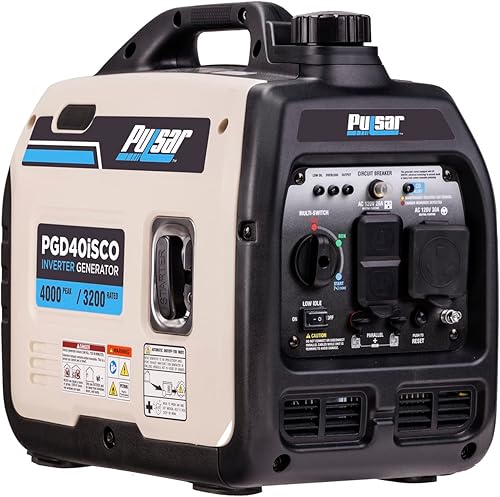
Pulsar PGD40ISCO Ultra Light Quiet 4000W Portable: Best for low carry weight
- 4000 peak watts, 3200 rated watts
- 47.3 lb listed weight
- 59 dB noise rating
- Parallel ready
At 47.3 lb, this is the lightest pick in the group by the listed weight. It has 3200 rated watts and a 1-gallon tank.
Pros
- Lowest listed weight
- 59 dB noise rating
- Parallel ready
Cons
- 1-gallon tank
- Gasoline only
Pulsar is the lightest pick here by listed weight, at 47.3 lb, and provides 3200 rated watts. For more portable inverter options, compare lightweight inverter generators.
Its 1-gallon tank gives a stated 4 hours of runtime at half load.
The generator is rated at 59 dB and is parallel ready. Pulsar describes it as suitable for RV use, sensitive electronics and air-conditioning units up to 13,500 BTU.
That air-conditioner figure is a stated compatibility claim, so check your AC unit's startup and running needs before relying on it. Parallel operation also requires compatible equipment.
Choose Pulsar if lifting weight matters more to you than longer fuel intervals. Its small tank may mean more frequent refueling during a long outage or trip.
Aceup Energy 4000 Watt Gas Inverter Generator: Best for a built-in readout
- 4000 peak watts, 3200 rated watts
- Digital gauge tracks voltage and runtime
- Under 1.5% THD
- About 60 dB in Eco mode at 25% load
Its digital gauge tracks voltage, runtime, gasoline level, hertz and power output. The inverter has an RV receptacle and parallel capability.
Pros
- Multi-value digital gauge
- Under 1.5% THD
- 48 lb listed weight
Cons
- Up to 5 hours at half load
- Parallel kit sold separately
Aceup's digital gauge tracks several operating details, including voltage, runtime, gasoline level, hertz and power output. It supplies 3200 rated watts from a 149cc engine and includes an RV receptacle and a 12V DC outlet.
Aceup states a noise level of about 60 dB in Eco mode at 25% load from 23 ft. The inverter's stated THD is below 1.5%, and the generator is parallel ready with a separately sold kit.
Its 1.32-gallon tank supports up to 5 hours at half load. The 48 lb weight is among the lowest in this group, but the shorter stated runtime makes fuel planning more important.
Consider it if you want a built-in readout and a lighter gasoline generator. Its 3200 rated watts suit a smaller load than the WEN's 4000 rated watts.
How do the running watts compare?
Running watts tell you how much power a generator can supply over time, while peak or starting watts cover a short demand surge. In this group, the listed running outputs range from 2700 watts on propane to 4000 watts.
| Product | Best for | Running watts | Fuel | Weight | Our score |
|---|---|---|---|---|---|
| Oxseryn Power Equipment 4400 Watts Inverter Generator | lighter RV and backup loads | 3400 | Gasoline | 56 lb | 9.5 |
| Champion 4000-Watt Dual Fuel RV Ready Portable | gasoline or propane | 3000 gasoline, 2700 propane | Gasoline or propane | 51.8 lb | 9.4 |
| PowerSmart 4000 Watt Portable Inverter Generator | quiet campsite power | 3200 | Gasoline | 50.7 lb | 9.3 |
| Evernexta 4000W Gas-Powered Inverter Generator | an open-frame RV setup | 3400 | Gasoline | 55 lb | 9.3 |
| WEN Quiet and Lightweight 4800-Watt RV-Ready Portable | 4000 rated watts | 4000 | Gasoline | 72.7 lb | 9.3 |
| Pulsar PGD40ISCO Ultra Light Quiet 4000W Portable | low carry weight | 3200 | Gasoline | 47.3 lb | 8.7 |
| Aceup Energy 4000 Watt Gas Inverter Generator | a built-in readout | 3200 | Gasoline | 48 lb | 8.5 |
Before settling on a model, total the running watts for the devices you expect to use together. Then check startup demand for refrigerators, pumps and air conditioners, since the moment they start can require more power than their steady running load.
The Champion's output changes by fuel, and its propane rating is lower than its gasoline rating. The WEN is the only pick here with 4000 rated watts, while several others provide between 3000 and 3400 running watts.
What should you check before buying?
Match the generator's running watts and outlets to your planned load, then compare fuel, weight and operating details. If that load needs more capacity, review 7,000-watt generators.
A wattage label alone doesn't tell you how many devices can run at once.
Write down each appliance's running wattage and startup demand. If the appliance label gives amps instead, use its voltage and amperage to estimate watts, then leave room for startup surges.
Check the outlet types before choosing a generator for an RV or tool. If your setup needs a 50A connection, compare 50-amp portable generators.
A 30A outlet, a TT-30R RV receptacle and an L5-30R twist-lock are different connections, so confirm the match with your cable and equipment.
Weight matters if you move the generator by hand. Pulsar and Aceup are the lightest by their listed weights, while WEN weighs 72.7 lb and includes wheels and a telescoping handle.
Is an inverter generator the right choice?
An inverter generator can suit electronics and campsite use when its output, noise and portability fit your needs. Several models here specify low THD, but their power levels, fuel systems and outlet layouts differ.
For example, PowerSmart specifies less than 3% THD, while Aceup specifies less than 1.5%. WEN gives a more detailed claim in its product description, with THD below 0.3% at no load and below 1.2% at full load.
Noise figures also need context. The PowerSmart and Pulsar state 59 dBA or dB under particular conditions, while the Champion states 64 dBA from 23 ft; load and measurement conditions vary.
A conventional generator may be a better match if inverter output and a quieter setup are not priorities. Compare the best 3000-watt portable generator options if your expected load is lower, or review the best 2000-watt portable generator picks for lighter-duty needs.
How much generator capacity do you need?
A 4000-watt class generator makes sense when your planned running load and startup surges exceed what smaller units can handle. A smaller model may be easier to carry and use less fuel when your essential load is modest.
Start with your essentials: refrigeration, lights, chargers, a fan or selected RV appliances. Add their running demands, then identify which motors may start at the same time.
If you're deciding between classes, our guide to which is better, a 2000-watt or 4000-watt generator explains the capacity tradeoff. The companion guide on whether a 2000-watt or 4000-watt generator is worth buying can help you weigh extra capacity against portability and fuel needs.
For the smallest carry options, see our best smallest portable generators guide. Measure your storage space and plan safe outdoor placement before buying any fuel-powered model.
Which 4000-watt portable generator should you choose?
Choose the Oxseryn for a balance of 3400 running watts and 56 lb weight, Champion for gasoline-or-propane flexibility, or WEN when you need 4000 rated watts. The right best 4000 watt portable generator is the one whose running output, outlet and fuel plan match your actual load.
Use running watts to make the final comparison, then confirm startup demands and cable compatibility. For RV use or home backup, follow the generator manual and operate fuel-powered equipment outdoors, away from openings.
Our top 3 picks at a glance
-
1
Best for lighter RV and backup loads
Oxseryn Power Equipment 4400 Watts Inverter Generator
9.5/10 our score
See it on Amazon -
2
Best for gasoline or propane
Champion 4000-Watt Dual Fuel RV Ready Portable
9.4/10 our score
See it on Amazon -
3
Best for quiet campsite power
PowerSmart 4000 Watt Portable Inverter Generator
9.3/10 our score
See it on Amazon
Frequently asked questions
What can a 4000-watt portable generator run?
That depends on its running watts and the starting demand of each appliance. The picks here range from 2700 running watts on propane for the Champion to 4000 rated watts for the WEN.
Add the running needs of the devices you plan to power, then account for motors that draw extra power at startup.
Is a 4000-watt inverter generator enough for an RV?
It can suit some RV setups, but your appliances and their startup loads determine the fit. Several picks include a TT-30R or 30A RV outlet, while others have different outlet layouts.
Check your RV's connection and power needs before choosing a generator.
Should I choose an inverter or conventional generator?
An inverter model can be a good fit when clean power for electronics, a quieter campsite setup or portability matters. A conventional generator may suit buyers focused on backup output and a simpler setup.
Compare rated watts, outlet types, weight and noise claims for your intended use.
Does a 4000-watt generator make 4000 running watts?
Not always. Some generators use a 4000-watt label for peak or starting output, while their running output is lower.
For example, the Champion provides 4000 starting watts and 3000 running watts on gasoline.
Check the running-watt figure when adding up your planned load.
Can I run a generator indoors or in an RV?
No. Run a fuel-powered generator outdoors, well away from doors, windows and vents, and follow its manual and applicable safety guidance.
Carbon monoxide is dangerous and can build up quickly in enclosed or partly enclosed spaces.
A CO shutoff feature does not make indoor operation safe.