
Is It Worth Buying 2000 Watt or 4000 Watt Generator?
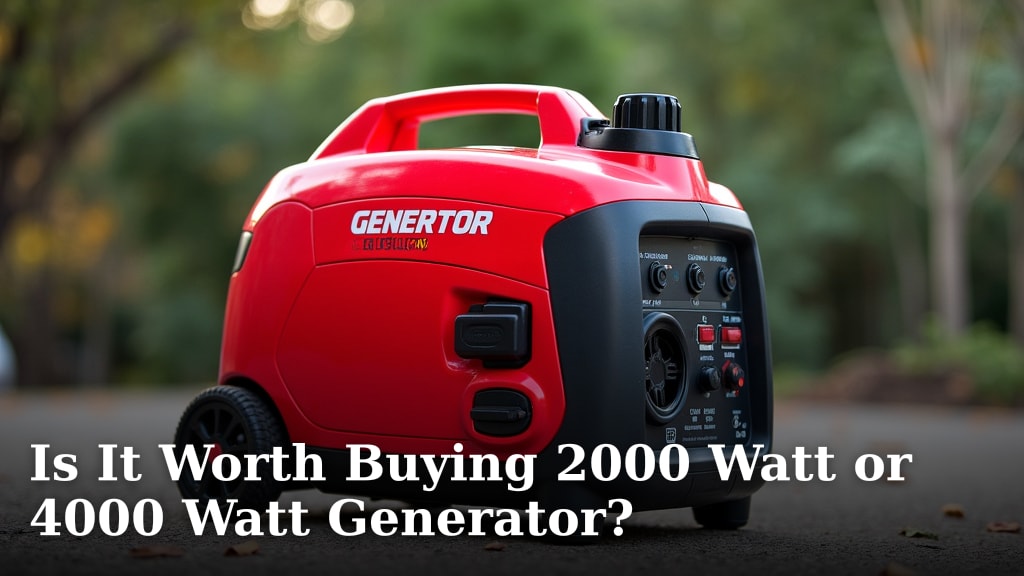
When deciding between a 2000 watt or 4000 watt generator, the 4000-watt model is often the better choice for most homeowners. This is because it offers greater versatility and power, handling more appliances simultaneously during outages or for recreational use.
Choosing the right generator size depends on your specific power needs. A 2000-watt generator might suit basic camping, but a 4000-watt unit offers more practical applications. We found that many people underestimate the power they truly need.
- Most homes need more than 2000 watts.
- 4000-watt generators handle essential appliances better.
- Consider starting watts (surge) versus running watts.
- Portable generators are not for whole-home power.
- Always prioritize safety with generator use.
Let’s dive into the details. We’ll help you figure out exactly which generator size makes the most sense for your life and why.
Choosing Between a 2000W and 4000W Generator: Which is Right for You?
Deciding on the perfect generator size can feel overwhelming. Let’s break down whether a 2000-watt or a 4000-watt model will better meet your needs.
We’ll look at typical uses, what appliances they can power, and the practical differences.
Understanding Generator Watts: Running vs. Starting Power
Before we compare sizes, it’s vital to grasp two key terms: running watts and starting watts.
Running watts (or rated watts) are the continuous power a generator can supply. This is what your appliances use once they’re already on.
Starting watts (or surge watts) are the extra burst of power an appliance needs for a few seconds to get going. Think of your refrigerator or air conditioner kicking on.
Your generator needs to handle both. Always pick a generator with enough starting watts for your largest surge-demand appliance.
What Can a 2000-Watt Generator Power?
A 2000-watt generator is often called a “light-duty” or “camping” generator. It’s compact and portable, making it easy to carry.
You might find these perfect for small outings or very basic backup power.
Typical Uses for a 2000-Watt Generator
- Camping trips: Charging phones, running a small fan, electric cooler, or a few LED lights.
- Tailgating: Powering a TV, slow cooker, or a small speaker system.
- Small DIY projects: Operating a drill or a small saw for a short period.
- Emergency essentials (minimal): Keeping a few lights on, charging devices, or running a small radio during a power outage.
Limitations of a 2000-Watt Generator
While convenient, a 2000-watt generator has significant limitations. You can typically only run one or two major appliances at a time.
For example, you likely couldn’t run a refrigerator and a microwave simultaneously. It simply doesn’t have the muscle for it.
You’ll often need to manage your power carefully, deciding which essential item gets power at any given moment.
What Can a 4000-Watt Generator Power?
A 4000-watt generator offers double the power output of a 2000-watt model. This extra capacity opens up many more possibilities.
These generators are still portable, though a bit heavier and larger than their 2000-watt cousins.
Typical Uses for a 4000-Watt Generator
- Home backup (essential circuits): Running a refrigerator, lights, a TV, and perhaps a small window AC unit or a space heater.
- RV camping: Powering your RV’s microwave, air conditioner (smaller units), lights, and entertainment systems.
- Job sites: Operating multiple power tools like circular saws, air compressors, or electric hammers.
- Outdoor events: Powering sound systems, lighting, and food preparation equipment.
Advantages of a 4000-Watt Generator
The main advantage is versatility. You won’t have to choose between keeping your food cold and having a fan running.
It provides a much more comfortable experience during outages or recreational activities. We found that most people who start with a 2000-watt generator often wish they had opted for more power later.
Comparing 2000-Watt and 4000-Watt Generators Side-by-Side
Let’s put them head-to-head. This table highlights the key differences you should consider.
| Feature | 2000-Watt Generator | 4000-Watt Generator |
|---|---|---|
| Power Output (Running) | ~1600-1800W | ~3200-3600W |
| Common Uses | Light camping, tailgating, very basic emergencies | RV camping, essential home backup, job sites, outdoor events |
| Appliances Supported | 1-2 small appliances (lights, fan, phone charger) | Refrigerator, lights, TV, microwave, small AC, power tools |
| Portability | Very portable, easy to carry | Portable, but heavier; may have wheels |
| Fuel Consumption | Lower | Higher |
| Price Range | Lower | Higher |
| Noise Level | Often quieter (especially inverter models) | Can be louder (conventional models) |
How to Calculate Your Power Needs Accurately
The best way to choose is to calculate your specific needs. Don’t guess. Take a few minutes to list the appliances you want to run.
Find the running watts and starting watts for each. This information is usually on a label on the appliance itself or in its manual.
Step-by-Step Power Calculation
- List all appliances: Write down everything you might want to power at once.
- Find running watts: Add up the running watts for all these items. This is your baseline.
- Identify highest starting watts: Look at your list for the appliance with the highest starting wattage requirement.
- Add it up: Take your total running watts and add the highest single starting wattage to it. This gives you your total estimated wattage need.
For instance, if your refrigerator needs 600 running watts and 1800 starting watts, and your lights, TV, and fan combine for 400 running watts (with no significant surge), your total would be 400 (other running) + 600 (fridge running) + 1800 (fridge starting) = 2800 watts.
In this example, a 2000-watt generator wouldn’t even start the fridge, let alone run everything else. A 4000-watt generator would likely handle this with ease.
When is a 2000-Watt Generator Sufficient?
You might be happy with a 2000-watt generator if your needs are genuinely minimal.
Consider it if you primarily need to:
- Charge small electronics.
- Run a few lights.
- Power a small fan or a portable cooler.
- Only need it for short camping trips without major appliances.
It’s excellent for situations where portability and quiet operation are your absolute top priorities, and you don’t need much power.
Why a 4000-Watt Generator is Often the Better Value
Many experts, and our own research, show that a 4000-watt generator provides a better “bang for your buck” for most homeowners and campers.
You get significantly more power for a relatively small increase in price, size, and weight. It offers a buffer for unexpected needs or for adding an extra appliance later.
Think of it as future-proofing your power supply. You’ll avoid the frustration of realizing your generator can’t handle a crucial appliance during an outage.
Considerations Beyond Wattage: Fuel, Noise, and Type
Wattage isn’t the only factor. You also need to think about fuel type, noise, and whether you need an inverter generator.
Fuel Type: Gasoline vs. Propane (Dual Fuel)
Most portable generators run on gasoline. Dual-fuel models can use either gasoline or propane.
- Gasoline: Readily available, but has a shorter shelf life and can be harder to store safely.
- Propane: Burns cleaner, stores almost indefinitely, and is easier to handle. However, it can be less efficient and may have slightly lower power output.
Noise Level: Conventional vs. Inverter Generators
This is a big one, especially if you’re camping or have close neighbors.
- Conventional Generators: Tend to be louder. They run at a constant engine speed.
- Inverter Generators: Often much quieter. They adjust engine speed to match the power demand, saving fuel and reducing noise (Consumer Reports).
Most 2000-watt generators are inverter models, which contributes to their popularity for camping. Many 4000-watt models are also inverters, but some are conventional, so always check.
Safety First: Generator Placement and Usage
No matter which generator you choose, safety is non-negotiable. Carbon monoxide poisoning is a serious risk.
Always operate generators outdoors, far from windows and doors. Never run them in a garage, even with the door open. The CDC offers clear guidelines on generator safety.
Make sure you have working carbon monoxide detectors in your home.
Your Generator Checklist
Before you make a purchase, run through these quick points:
- Have you calculated your exact power needs?
- Does the generator have enough starting watts for your biggest appliance?
- Is the noise level acceptable for your intended use?
- Do you prefer gasoline, propane, or dual fuel?
- Is it easy enough to transport for your purposes?
- Do you have a safe, outdoor place to operate it?
By answering these questions, you’ll be well-equipped to choose the generator that truly fits your lifestyle.
Conclusion
Choosing between a 2000-watt and a 4000-watt generator boils down to your specific needs, but for most homeowners, the 4000-watt model offers far more practical benefits. It provides the versatility to power essential appliances comfortably during an outage or enjoy more amenities while camping. Our research shows that few regret having more power, but many wish they had invested in a larger unit.
By carefully calculating your wattage requirements and considering factors like noise and fuel, you can make an informed choice. Prioritize safety, always operate your generator outdoors, and you’ll be well-prepared for any power challenge that comes your way.
Frequently Asked Questions
Is a 4000-watt generator considered loud?
The noise level of a 4000-watt generator can vary. Many modern 4000-watt inverter generators are surprisingly quiet, often running at around 58-65 decibels, similar to a normal conversation. Conventional models tend to be louder, so always check the decibel rating before you buy.
Can a 4000-watt generator run a whole house?
No, a 4000-watt generator is generally not powerful enough to run an entire house, especially one with central air conditioning or electric heating. It’s designed for powering essential circuits like a refrigerator, lights, a TV, and perhaps a small window AC unit or a few power tools. For whole-home power, you would typically need a much larger standby generator.
How long can a 4000-watt generator run on a tank of gas?
The run time for a 4000-watt generator depends on its fuel tank size and the load it’s carrying. On average, a 4-gallon tank might provide 8-12 hours of run time at a 25% load, but this decreases significantly as you add more appliances. Always check the manufacturer’s specifications for exact run times.
Are 2000-watt generators generally more fuel-efficient?
Yes, 2000-watt generators typically consume less fuel than 4000-watt generators. This is because they have smaller engines and are designed for lighter loads. If fuel economy for very minimal power needs is your top priority, a 2000-watt unit will often be more efficient per hour of operation.
What maintenance does a 4000-watt generator need?
A 4000-watt generator requires regular maintenance similar to a car engine. This includes checking and changing the oil, inspecting and cleaning or replacing the air filter, checking the spark plug, and ensuring the fuel system is clean. It’s also important to run it periodically (e.g., once a month) to keep components lubricated and ensure it starts when needed.
