8 Best Champion Generators with Electric Start (November 2026)
The best champion generator with electric start include the WEN for transfer switch backup, the WEN Quiet and Lightweight 4800-Watt Dual Fuel for quiet RV camping, and the Champion 4500-Watt Electric Start Dual Fuel Portable (best champion pick for rv use).
On this page (10 sections)
- Champion generator with electric start models by power level
- Electric start Champion generator comparison by output
- How we compared these electric start generators
- Is electric start better than recoil start?
- What size generator do you need for home backup?
- Champion dual fuel vs tri fuel: which fuel should you pick?
- Inverter vs open frame: which type fits your use?
- How do you set up and care for an electric start generator?
- What outlets and features matter most?
- Verdict: which electric start generator should you buy?
The best Champion generator electric start choice for most buyers is the Champion 4500-Watt Electric Start Dual Fuel Portable, because it combines battery powered starting with quiet inverter output and long runtime. Champion electric start generator models in this list cover portable, RV and home backup use, with some models offering tri fuel choice for natural gas.
Electric start matters when you need power fast. You turn a key or press a button instead of pulling a recoil cord, and that helps during an outage or at a campsite.
Our score weighs specs, features and buyer feedback against what you are shopping for.
Compare the best champion portable generators if you want more Champion options beyond electric start models. For fuel choice, see our best champion generator tri fuel guide for models that also run on natural gas.
Our picks at a glance
-
1

-
2
 Best for quiet RV camping
WEN Quiet and Lightweight 4800-Watt Dual Fuel
9.6/10 our score
See it on Amazon -
3
 Best Champion pick for RV use
Champion 4500-Watt Electric Start Dual Fuel Portable
9.2/10 our score
See it on Amazon
- 4
 Check it
Westinghouse 4000 Peak Watt Super Quiet Dual
Best for remote start convenience - 5
 Check it
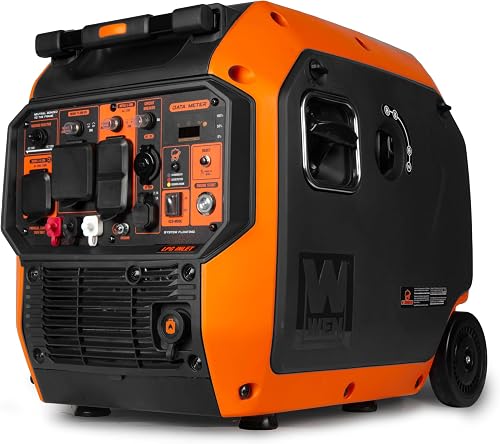
WEN 6800-Watt Dual Fuel RV-Ready Electric Start
Best for EV and RV charging - 6
 Check it
Westinghouse 4650 Peak Watt Dual Fuel Portable
Best for remote start on a budget - 7
 Best for whole home backupCheck it
- 8
 Check it
Champion 5000-Watt Electric Start Tri Fuel Portable
Best for three fuel flexibility
Champion generator with electric start models by power level
These picks range from a compact 3,300 rated watt inverter to a 12,000 running watt home backup unit. A champion generator with electric start in the 4,000 to 5,000 watt range covers most RV and home essentials, while the largest model suits whole house loads.
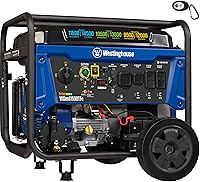
WEN: Best for transfer switch backup
- 4,750 surge watts on gasoline, 3,800 running watts
- 4,350 surge watts on propane, 3,500 running watts
- Electric start, 224cc engine, 4-gallon tank
- 120V/240V selector, L14-30R outlet, wheel kit
A 120V/240V dual fuel generator with electric start, a 4-gallon tank, and transfer switch ready outlets for emergency backup.
Pros
- 120V/240V voltage selector
- Electric start with key
- Up to 11 hours at half load
Cons
- 105.8 lb weight
- Propane output is lower than gasoline
This WEN model suits buyers who need 240V power for a transfer switch. It gives 4,750 surge watts and 3,800 running watts on gasoline, with 4,350 surge and 3,500 running watts on propane.
The voltage selector switches between 120V and 240V, which helps with emergency backup.
Electric start powers the 224cc engine with a key turn. A 4-gallon tank gives up to 11 hours at half load on gasoline.
Included outlets are two 120V GFCI outlets, a NEMA 30A twist lock, and a 12V DC plug. A 47-inch LPG hose and wheel kit are included.
The trade-off is weight at 105.8 lb and lower output on propane. It is a strong value pick for home backup, but it is not a quiet inverter for close camping.
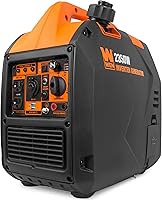
WEN Quiet and Lightweight 4800-Watt Dual Fuel: Best for quiet RV camping
- 4,800 surge watts, 4,000 rated watts on gasoline
- 4,320 surge watts on propane
- Clean inverter power, 62 dB at quarter load
- CO Watchdog, fuel shut off, RV TT-30R outlet
A lightweight inverter generator with clean power for sensitive electronics and quiet operation for camping and residential use.
Pros
- 78.5 lb weight
- Clean power for electronics
- CO Watchdog shutdown
Cons
- Smaller fuel capacity than open frame models
- Inverter output limits heavy motor loads
This WEN inverter suits RV and campsite use where quiet power matters. It gives 4,800 surge watts and 4,000 rated watts on gasoline, and 4,320 surge watts on propane.
WEN says operation compares to a normal conversation, at 62 decibels at quarter load.
Clean power helps protect phones, tablets and laptops. The CO Watchdog shuts the unit off if carbon monoxide reaches dangerous levels.
Fuel shut off helps limit maintenance by using remaining carburetor fuel before shutdown.
At 78.5 lb, it is lighter than most open frame models here. The trade-off is a smaller tank and inverter limits on heavy motor starting loads.
Choose it for quiet, clean power over maximum whole house output.
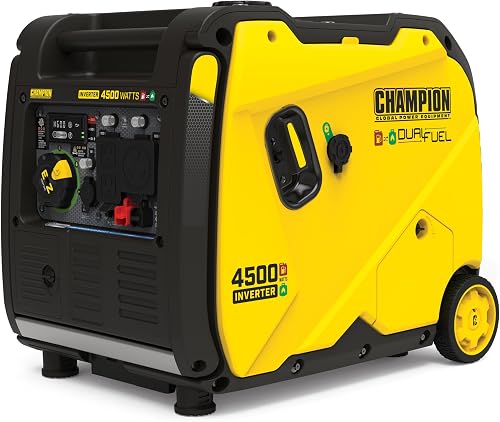
Champion 4500-Watt Electric Start Dual Fuel Portable: Best Champion pick for RV use
- 4,500 starting watts, 3,500 running watts on gasoline
- 3,150 running watts on propane
- 61 dBA, up to 14 hours on gasoline, 21 hours on propane
- CO Shield, Intelligauge, parallel ready
A quiet Champion inverter with EZ Start Dial, CO Shield, and extended runtime that suits RV, tailgating and camping.
Pros
- 61 dBA quiet operation
- Long propane runtime
- Parallel ready with optional kit
Cons
- 99.2 lb weight
- Parallel kit sold separately
This Champion inverter is the core pick for Champion buyers. It gives 4,500 starting watts and 3,500 running watts on gasoline, and 3,150 running watts on propane.
Champion says noise is 61 dBA from 23 feet, which suits RV and tailgating use.
Runtime is a key strength. It runs up to 14 hours on gasoline and up to 21 hours on a 20-pound propane tank at 25% load.
The EZ Start Dial simplifies startup, and Intelligauge shows voltage, frequency and hours.
CO Shield provides carbon monoxide auto shutoff. The trade-off is 99.2 lb weight and a separate parallel kit if you want more output.
For a Champion electric start generator for camping and essentials, it hits a strong balance.
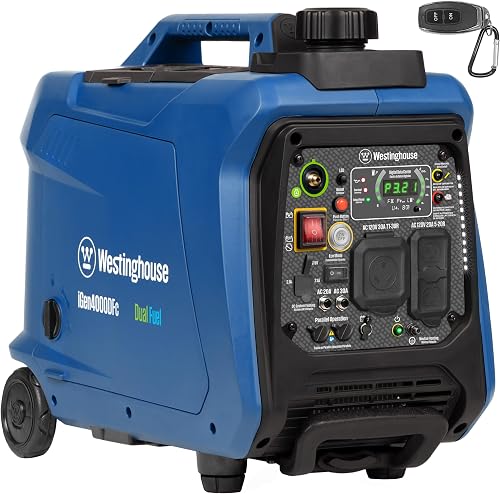
Westinghouse 4000 Peak Watt Super Quiet Dual: Best for remote start convenience
- 4,000 peak watts, 3,300 rated watts
- As low as 52 dBA, up to 7 hours on 1.69-gallon tank
- Remote electric start with key fob
- CO sensor, LED data center, parallel capable
A compact remote start inverter with a digital display, economy mode, and clean power under 3% THD for travel and home use.
Pros
- 62.8 lb lightweight design
- Remote start included
- Digital display for fuel and output
Cons
- 7 hour runtime is shorter than larger models
- Lower rated watts than 4,500 watt picks
This Westinghouse inverter suits buyers who want remote start. It gives 4,000 peak watts and 3,300 rated watts, with clean power at less than 3% THD.
Remote start uses an included key fob, plus push button electric start and recoil start.
Noise is as low as 52 dBA, and runtime is up to 7 hours on a 1.69-gallon gas tank. Economy mode helps fuel efficiency by matching engine speed to load.
An LED data center shows fuel level, output, runtime, voltage and lifetime hours.
At 62.8 lb, it is the lightest inverter here. The trade-off is shorter runtime and lower rated watts than the 4,500 watt Champion.
Choose it for portability and remote start, not for long overnight runs.
WEN 6800-Watt Dual Fuel RV-Ready Electric Start: Best for EV and RV charging
- 6,800 surge watts, 5,100 rated watts on gasoline
- 6,000 surge watts, 4,500 rated watts on propane
- 240V bonded neutral for low power Level 2 EV charging
- CO Watchdog, fuel shut off, L14-30R and TT-30R outlets
A high output inverter generator with 240V output for RV power and electric vehicle backup, plus clean power for electronics.
Pros
- Highest rated watts in this group
- 240V for EV charging
- Clean power under 1.2% THD at full load
Cons
- 99.2 lb weight
- 64 dB is louder than quieter inverters
This WEN inverter suits RV owners and electric vehicle owners. It gives 6,800 surge watts and 5,100 rated watts on gasoline, the highest rated output in this group.
On propane, it gives 6,000 surge and 4,500 rated watts.
The bonded neutral 240V configuration supports low power Level 2 charging for battery and hybrid vehicles. Clean power at under 1.2% THD at full load helps with sensitive electronics.
The CO Watchdog and fuel shut off add safety and maintenance benefits.
At 99.2 lb, it is portable but not light. Noise is 64 decibels at quarter load, so it is louder than quieter inverters.
Choose it for high output and 240V charging over quietest camping use.
Westinghouse 4650 Peak Watt Dual Fuel Portable: Best for remote start on a budget
- 4,650 peak watts, 3,600 rated watts on gasoline
- 3,240 rated watts on propane
- 4-gallon tank, up to 14 hours on gasoline
- Remote electric start with auto choke, RV ready 30A outlet
An open frame dual fuel generator with remote start, a 4-gallon tank, and RV ready outlets for home backup and travel trailers.
Pros
- Long 14 hour gasoline runtime
- Remote start with key fob
- Dual fuel switching without shutdown
Cons
- 121.1 lb weight
- Open frame is louder than inverter models
This Westinghouse open frame model suits home backup on a budget. It gives 4,650 peak watts and 3,600 rated watts on gasoline, and 3,240 rated watts on propane.
A 4-gallon tank runs up to 14 hours on gasoline.
Remote electric start with auto choke makes startup easier. It includes a key fob, an RV ready TT-30R 30A outlet, a 5-20R duplex outlet, and an L5-30R outlet.
Dual fuel switching works without shutting off the unit.
At 121.1 lb, it is heavy and open frame noise will be higher than inverter picks. The trade-off is worth it if you want long runtime and remote start for less money.
It suits garage and home use more than quiet campsites.
Champion Power Equipment: Best for whole home backup
- 15,000 starting watts, 12,000 running watts on gasoline
- 12,500 starting watts on natural gas, 13,750 on propane
- 717cc V-Twin engine, electric start, CO Shield
- Up to 9 hours on gasoline, natural gas and propane hoses included
A large tri fuel home backup generator with a 717cc V-Twin engine and battery included electric start for whole house power.
Pros
- 12,000 running watts
- Tri fuel flexibility
- Natural gas hose included
Cons
- 331 lb weight
- 78 dBA noise level
This Champion tri fuel model suits whole home backup. It gives 15,000 starting watts and 12,000 running watts on gasoline, with 13,750 starting watts on propane and 12,500 on natural gas.
That output can run many home circuits through a transfer switch.
The 717cc Milwaukee Series V-Twin engine uses battery included electric start with a toggle switch. CO Shield adds carbon monoxide auto shutoff.
Natural gas and propane hoses are included, so it can run on any fuel right out of the box.
Runtime is up to 9 hours on gasoline. The trade-off is size at 331 lb and 78 dBA noise.
It is a fixed home backup choice, not a portable camping generator. Choose it for capacity and fuel flexibility.
Champion 5000-Watt Electric Start Tri Fuel Portable: Best for three fuel flexibility
- 5,000 starting watts, 4,000 running watts on gasoline
- 4,500 starting watts on propane, 4,050 on natural gas
- 224cc engine, electric start with battery included
- Up to 14 hours at 50% load on gasoline, Intelligauge
A portable tri fuel generator with electric start and included hoses, so you can run on gasoline, propane or natural gas.
Pros
- Three fuel options
- Hoses included for propane and natural gas
- Cold start technology
Cons
- 135 lb weight
- Lower output on natural gas
This Champion tri fuel model suits buyers who want three fuel options in a portable size. It gives 5,000 starting watts and 4,000 running watts on gasoline, with 4,500 starting watts on propane and 4,050 on natural gas.
Electric start uses a rocker switch with battery included. Cold Start Technology helps with cold weather starts.
Intelligauge tracks voltage, frequency, session runtime and total runtime, and a CO sensor uses an LED to show shutoff or fault.
Runtime is up to 14 hours at 50% load on gasoline and 10.5 hours on propane. At 135 lb, it is heavy for frequent transport.
The output drops on natural gas, so plan loads for that fuel. It is best for home backup with natural gas access.
Electric start Champion generator comparison by output
The Champion 4500-Watt model leads Champion picks at 3,500 running watts, while the tri fuel Champion 5000-Watt model gives 4,000 running watts on gasoline. The large Champion home backup model gives 12,000 running watts for whole house use.
| Product | Best for | Surge Watts | Running Watts | Fuel | Our score |
|---|---|---|---|---|---|
| WEN | transfer switch backup | 4,750 on gasoline | 3,800 on gasoline | Gasoline, LPG | 9.7 |
| WEN Quiet and Lightweight 4800-Watt Dual Fuel | quiet RV camping | 4,800 on gasoline | 4,000 rated watts | Gasoline, LPG | 9.6 |
| Champion 4500-Watt Electric Start Dual Fuel Portable | Champion pick for RV use | 3,500 on gasoline | Gasoline, propane | 9.2 | |
| Westinghouse 4000 Peak Watt Super Quiet Dual | remote start convenience | Gasoline, LPG | 8.9 | ||
| WEN 6800-Watt Dual Fuel RV-Ready Electric Start | EV and RV charging | 6,800 on gasoline | Gasoline, LPG | 8.7 | |
| Westinghouse 4650 Peak Watt Dual Fuel Portable | remote start on a budget | Gasoline, LPG | 8.6 | ||
| Champion Power Equipment | whole home backup | 12,000 on gasoline | Gasoline, propane, natural gas | 8.6 | |
| Champion 5000-Watt Electric Start Tri Fuel Portable | three fuel flexibility | 4,000 on gasoline | Natural gas, propane, gasoline | 8.5 |
How we compared these electric start generators
We compared specs, features and buyer feedback for each model. We looked at surge watts, running watts, fuel options, runtime, noise, weight and outlet types.
We checked which models are Champion brand and which are other brands with electric start. This roundup is about the best champion generator electric start search, so Champion models are featured, but other brands help you compare value.
We used maker data for power, runtime and noise claims. We did not test units hands on, and we label claims by brand where it helps.
Scores reflect how well each model fits electric start shopping. A high score means strong specs for key uses like RV power, home backup and portable work.
Is electric start better than recoil start?
Electric start is better if you start often, need fast power, or cannot pull a recoil cord easily. It also helps when the generator sits in a tight space or you start it while wearing gloves.
Recoil start is simpler and does not depend on a battery. A recoil backup is still useful on many electric start models if the battery runs low.
Read our guide on Which Is Better Electric Start or Recoil Start Generator? before you decide. It explains battery care, cold weather starts and backup options.
When electric start helps most
Electric start helps during outages, at campsites and in cold weather. You can start from a button or key instead of repeated pulls.
It also helps older buyers or anyone with limited arm strength. That ease of use can make you more likely to run the generator when you need it.
When recoil start may be enough
Recoil start may be enough for occasional job site use where the unit sits in open space. It avoids battery upkeep and adds less weight.
If you choose electric start, check the battery in fall and spring. A weak battery is the most common reason electric start fails.
What size generator do you need for home backup?
An electric start dual fuel generator for freezers and essentials usually needs 3,500 to 4,000 running watts. That covers a refrigerator, lights, phones, a TV and a sump pump in many homes.
Add surge watts for motors. A refrigerator or sump pump may need extra power at startup, so check the running watts, not just surge watts.
See our Best Electric Start Dual Fuel Generator For Freezers guide if food storage during an outage is your main concern. It helps you size loads for refrigeration.
Small home or apartment backup
A 3,300 to 4,000 rated watt inverter covers essentials for a small home. It runs lights, a refrigerator and small electronics for several hours.
Choose quieter inverter models if neighbors are close. The Westinghouse 52 dBA model and the Champion 61 dBA model are strong options here.
Whole home backup
Whole home backup needs 5,100 rated watts or more, and the 12,000 running watt Champion is the only true whole house pick here. Use a transfer switch for hardwired home circuits.
Never backfeed a home panel without a transfer switch. That can hurt utility workers and damage your equipment.
Champion dual fuel vs tri fuel: which fuel should you pick?
Dual fuel gives you gasoline and propane choice, while tri fuel adds natural gas for home backup. Propane is clean burning and stores well, while gasoline is widely available during storms.
Natural gas is useful if your home already has a gas line. The Champion tri fuel models include hoses, so you can connect without buying extra parts.
Our best champion generator tri fuel guide covers tri fuel models in more detail. It compares output on each fuel and runtime.
Gasoline for maximum output
Gasoline gives the highest watts on most models here. The WEN 4,750 watt model and Champion 5,000 watt model both peak on gasoline.
The downside is fuel storage. Gasoline can go stale, so rotate fuel and use stabilizer if you store it for months.
Propane for storage and runtime
Propane gives lower watts but longer propane runtime on some models. The Champion 4500-Watt inverter runs up to 21 hours on propane.
Propane tanks also store well for emergency use. Check that your tank valve and hose fit your model before an outage.
Natural gas for home backup
Natural gas gives the lowest watts, but it runs as long as your home supply lasts. That removes refueling during a long outage.
The Champion 5000-Watt tri fuel model drops to 3,240 running watts on natural gas. Plan your essential loads for that lower number.
Inverter vs open frame: which type fits your use?
Inverter generators are better for RV, camping and sensitive electronics, while open frame models give more watts per dollar. Inverters run quieter and produce cleaner power.
Open frame models like the Westinghouse 4,650 peak watt pick give long runtime and strong output. They suit home backup and job sites where noise matters less.
Check champion 4000 watt generator reviews if you are comparing in the 4,000 watt class. It helps you weigh inverter vs open frame trade-offs.
Quiet power for camping
Inverter models at 52 to 64 decibels suit campsites and RV parks. They also work better near your home during an outage.
Clean power under 3% THD helps protect laptops and phones. Most inverter picks here meet that standard.
Strong power for tools and home loads
Open frame and large home backup models give higher surge watts for tools and motors. They handle air compressors and power tools better.
The trade-off is noise and weight. Plan for placement away from sleeping areas and keep exhaust away from windows.
How do you set up and care for an electric start generator?
Set up an electric start generator outdoors, check oil, connect fuel, charge the battery, then start and let it warm up. Place it on level ground with exhaust pointing away from people.
Use the included oil and funnel on first setup. Check oil before each run, and keep the unit dry and ventilated.
Battery care for electric start
Charge the battery before storage and every few months if you store the unit. A battery left discharged for months may not hold a charge.
Keep the battery terminals clean and dry. If starting gets slow, charge it before you need it in an outage.
Fuel and oil checks
Use fresh fuel and check oil level before each use. Low oil shutoff will stop many models, but it is better to check yourself.
Run the generator for a few minutes every month or two. That helps keep seals moist and the battery charged.
Safe placement and cords
Never run a generator indoors or in a closed garage. Carbon monoxide is colorless and odorless, and CO Shield or CO Watchdog only helps as a backup.
Use outdoor rated cords and keep connections dry. Plug heavy loads directly into the generator when possible.
What outlets and features matter most?
RV ready TT-30R outlets, 120V household outlets and 240V twist lock outlets matter most for different uses. Match the outlet to your RV, transfer switch or tools before you buy.
USB ports and 12V DC outlets help charge phones and small devices. They are useful at campsites but do not replace household outlets.
Look for a fuel gauge, Intelligauge or LED display. Those help you track runtime and plan refueling.
Check remote start if you want it. Our best champion generator remote start guide covers remote start models, including Westinghouse picks here.
For RV and travel trailer use
Choose a model with a TT-30R RV outlet for travel trailers. Inverter models with clean power are best for RV air conditioners and electronics.
The Champion 4500-Watt inverter and WEN 4800-Watt inverter both fit RV use well. Check your RV power needs in amps before you choose.
For transfer switch home backup
Choose a model with 120V/240V output and an L14-30R outlet for a transfer switch. The WEN 4,750 watt model and WEN 6,800 watt model fit that need.
A transfer switch lets you power selected home circuits safely. An electrician should install it, and you should size loads before you buy.
Verdict: which electric start generator should you buy?
Buy the Champion 4500-Watt Electric Start Dual Fuel Portable if you want the best Champion generator electric start balance of quiet power and runtime. It suits RV, camping and home essentials.
Choose the Champion 5000-Watt Electric Start Tri Fuel Portable if you want natural gas, propane and gasoline choice for home backup. Choose the Champion Power Equipment 15,000-Watt model for whole home backup.
Choose the WEN 4,750-Watt Dual Fuel Portable for transfer switch backup at a lower cost. Choose the WEN Quiet and Lightweight 4800-Watt Dual Fuel for quiet RV camping.
Choose the Westinghouse 4000 Peak Watt Super Quiet Dual for remote start and light weight.
For a freezer focused setup, check our Best Electric Start Dual Fuel Generator For Freezers guide next. It helps you plan running watts for refrigeration during an outage.
Our top 3 picks at a glance
-
1
-
2
Best for quiet RV camping
WEN Quiet and Lightweight 4800-Watt Dual Fuel
9.6/10 our score
See it on Amazon -
3
Best Champion pick for RV use
Champion 4500-Watt Electric Start Dual Fuel Portable
9.2/10 our score
See it on Amazon
Frequently asked questions
Is electric start worth it on a portable generator?
Electric start is worth it if you start the generator often or need quick power during an outage. It removes the pull cord effort and helps when the unit sits in a tight spot.
Check that the battery stays charged on models you plan to store for months.
Can I run a dual fuel generator on propane instead of gasoline?
Yes, dual fuel models in this roundup run on gasoline or propane. Propane usually gives lower running watts, so check the propane rating before you plan loads.
Use the included hose and follow the fuel select steps for your model.
What size Champion generator do I need for home backup?
A 4,500 to 5,000 watt model covers essentials like lights, a refrigerator and small tools. A 12,000 running watt model suits whole home backup with larger loads.
Add up running watts for each item, then allow extra surge watts for motors.
Are inverter generators better for RV camping?
Inverter generators produce cleaner power and run quieter, which suits RV air conditioners and sensitive electronics. They also tend to be lighter than open frame models with similar output.
Check the RV outlet type and total rated watts before you buy.