Portable Diesel Generators: How to Choose the Right Size
Choose a portable diesel generator by its starting watts, expected runtime and transport needs. Add the running watts of the equipment you’ll power, then allow for the largest motor’s startup demand.
On this page (7 sections)
- How do you size a portable diesel generator?
- How much runtime do you need?
- What makes a portable generator easy to move?
- Which fuel and outlets fit your setup?
- Which portable generator size fits your use?
- What should you check before buying a portable diesel generator?
- How do you choose the right portable diesel generator size?
Choose a portable diesel generator by the load you need to start and run, the hours you need power, and the weight and space you can manage. Add the running watts of equipment used at the same time, then check whether the generator’s peak rating covers startup surges.
This guide explains how to estimate capacity and compare runtime, fuel, outlets and portability. The example products below are gasoline or dual-fuel models, not diesel generators, so use them to understand sizing trade-offs rather than as diesel recommendations.
How do you size a portable diesel generator?
Choose capacity by adding the running watts for simultaneous loads and checking the startup watts of motor-driven equipment. The generator must meet both the continuous demand and the largest startup surge.
Make a list of the appliances and tools you expect to use together. Find each item’s running and starting wattage in its manual or on its label.
Add the running watts, then compare the highest startup requirement with the generator’s peak rating.
| Load-planning step | What to check |
|---|---|
| Choose essential equipment | Include only items you expect to use at the same time |
| Add running demand | Total the watts each item needs while operating |
| Check startup surges | Identify the highest motor or compressor startup demand |
| Match generator ratings | Running watts must cover the steady load; peak watts must cover startup |
| Leave room for changes | Avoid planning to operate at the generator’s full capacity continuously |
Starting demand varies by equipment, so don’t assume every refrigerator, pump or air conditioner has the same surge. If the manufacturer doesn’t publish a figure, check its manual or ask the maker before choosing a generator.
A larger peak number doesn’t mean the generator can provide that output continuously. Compare running watts first, then use peak watts to assess brief startup needs.
What running watts do portable diesel generators need?
Portable diesel generator capacity should cover the running watts of the equipment you’ll operate together. For example, if your planned simultaneous load adds up to 2,800 running watts, compare models with a running rating above that amount and enough peak output for startup.
Write down the actual equipment and its wattage instead of using a household-size estimate. A home running a refrigerator, lights and a sump pump has a different load from an RV running an air conditioner and kitchen appliances.
Leave headroom for loads that may start while other equipment is already running. If you can stagger use, such as switching off a kettle before starting a compressor, your required capacity may be lower.
How much runtime do you need?
Choose runtime based on how long you need power between refueling stops and the load at which the runtime figure applies. A tank size alone does not tell you how many hours the generator will run.
Check the stated runtime and the load percentage or conditions tied to it. For example, one product below gives a runtime of up to 14 hours per tank, while the Oxseryn describes up to 14 hours at 25% load with ECO mode.
Those figures aren’t directly comparable because the stated conditions differ.
Plan extra fuel for longer outages or remote trips, and follow the generator maker’s storage and handling instructions. Your actual runtime can change with the equipment connected and how much power it draws.
The Westinghouse 12500 Watt Dual Fuel Home Backup runs on gasoline or propane. Its stated output is 9,500 running watts and 12,500 peak watts on gasoline, or 8,500 running watts and 11,200 peak watts on propane.
Those ratings make it an example for buyers comparing a larger home-backup load. It is a heavy-duty open-frame generator, so check its dimensions, movement plan and fuel storage needs before choosing a similar size.
What makes a portable generator easy to move?
A generator is portable only if you can move it safely along your actual route. Check its weight, dimensions, handles, wheels and the number of people needed to load it.
For an RV or jobsite, account for the path from storage to use, not only the vehicle’s cargo capacity. Measure doorways, storage bays and ramps, then compare those spaces with the generator’s dimensions.
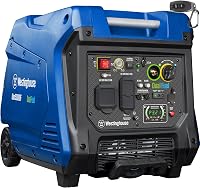
The Westinghouse 4650 Peak Watt Portable Generator has 3,600 running watts and 4,650 peak watts. For a nearby higher-output class, compare 5,000-watt portable generators.
Its listed outlets include a TT-30R RV-ready 30A receptacle, an L5-30R 30A receptacle and household duplex outlets.
It has a 4-gallon tank and a stated runtime of up to 14 hours per tank. The weight is 100.6 lb, so include loading help and secure storage in your RV plan.
For a lighter example, the Oxseryn Power Equipment 4400 Watts Inverter Generator weighs 56 lb and provides 3,400 running watts and 4,400 peak watts. To compare inverter brands and their support, see inverter generator brand guidance.
It uses gasoline, has a 2-gallon tank, and its stated runtime is up to 14 hours at 25% load with ECO mode.
The Oxseryn’s weight may make it easier to handle than a heavier open-frame unit, but portability still depends on your storage space and lifting ability. Check the dimensions and carry method before deciding.
Which fuel and outlets fit your setup?
Choose a fuel type you can store, transport and obtain where you’ll use the generator. Also confirm that the generator’s outlet matches the equipment or transfer setup you plan to power.
Diesel, gasoline and propane have different handling and storage requirements. If you want a portable generator that also runs on natural gas, compare tri-fuel portable generators.
Follow the generator manual and fuel-container rules for your location.
Don’t assume a dual-fuel gasoline and propane model can run on diesel.
The Westinghouse 12500 Watt Dual Fuel Home Backup uses gasoline or propane and includes a transfer-switch-ready L14-30R outlet and an RV-ready 120/240V 14-50R outlet. That makes it an example of how fuel options and outlet types can shape a home-backup plan.
Before buying, list the plugs your equipment needs and check voltage and amperage. A matching outlet does not guarantee that the generator can safely power every connected load at once.
If you’re weighing different fuel choices, read What Is a Dual Fuel Generator and How Does It Work? and What Is a Dual Fuel Generator Used For?. For propane setups, see how to choose propane tank size for a generator and what you need to choose propane tank size for a generator.
For gasoline alternatives, compare the best gas powered generator guide and the best fuel injected generator guide.
Which portable generator size fits your use?
The right size depends on your actual load and transport limits, not the fuel name alone. For smaller power needs, compare 2000-watt portable generators.
These examples show how wattage and weight can differ across portable generator classes.
| Example | Running watts | Peak watts | Fuel | Weight |
|---|---|---|---|---|
| Westinghouse 12500 Watt Dual Fuel Home Backup | 9,500 on gasoline; 8,500 on propane | 12,500 on gasoline; 11,200 on propane | Gasoline or propane | Not specified here |
| Westinghouse 4650 Peak Watt Portable Generator | 3,600 | 4,650 | Gasoline | 100.6 lb |
| Oxseryn Power Equipment 4400 Watts Inverter Generator | 3,400 | 4,400 | Gasoline | 56 lb |
These products are not diesel models. They help illustrate how to compare output, fuel and carrying weight, but diesel options should be checked against their own manuals and specifications.
What should you check before buying a portable diesel generator?
Check ratings, outlets, runtime conditions, dimensions and support details before you buy. A generator that meets the wattage target can still be a poor fit if it won’t fit your space or connect to your equipment.
Use this checklist:
- Confirm running watts cover the loads you’ll use together.
- Confirm peak watts cover the largest startup surge.
- Check the exact fuel type and runtime conditions.
- Match outlet voltage, amperage and plug type to your equipment.
- Measure storage, transport and operating clearances.
- Check the manual for maintenance, grounding and safe operating instructions.
- Plan outdoor operation and carbon monoxide protection.
A CO sensor or automatic shutdown can be an added feature, but it does not make indoor operation safe. Follow the manufacturer’s placement instructions and keep the generator outdoors.
How do you choose the right portable diesel generator size?
Choose a portable diesel generator by matching its running output to your steady load, its peak output to startup demand, and its weight to your transport plan. Pick a smaller unit when the load is limited and easy movement matters; choose more capacity when your calculated simultaneous demand requires it.
Use the gasoline and dual-fuel examples here only to compare sizing trade-offs. To compare other fuel setups, start with our guides to dual-fuel generator uses and gas-powered portable generators.
Frequently asked questions
How do I size a portable diesel generator?
List the equipment you plan to run at the same time, add its running watts, then account for the largest startup demand. Compare that total with a generator’s running and peak ratings.
Also check outlet types, runtime at a stated load, fuel access and whether you can move the unit safely.
Are portable diesel generators good for RVs?
They can suit RV use when the generator’s running output, peak output and outlet match the RV’s needs. Check the RV air conditioner’s startup demand, the generator’s weight and dimensions, and how you will secure and transport it.
A model described as RV ready still needs a compatible cord and load plan.
Is a diesel generator better than a gas generator?
Neither fuel is best for every buyer. Compare the specific models’ output, runtime at a comparable load, fuel availability, maintenance requirements, noise and transport needs.
This guide’s examples use gasoline or gasoline and propane, so they illustrate sizing trade-offs rather than diesel performance.
Can I run a generator in a garage or RV?
No. Run a fuel-powered portable generator outdoors, away from doors, windows and vents, because carbon monoxide can enter enclosed spaces.
Follow the generator manual and local safety guidance, and use a carbon monoxide alarm in occupied spaces.
Never run one inside a home, garage or RV.