What Size Generator Do You Need to Run RV AC?
Most RV air conditioners need a generator with enough starting watts for the compressor and steady running watts for the AC and other loads. A 3,600 to 3,900 running-watt generator suits many 30-amp RV setups, while larger 50-amp RVs may need much more.
On this page (7 sections)
- What size generator do you need to run RV AC?
- How do you calculate RV AC generator size?
- Do 30-amp and 50-amp RVs need different generator sizes?
- Which generator sizes fit these RV AC situations?
- How can you prevent an RV generator overload?
- Should you choose more generator capacity than the AC needs?
- What is the final answer for RV AC generator size?
Most RV air conditioners need a generator with enough peak watts for compressor startup and enough running watts for the AC plus your other loads.
That idea matters more than plug size alone. A 30-amp RV can overload a small generator if the AC starts with a microwave or battery charger.
For many 30-amp RVs, about 3,600 to 3,900 running watts is a useful starting point. It leaves room for one AC, a refrigerator, lights, fans and a charger when loads are managed one at a time.
Larger 50-amp RVs may need substantially more. They often have more circuits, larger appliances or two air conditioners sharing the same supply.
The AC is usually the hardest appliance to start. Its compressor needs a short surge, then settles into a lower steady draw.
Once running, you still need capacity for other equipment that cycles on and off. Those loads use running watts while they operate.
On a hot afternoon, the AC may run almost nonstop while the refrigerator cycles and the charger adds load. Planning for the AC alone can leave you short.
If you are sizing the whole system, begin with our guide to what size generator you need for an RV.
Start by checking the AC label or manual for amps, voltage and starting information. Then list other appliances you expect to use at the same time.
Add those loads and compare the total with the generator running watts. Also check that peak watts can cover the compressor surge.
If spare capacity is small, choose a larger generator or limit simultaneous loads. That trade-off makes RV AC power more reliable.
What size generator do you need to run RV AC?
Choose a generator by comparing starting watts first, then running watts. The compressor can draw a brief surge when the AC starts, so a generator that only matches the air conditioner's normal running demand may still overload.
A practical starting guide looks like this:
| RV air conditioner setup | Generator starting point |
|---|---|
| Smaller AC with few other loads | About 3,000 peak watts, after checking the AC label |
| Common 30-amp RV AC setup | About 4,000 to 5,000 peak watts |
| 30-amp RV with several appliances | More than 4,500 peak watts may be useful |
| Large or multiple AC setup | Often needs a much larger generator and careful load planning |
These are planning ranges, not guarantees. Air conditioner size, compressor condition, ambient heat and the appliances running at the same time all affect the result.
A small AC in a shaded travel trailer may behave very differently from a larger unit in a motorhome on a hot day. Heat makes the compressor work harder and can raise demand during startup.
The generator's running-watt rating matters after startup. Its peak-watt rating only covers short surges, so do not treat the peak number as the amount available for continuous use.
That distinction is easy to miss when shopping. A high peak number can look strong, yet the running watts decide what you can keep on all afternoon.
Check both ratings before you decide. Use peak watts for the compressor surge and running watts for the loads that stay on.
Also check the outlet type. A generator may have enough watts but need an adapter or a different RV-ready connection.
Leave some spare capacity for cycling loads. A refrigerator or charger can start while the AC is already running and push the total higher.
If you are close to the limit, reduce other loads before the AC starts. That simple step can prevent a breaker trip and a warm RV.
Planning ranges help you narrow the choice. Your AC label, manual and real load list should make the final call.
How do you calculate RV AC generator size?
Add the AC's running watts to the other loads you expect to use together, then allow extra capacity for startup. The AC label or manual is the best place to find its electrical requirements.
Use this simple process:
- Find the air conditioner's running amps or watts.
- Check whether the manual gives a separate locked-rotor or starting requirement.
- Convert amps to watts when needed by multiplying volts by amps.
- Add continuous loads such as the refrigerator, battery charger, lights and fans.
- Add appliances you may use at the same time, such as a microwave or coffee maker.
- Compare the total with the generator's running watts.
- Confirm the generator's peak watts can handle the AC compressor startup.
Avoid sizing the generator around one appliance only. A unit that starts the AC may still trip when the microwave, refrigerator and charger operate together.
For a 30-amp RV, our what size generator you need for a 30-amp RV guide covers the connection and load limits in more detail.
Do 30-amp and 50-amp RVs need different generator sizes?
A 30-amp RV usually has a simpler total-load target, while a 50-amp RV can support more electrical demand. The shore-power plug rating does not tell you the exact generator size by itself.
A generator with a 30-amp RV-ready outlet can connect directly to many travel trailers and smaller motorhomes. It may be a good fit when you plan to run one AC and modest additional loads.
A 50-amp RV often has two hot legs and may contain multiple air conditioners or larger appliances. Check how the adapter or transfer equipment distributes power before assuming a generator can run every circuit.
Outlet type matters as much as wattage. A generator may have enough power but lack the RV-ready connection you want.
Compare options in our guide to the best generators with a 50-amp RV plug and our list of the best generators for 50-amp RVs.
Which generator sizes fit these RV AC situations?
The best choice depends on whether you need quiet campsite power, a basic 30-amp hookup or enough output for a larger RV system. These three options show the trade-offs clearly.
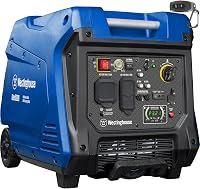
Westinghouse 5000 Peak Watt Super Quiet Portable
The Westinghouse 5000 Peak Watt Super Quiet Portable provides 5,000 peak watts and 3,900 rated watts, with an RV-ready TT-30R 30-amp outlet. That gives a 30-amp RV a direct connection and useful room for one AC plus selected smaller loads.
It uses gasoline and has a 3.4-gallon tank with up to 18 hours of run time, depending on load. The generator also has remote, electric and recoil starting, a telescoping handle, wheels and an LED display that shows fuel level, output, voltage and run time.
The 52 dBA low noise output and economy mode may suit a campsite better than a large open-frame generator. Its 3900 rated watts are the key number for continuous use, while 5000 peak watts provide extra starting capacity.
Westinghouse 12500 Watt Dual Fuel Home Backup
The Westinghouse 12500 Watt Dual Fuel Home Backup is the largest option here, with 9,500 running watts and 12,500 peak watts on gasoline. On propane, it provides 8,500 running watts and 11,200 peak watts.
Its 120/240V 14-50R 50-amp RV-ready outlet suits a larger connection, while the L14-30R 30-amp outlet supports transfer-switch-ready use. Gasoline and propane operation gives you two fuel choices, and the 6.6-gallon tank can run up to 12 hours.
This is an open-frame generator with a 457cc engine and a much larger 27.2 x 26.1 x 26.5 in body. Choose it for capacity and outlet flexibility, not for the smallest campsite footprint.
For another comparison of dual-fuel RV options, see Top 7 Watt Dual Fuel Generator For RV Use. A second related guide is available at Top 7 Watt Dual Fuel Generator For RV Use.
Westinghouse 4650 Peak Watt Portable Generator
The Westinghouse 4650 Peak Watt Portable provides 4,650 peak watts and 3,600 running watts, with an RV-ready TT-30R 30-amp outlet. It can suit a 30-amp RV where the AC and smaller loads are planned carefully.
The gasoline generator has a 4-gallon tank with up to 14 hours of run time. It starts by recoil and includes a fuel gauge, two household duplex outlets and an L5-30R 30-amp outlet.
Its 212cc engine includes automatic low-oil and carbon-monoxide shutdown. At 23.3 x 17.5 x 18.7 in, it is slightly smaller than the 5000-watt inverter option, but it has less running and peak capacity.
How can you prevent an RV generator overload?
Prevent overload by starting with the AC and adding other appliances one at a time. Turn off the microwave, coffee maker, electric water heater or other high-draw item before starting the compressor.
Give the AC a clear path to start. Start it first, let it settle into steady running, then bring other loads online in stages.
Keep the refrigerator and battery charger in your running-load estimate. They may not draw their highest demand continuously, but they still compete for available generator capacity.
A charger can draw a lot after a long drive or a night without shore power. The refrigerator also cycles, and its compressor can add load at an awkward moment.
Use the generator's display or controls to watch output when available. If the breaker trips, reduce the load before restarting the AC instead of repeatedly resetting the breaker.
Repeated resets can hide the real problem. Find which appliance caused the trip, switch it off, then restart in a better order.
Plan your heaviest tasks around the AC cycle. Run the microwave or coffee maker when the AC has settled, not during compressor startup.
Keep a short load list near the generator. Mark what must stay on, what can wait, and what should never start with the AC.
Placement matters as much as load management. Do not run a portable fuel generator inside the RV, under an awning or in an enclosed storage area.
Keep exhaust away from doors, windows and vents, and follow the generator and RV manuals for placement and connection. Good airflow helps the engine run properly and keeps exhaust from drifting toward living space.
Set the generator on level ground with room around it. Keep cords routed so they are not a trip hazard at the campsite.
Check fuel, oil and outlet covers before a long run. A quick check can prevent a shutdown in the middle of a hot day.
If the generator is new, follow the break-in and maintenance steps in the manual. Clean filters, check oil and store fuel safely between trips.
Quiet operation also helps at a campsite. Economy mode or lower load can reduce noise, but do not overload the unit to save fuel.
A calm, staged start is the best habit. It protects the generator, the AC and the rest of your RV power system.
Should you choose more generator capacity than the AC needs?
Choose some spare capacity if you want to run other appliances while the AC runs. A small margin also reduces the chance that a normal startup surge pushes the generator to its limit.
Spare capacity makes daily use easier. You can start the AC without switching off everything else, and cycling loads have room to come on.
It also helps on hot days. The AC may run longer, the refrigerator cycles more often, and chargers work harder after shore power ends.
More capacity also means more weight, fuel use, storage space and noise in many designs. The 12500-watt dual-fuel model offers far more output than a typical single-AC 30-amp setup, but it suits buyers who need that extra power.
That trade-off matters for travel. A larger generator can be harder to lift, load and store, and may need more space in a truck bed or storage bay.
Fuel is another factor. Bigger engines and higher loads can use fuel faster, so longer AC runs may need more refueling stops.
For a basic travel trailer with one AC, a 3,600 to 3,900 running-watt model may be enough after you confirm starting demand. That size can suit a 30-amp RV with a direct TT-30R connection and careful load planning.
For a larger 50-amp RV or multiple heavy loads, move toward a generator with a 50-amp outlet and substantially higher running watts. Outlet access and total capacity both matter then.
Think about how you camp. Weekend trips with one AC differ from full-time use with two AC units, a washer, a dryer or a residential refrigerator.
Also think about storage and noise. A compact inverter-style unit may fit more easily, and a quieter generator may be easier to live with at shared campgrounds.
Choose capacity for the loads you truly run together. Extra watts help only if weight, noise and storage still fit your camping style.
What is the final answer for RV AC generator size?
A generator with about 3,600 to 3,900 running watts and at least 4,650 to 5,000 peak watts is a useful starting range for many 30-amp RV air conditioners.
Choose more capacity when you have a larger AC, more than one AC or several heavy appliances running together. Those setups need higher running watts, not just a higher peak rating.
Pick the Westinghouse 4650 for a straightforward 30-amp gasoline setup. It offers 3,600 running watts, 4,650 peak watts and a TT-30R RV-ready outlet for a direct travel trailer connection.
That model uses recoil start and a 4-gallon tank with up to 14 hours of run time, depending on load. It also includes a fuel gauge, household duplex outlets and an L5-30R outlet.
Its 212cc engine has automatic low-oil and carbon-monoxide shutdown. That can suit buyers who want a simpler generator without remote start or inverter-style quiet operation.
Pick the Westinghouse 5000 for more running capacity and quieter inverter-style operation. It offers 3,900 running watts, 5,000 peak watts and a TT-30R outlet for 30-amp RVs.
It also has remote, electric and recoil starting, wheels and a telescoping handle. The LED display shows fuel level, output, voltage, run time and lifetime hours.
The 52 dBA low noise output and economy mode may suit a campsite better than a large open-frame generator. Its 3.4-gallon tank can run up to 18 hours, depending on load.
Pick the Westinghouse 12500 when a 50-amp RV connection, dual-fuel operation or several simultaneous heavy loads matter most. It offers 9,500 running watts and 12,500 peak watts on gasoline.
On propane, it offers 8,500 running watts and 11,200 peak watts. Its 120/240V 14-50R outlet suits larger RV connections, and the L14-30R outlet supports transfer-switch-ready use.
That dual-fuel model is larger and heavier, so it fits buyers who need capacity more than a compact campsite footprint. For a single AC in a 30-amp RV, the smaller options are usually easier to store and move.
Match the final choice to your AC label, outlet type and load list. That will give you cool air without constant breaker trips.
Frequently asked questions
What size generator do I need to run my RV AC?
Many RV air conditioners can work with a generator in the 3,600 to 3,900 running-watt range, but the correct size depends on the AC's starting demand and what else you run. Add the air conditioner's running watts, allow extra capacity for compressor startup, and leave room for lights, a refrigerator, chargers and other loads.
Can a 3,000-watt generator run an RV air conditioner?
A 3,000-watt generator may run a smaller RV air conditioner if its starting demand is low and other appliances are off, but it leaves little spare capacity. Check the AC label and generator's running and peak watt ratings before relying on that setup.
Do I need a 50-amp generator for a 50-amp RV?
A 50-amp RV does not always need a generator with a 50-amp outlet, but the generator must support the connection and total load you plan to use. A 50-amp outlet can make the hookup simpler, while available running watts determine whether the AC and other appliances can operate together.
How many watts does an RV AC use when starting?
Starting demand is higher than steady running demand because the compressor needs an initial surge. The exact figure varies by air conditioner, so check its label or manual.
Choose a generator whose peak-watt rating covers startup and whose running-watt rating covers the ongoing load.