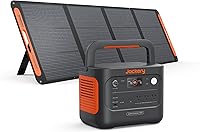
9 Best Portable Power Stations for Home Use (November 2026)
The best portable power stations for home use include the Jackery Explorer 300 Portable Power Station for small home essentials, the Jackery Explorer 1000 v2 Portable Power Station for fast emergency charging, and the PECRON Portable Power Station F3000LFP for long household backup.
On this page (7 sections)
- Which portable power station is best for home use?
- How we picked the best portable power stations for home use
- The best portable power stations for home use
- How do you choose a portable power station for a home outage?
- What should you run from a portable power station?
- How should you set up and care for a home power station?
- Verdict: which portable power station should you buy?
The best portable power stations for home use range from compact 300W units for small electronics to 1,800W and 3,600W models for appliances and longer outages. Jackery Explorer 300 is the easiest small pick for a shelf or cupboard.
BLUETTI AC180 and PECRON F3000LFP suit bigger household loads when a fridge or other appliance needs more headroom. A small station is simple to store and move, while a larger one gives more choice about what to plug in and for how long.
We compared battery capacity, rated output, surge power, charging choices, UPS response, portability and everyday limits. We focused on home use, from keeping a work laptop running to supporting selected appliances during a power cut.
Specs alone do not tell the full story. Watt hours show stored energy, watts show what can run at once, and the two numbers together help judge fit.
Weight, size and charging method also matter. Wall charging is simple before an outage, while solar or car charging may help if mains power stays off.
The picks that follow suit different homes. Match the watt rating to your devices first, then look at capacity and weight.
Our picks at a glance
-
1
 Best for small home essentials
Jackery Explorer 300 Portable Power Station
9.6/10 our score
See it on Amazon -
2
 Best for fast emergency charging
Jackery Explorer 1000 v2 Portable Power Station
9.5/10 our score
See it on Amazon -
3
 Best for long household backup
PECRON Portable Power Station F3000LFP
9.5/10 our score
See it on Amazon
- 4
 Check it
BLUETTI Elite 30 V2 Portable Power Station
Best for compact UPS backup - 5
 Check it
BLUETTI Portable Power Station AC180
Best for larger home appliances - 6
 Check it
Anker SOLIX C1000 Gen 2 Portable Power
Best for app-controlled home backup - 7
 Check it
Anker SOLIX C1000 Portable Power Station
Best for expandable charging options - 8
 Check it
EF ECOFLOW Portable Power Station Delta
Best for outage-ready electronics - 9
 Check it
ALLWEI Portable Power Station 300W
Best for lightweight emergency storage
Which portable power station is best for home use?
The best portable power station for most small home essentials is the Jackery Explorer 300. It weighs about 7.5 lb, stores 292Wh and provides 300W of rated output, so it fits a closet, car or emergency shelf without becoming difficult to move.
That size makes it a sensible first option for phones, laptops and other modest loads. You can keep it charged in a spare room and bring it to the device, rather than moving cables across the house.
For larger appliances, the BLUETTI AC180 offers 1,152Wh and 1,800W output. It has more stored energy and more power for household equipment, but it is also heavier and takes up more space.
The PECRON F3000LFP goes further with 3,072Wh and 3,600W, but its 63.3 lb weight makes it a planned backup station rather than a grab-and-go battery. Think about where it will live and how you would move it to the room that needs power.
If you need a power station specifically for a room with sensitive electronics, compare these picks with our best portable power stations for indoor use. For solar charging plans, our guide to the best solar generators portable explains how panel input changes the setup.
| Product | Best for | Capacity | Output | Weight | Our score |
|---|---|---|---|---|---|
| Jackery Explorer 300 Portable Power Station | small home essentials | 292Wh | 300W, 600W peak | 7.5 lb | 9.6 |
| Jackery Explorer 1000 v2 Portable Power Station | fast emergency charging | 1,070Wh | 1,500W, 3,000W surge | 23.8 lb | 9.5 |
| PECRON Portable Power Station F3000LFP | long household backup | 3,072Wh | 3,600W | 63.3 lb | 9.5 |
| BLUETTI Elite 30 V2 Portable Power Station | compact UPS backup | 288Wh | 600W, 1,500W lifting mode | 9.5 lb | 9.4 |
| BLUETTI Portable Power Station AC180 | larger home appliances | 1,152Wh | 1,800W, 2,700W peak | 37.4 lb | 9.4 |
| Anker SOLIX C1000 Gen 2 Portable Power | app-controlled home backup | 1,024Wh | 2,000W, 3,000W peak | 9.3 | |
| Anker SOLIX C1000 Portable Power Station | expandable charging options | 1,056Wh | 1,800W, 2,400W peak | 27.6 lb | 9.2 |
| EF ECOFLOW Portable Power Station Delta | outage-ready electronics | 1,024Wh | 1,800W, 3,600W surge | 26.7 lb | 9.1 |
| ALLWEI Portable Power Station 300W | lightweight emergency storage | 256Wh | 300W, 600W peak | 6.4 lb | 8.6 |
How we picked the best portable power stations for home use
We looked first at rated output because a station must support the device you want to plug in. Surge ratings matter for equipment with a higher startup demand, but they don't replace the continuous watt rating.
Battery capacity shows how much stored energy is available. A 1,000Wh-class station can support more total use than a 300Wh model, while the actual runtime still changes with device power, inverter loss and the device's duty cycle.
Charging speed matters before and during an outage. AC charging is usually the simplest option, while solar and car charging can help when wall power is unavailable.
Check the input limits and required cables before building a solar setup.
UPS timing also matters for routers, computers and other devices that should stay on during a power cut. The BLUETTI Elite 30 V2, Anker SOLIX C1000 Gen 2 and EcoFlow DELTA 3 Classic all list fast UPS switching.
The best portable power stations for home use
1. Jackery Explorer 300 Portable Power Station
Jackery Explorer 300 Portable Power Station: Best for small home essentials
- 292Wh capacity
- 300W rated output
- 2 AC outlets
- 7.5 lb weight
The compact Explorer 300 suits phones, laptops, cameras and other small loads. Its 292Wh battery and 300W output keep it easy to move around the home.
Pros
- Lightweight
- 2 AC outlets
- 100W USB-C port
Cons
- Not for high-draw kitchen appliances
- Solar panel sold separately
The Jackery Explorer 300 Portable Power Station is the best fit for small home essentials. Its 292Wh battery and 300W rated output suit phones, laptops, cameras, drones and other devices below the output limit.
The station has 2 AC outlets, a 100W USB-C port, 2 USB-A ports and a 120W car port. That mix suits a desk or bedside setup where several small devices can charge at once.
It weighs about 7.5 lb and has an integrated handle, so it is easy to move between a desk, bedroom and emergency storage. Setup is simple, as you plug in the device and check the total load stays within the rated output.
Jackery says it can reach 80% charge in about 2.8 hours with a 100W solar panel. A solar panel is not included, while the box includes the station, AC adapter, car charger cable and user guide.
For care, keep vents clear and store the unit dry with space for air flow. Check the charge before storm season rather than leaving it empty in storage.
Choose it when small electronics matter more than appliance power. It automatically shuts off if overloaded, so check each device wattage before plugging in a high draw appliance.
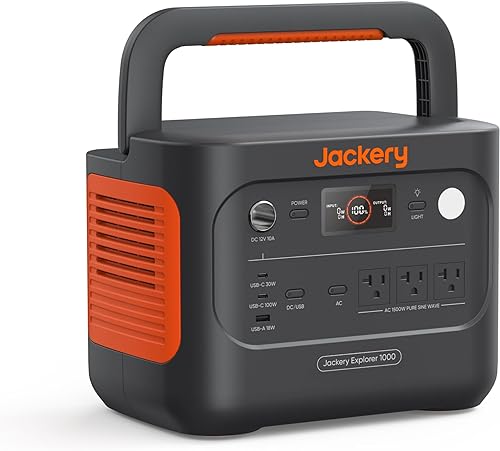
2. Jackery Explorer 1000 v2 Portable Power Station
Jackery Explorer 1000 v2 Portable Power Station: Best for fast emergency charging
- 1,070Wh capacity
- 1,500W output
- 3,000W surge
- 1-hour emergency charging
The Explorer 1000 v2 gives home users a larger battery with a foldable handle and app-controlled charging modes. It suits outages, road trips and multiple smaller devices.
Pros
- Large capacity
- 1-hour emergency charging mode
- 3 AC outlets
Cons
- Solar charging works only with Jackery solar panels
- Solar panel sold separately
The Jackery Explorer 1000 v2 Portable Power Station raises the capacity to 1,070Wh and the rated output to 1,500W. That makes it a better match for a home outage kit that needs more than phones and laptops.
It has 3 pure sine wave AC ports, 2 USB-C ports, 1 USB-A port and 1 DC car port. The station weighs 23.8 lb and includes a foldable handle, so it remains movable without feeling like a small travel battery.
Jackery gives the unit a default 1.7-hour charging mode and an emergency mode that can charge from 0% to 100% in 1 hour when enabled in the app. The app also includes a 30 dB quiet overnight charging mode and an energy efficiency mode.
Choose it for a portable 1,000Wh-class backup with fast charging. It works only with Jackery solar panels for solar charging, and the solar panel is sold separately.
3. PECRON Portable Power Station F3000LFP
PECRON Portable Power Station F3000LFP: Best for long household backup
- 3,072Wh capacity
- 3,600W output
- 13 ports
- UPS switch in 8–20 ms
The F3000LFP is the high-capacity choice for refrigerators, air conditioners, power tools and several home essentials. Its 120V output and 63.3 lb weight make it better for planned placement than frequent carrying.
Pros
- Largest battery here
- 13 output ports
- Solar and car charging
Cons
- Heavy
- 120V output, not 240V
The PECRON Portable Power Station F3000LFP is the strongest choice here for long household backup. Its 3,072Wh LiFePO4 battery and 3,600W pure sine wave output support larger loads such as refrigerators, air conditioners and power tools.
It has 13 ports, including 6 AC outlets, 2 USB-C ports, 2 USB-A ports, 1 car port and 2 DC 5525 outputs. That range suits several devices at once, from a fridge to laptops and lighting.
The built-in UPS switches in 8–20 ms, which can help keep computers and medical devices running during an outage. It does not make every device immune to interruption.
PECRON lists AC, solar and car charging, with up to 1,800W AC input. Solar and car charging may help during a longer outage, subject to the input limits.
The station measures 19.3 x 11.6 x 11.1 in and weighs about 63.3 lb, so plan its storage spot before moving it. This model provides 120V AC output, not 240V.
4. BLUETTI Elite 30 V2 Portable Power Station
BLUETTI Elite 30 V2 Portable Power Station: Best for compact UPS backup
- 288Wh capacity
- 600W output
- 1,500W Power Lifting Mode
- 10 ms UPS
The Elite 30 V2 fits a small home backup role where a fast UPS switch matters. It can support laptops, routers, CPAP machines and other modest loads.
Pros
- 10 ms UPS
- 380W wall charging
- 9.5 lb weight
Cons
- Small battery
- Power Lifting Mode does not change the battery capacity
The BLUETTI Elite 30 V2 Portable Power Station is the compact UPS pick. Its 288Wh battery provides 600W of continuous output, while Power Lifting Mode raises supported output to 1,500W for certain loads.
The unit weighs about 9.5 lb and has 9 total outlets. That small footprint suits a desk, hallway cupboard or bedside area where it can stay ready without taking up much room.
BLUETTI lists a 10 ms UPS switch for laptops, routers and CPAP machines. That fast switch suits devices where even a short interruption could mean lost work or a dropped connection.
It also lists 380W wall charging that reaches 80% in about 45 minutes. Fast wall charging is useful before a storm or soon after power returns.
Charging options include AC, car and solar input. The box includes the Elite 30 V2, an AC charging cable, a car charging cable and a user manual.
Power Lifting Mode adds headroom for certain loads, but it does not change battery capacity. Runtime still depends on the 288Wh stored energy and the power draw of what you plug in.
Choose it when a small footprint and fast backup switch matter more than long runtime.
5. BLUETTI Portable Power Station AC180
BLUETTI Portable Power Station AC180: Best for larger home appliances
- 1,152Wh capacity
- 1,800W output
- 2,700W peak
- 500W solar input
The AC180 balances a large battery with enough output for many household appliances. Its 20 ms UPS mode and 500W solar input make it a practical outage station.
Pros
- 1,800W output
- Fast AC charging
- Solar charging cable included
Cons
- Heavier than 1,000Wh-class picks
- Higher output uses the battery faster
The BLUETTI Portable Power Station AC180 is the better home-appliance pick for many buyers. It stores 1,152Wh and supplies 1,800W, with a 2,700W peak mode for higher starting demands.
The AC180 has 8 outlets and can charge at up to 1,440W from AC input. Fast AC charging suits home use, as you can top it up from a wall socket before an outage or between uses.
BLUETTI also lists up to 500W solar input, with a stated solar charging time of about 2.8 to 3.3 hours. Solar charging adds flexibility when mains power is unavailable, provided your panel and cables match the input limits.
Its 20 ms UPS mode can support selected essentials during an outage. That suits a router, laptop or CPAP machine while you manage the wider outage.
The unit weighs 37.4 lb and measures 13.39 x 9.72 x 12.48 in, so it is portable but better suited to planned movement than constant carrying. A trolley or a fixed storage spot near your main devices can make daily use easier.
The box includes AC, car and solar charging cables. Choose it when you want more appliance output while keeping the battery below the PECRON's size.
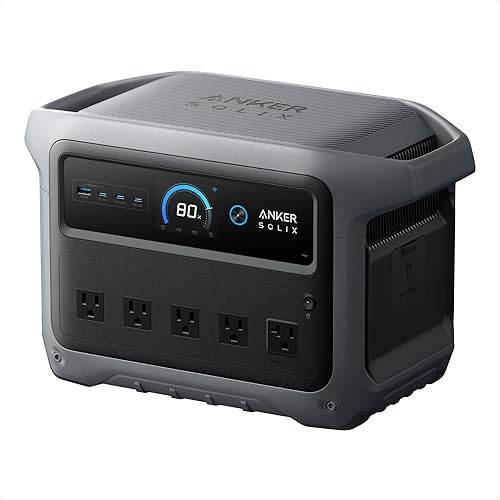
6. Anker SOLIX C1000 Gen 2 Portable Power
Anker SOLIX C1000 Gen 2 Portable Power: Best for app-controlled home backup
- 1,024Wh capacity
- 2,000W output
- 3,000W peak
- 49-minute full recharge
The C1000 Gen 2 is a strong fit for homes that want high output, app control and quick charging in a smaller package. Its capacity is fixed, so choose it when portability matters more than expansion.
Pros
- 2,000W output
- 49-minute recharge claim
- 10 ms UPS
Cons
- Capacity cannot be expanded
- App needed for UltraFast charging
The Anker SOLIX C1000 Gen 2 Portable Power combines 1,024Wh capacity with 2,000W output and a 3,000W peak. It suits home users who want strong output, app control and a compact station for outages or daily backup.
Anker lists 10 ports, a 10 ms UPS switch and 600W maximum solar input. That port count can suit a work area or living room where a laptop, router, lights and phone chargers may all need power at once.
HyperFlash charging can fully recharge the station in 49 minutes when enabled in the app, although charging speed depends on battery temperature. The fastest time is not guaranteed in a cold room or cold garage.
The unit is 14% smaller and 11% lighter than similar models, according to Anker. For home use, that compact shape helps it fit on a shelf or in a cupboard.
Its capacity cannot be expanded, so choose it when a self-contained station is more useful than adding battery packs later. The box includes the station, AC charging cable, quick start guide and safety and warranty card.
7. Anker SOLIX C1000 Portable Power Station
Anker SOLIX C1000 Portable Power Station: Best for expandable charging options
- 1,056Wh capacity
- 1,800W output
- 2,400W peak
- 600W solar input
The original C1000 offers a useful 1,056Wh battery, app controls and solar input up to 600W. It suits home users who want a capable mid-size station with a car charging cable included.
Pros
- Large 1,056Wh battery
- 11 ports
- 600W solar input
Cons
- UltraFast charging needs the app
- AC and DC inputs cannot charge at the same time
The Anker SOLIX C1000 Portable Power Station stores 1,056Wh and supplies 1,800W, with a 2,400W peak through SurgePad technology. It is a useful middle option for home backup, camping and RV use.
The station has 11 ports and supports up to 600W solar input. A wide port choice suits a household that wants to charge phones and laptops while also running a lamp or small appliance.
Anker says 0% to 80% charging can take 43 minutes under specified conditions, while the app controls UltraFast charging and tracks power use. The app is part of the setup, so check that it works on your phone before an outage.
It weighs 27.6 lb and measures 14.8 x 8.07 x 11.02 in. That is manageable for planned moves between rooms, but it is not a light unit to carry up and down stairs often.
The box includes AC and car charging cables, which is useful if you plan to recharge away from a wall outlet. Keep both cables with the station, so car charging remains an option if you need to move it in a vehicle.
Choose this model if you prefer its car cable and slightly larger stated capacity. AC and DC inputs cannot be used at the same time.
8. EF ECOFLOW Portable Power Station Delta
EF ECOFLOW Portable Power Station Delta: Best for outage-ready electronics
- 1,024Wh capacity
- 1,800W output
- 3,600W surge
- Under-10 ms UPS
DELTA 3 Classic suits home users who want fast AC charging, app controls and UPS support for computers, servers and medical devices. A 500W solar panel can recharge it in about 2.5 hours.
Pros
- Under-10 ms UPS
- 0–80% AC charging in 45 minutes
- 500W solar input
Cons
- Not compatible with the listed DELTA 2 Smart Extra Battery
- Solar panel sold separately
The EF ECOFLOW Portable Power Station Delta gives you 1,024Wh capacity, 1,800W output and a 3,600W surge rating. Its under-10 ms UPS is aimed at computers, servers and medical devices that should avoid a long interruption.
EcoFlow lists 0% to 80% AC charging in 45 minutes and solar charging in about 2.5 hours with a 500W panel. Fast AC charging suits a home where the station tops up between outages, while solar charging may help if wall power stays off.
The app can monitor use, set charging schedules and activate Storm Alert or Self-Powered Mode. Those controls suit homes that want the station ready for a storm, rather than setting it up at the last minute.
The DELTA 3 Classic weighs 26.7 lb and measures 7.9 x 11.1 x 15.7 in. Its LiFePO4 battery is rated for 10+ years of daily use.
For care, keep the unit dry and leave room around its vents when it is in use. Check cables and charge level before storm season, and follow the manual for storage and temperature guidance.
This model is a strong fit for electronics and selected home appliances. It is not compatible with the DELTA 2 Smart Extra Battery or Delta 3 Series Smart Extra Battery.
9. ALLWEI Portable Power Station 300W
ALLWEI Portable Power Station 300W: Best for lightweight emergency storage
- 256Wh capacity
- 300W output
- 600W peak
- 6.4 lb weight
The ALLWEI 300W is easy to keep in a car, closet or small emergency kit. Its six ports, LED light and 256Wh battery suit phones, laptops and other modest loads.
Pros
- Lightest pick here
- 6 output ports
- AC and solar charging
Cons
- Smallest capacity here
- Not for larger appliances
The ALLWEI Portable Power Station 300W is the lightest option in this group. Its 256Wh LiFePO4 battery supplies 300W continuously and 600W at peak, which suits laptops, phones, small devices and emergency lighting.
It has 1 AC outlet, 2 DC5521 ports, 1 car port, 1 USB-A port and 1 USB-C PD port. That mix covers basic home needs, such as charging a phone via USB while a laptop or lamp uses another outlet.
The station weighs 6.4 lb and measures 9.25 x 5 x 6.8 in, so it can stay in a closet, vehicle or small emergency kit. Its low weight makes it easy to hand to someone or move between rooms without planning a fixed space.
ALLWEI lists AC, car and solar charging, plus dual AC and solar charging that can take about 2 to 2.5 hours. Having more than one charging route helps if wall power is available one day and not the next.
A 3-level LED light includes an SOS mode. That built in light is a practical extra during an outage, especially if you keep the station in a dark hallway or spare room.
Choose it for low weight and basic backup needs. Its 256Wh battery and 300W output are not suited to large appliances.
How do you choose a portable power station for a home outage?
Choose the station by the biggest device you need to run and the number of hours you want it powered. A 300W model can support small electronics, but a refrigerator or kitchen appliance may need a larger rated output and enough surge capacity.
Then compare watt-hours. A simple estimate is battery capacity multiplied by an efficiency factor, divided by device wattage.
Actual runtime changes with inverter loss, self-consumption, startup demand and whether the appliance cycles on and off.
Weight affects how you will use the station. The ALLWEI 300W and Jackery Explorer 300 are easy to move, while the PECRON F3000LFP is better placed near the equipment it will support.
For more solar-focused planning, compare this roundup with best solar generators for home backup. If you are deciding between battery storage and fuel-powered equipment, read solar panels vs generator for home backup.
What should you run from a portable power station?
Run devices that stay within the station continuous output and do not exceed its surge limit at startup. Phones, laptops, routers, lights and small electronics are usually easier to match than heating appliances, air conditioners and refrigerators.
A fridge may cycle on and off, and its startup demand can be higher than its running draw, so a station that looks close on paper may still struggle. Keep a written list of each device wattage and startup needs.
During an outage, power the most important items first and avoid plugging in loads simply because an outlet is available. Several modest items added together can reach the station limit.
Small electronics are often the best match for a 300W station. They suit the Jackery Explorer 300 or ALLWEI 300W, where the focus is on phones, laptops, cameras and lighting.
Larger appliances need a larger rated output, not just a larger battery. A 1,000Wh class station with 1,800W or 2,000W output gives more choice, while the PECRON F3000LFP is aimed at heavier household loads.
Runtime changes with the device you choose. A laptop may run for many hours from a larger battery, while a high draw appliance can drain the same battery much faster.
If an appliance cycles, check the surge rating and keep some headroom, rather than running close to the continuous limit all the time. Avoid heating appliances unless the station is clearly rated for them.
A portable battery station is also different from a fuel generator, which brings different fuel storage, noise and ventilation issues. If you need a larger fuel-powered setup for an office, compare portable dual-fuel generators for home offices and portable dual-fuel generators for power outages.
How should you set up and care for a home power station?
Place the unit on a dry, stable surface with space around its vents. Air flow matters when the station is charging or supplying power, so avoid pushing it into a closed cupboard while it runs.
Keep cables organized and use the correct charging input for the model. The wrong cable or input can slow charging or stop it working, so check the labels before you plug in.
Check the screen before connecting a device with a high starting load. That quick check helps you stay within the continuous output and surge limit, rather than relying on the overload cut off.
Charge the station before storm season and inspect the cables when you store it. A station that is flat in storage may not be ready when you need it.
Follow the model manual for storage level, charging temperature and app settings, since these details vary by product. Some models use app controls for fast charging or backup modes, and those settings should be tested before an outage.
Do not connect a portable station to household wiring through an improvised cable. That is unsafe and can damage the station or the home electrics.
Use the station outlets for compatible devices, or have a qualified electrician install an approved transfer arrangement. Store the unit where it stays dry and not too hot or cold.
Test the station now and then, rather than leaving it unused for months. If you plan solar charging, check the panel voltage and input limits before an outage.
Label the station best uses on a note kept with it. A short list of devices it can run, and those it cannot, makes choices faster when power goes off.
Verdict: which portable power station should you buy?
The Jackery Explorer 300 is the clear pick for phones, laptops, lights and other small essentials. It is light enough to store in a closet or car, and its 300W output suits the devices most homes reach for first.
Choose the BLUETTI AC180 for a stronger balance of battery capacity and appliance output. Its 1,152Wh battery and 1,800W output make it a practical outage station for selected household equipment.
Choose the PECRON F3000LFP when long backup time and high output matter more than weight. Its 3,072Wh capacity and 3,600W output suit larger loads, but you need a planned space for a 63.3 lb unit.
The Anker SOLIX C1000 Gen 2 is a good app-focused choice for homes that want fast charging and a 10 ms UPS switch. The BLUETTI Elite 30 V2 fits compact UPS use where a small footprint matters.
Match the watt rating first, then choose the capacity, charging method and weight that fit your home. That order keeps you from buying a large battery that cannot run the device you care about most.
Our top 3 picks at a glance
-
1
Best for small home essentials
Jackery Explorer 300 Portable Power Station
9.6/10 our score
See it on Amazon -
2
Best for fast emergency charging
Jackery Explorer 1000 v2 Portable Power Station
9.5/10 our score
See it on Amazon -
3
Best for long household backup
PECRON Portable Power Station F3000LFP
9.5/10 our score
See it on Amazon
Frequently asked questions
What is the best portable power station for home use?
The best portable power station depends on the loads you need to run. Jackery Explorer 300 and ALLWEI 300W suit phones, laptops and small essentials.
BLUETTI AC180, Anker C1000 models and EcoFlow DELTA 3 Classic offer more output for appliances.
PECRON F3000LFP is the high-capacity choice.
How many watts should a home power station have?
Choose the watt rating from the devices you need to run at the same time. A 300W station suits small electronics, while 1,500W to 2,000W models can handle more household equipment.
Add the starting surge of motor-driven devices, such as refrigerators, before choosing.
How long will a portable power station run a refrigerator?
Runtime depends on the refrigerator's actual power use, startup surge and cycling pattern. A larger battery such as the 1,152Wh BLUETTI AC180 or 3,072Wh PECRON F3000LFP gives more stored energy, but you should compare the appliance's wattage with the station's output limits.
Can a portable power station run a house during an outage?
A portable power station can run selected home circuits or appliances, but it does not automatically power an entire house. Use its outlets for compatible devices and keep the total load below the rated output.
Never connect it to household wiring without an approved transfer setup.
Are portable power stations safe to use indoors?
Battery power stations do not produce combustion exhaust, so they can be useful indoors when used as directed. Keep the unit dry, leave room around vents, use the correct cables and stay within its output limits.
Fuel generators need different ventilation rules, as explained in our indoor-use guide.