9 Best Portable Inverter Generators (November 2026)
The best portable inverter generators include the Westinghouse 5000 Peak Watt Super Quiet Portable for RV and home backup balance, the WEN Super Quiet 2350-Watt Portable Inverter Generator for lightweight clean power, and the Oxseryn Power Equipment 4400 Watts Inverter Generator for open-frame inverter value.
On this page (4 sections)
The best portable generator inverter for most RV and home backup needs is the Westinghouse 5000 Peak Watt model, with 3,900 rated watts, an RV-ready outlet and remote start.
That mix suits travel trailers and emergency home use. Choose WEN for lighter transport, Westinghouse tri-fuel for larger backup loads, or AIVOLT for compact camping power.
The right choice depends on running watts, starting watts, fuel options, outlet type and carry weight. A watt total that looks fine on paper can fail if the outlet shape is wrong or the unit is too heavy to move where you need it.
Inverter designs also make sense for cleaner power for electronics and variable engine speed for lighter loads. Laptops, phones and televisions benefit from stable output.
Think about who will lift it and where it will live between uses. A 104.7 lb unit with wheels and a handle is very different from a 39 lb unit you can carry one handed into a car.
If you are still comparing fuel systems, read What Is a Dual Fuel Inverter Generator and How Does It Work? and What Is a Dual Fuel Inverter Generator Used For?. Use those guides alongside the outlet and weight checks below.
Our picks at a glance
-
1
 Best for RV and home backup balance
Westinghouse 5000 Peak Watt Super Quiet Portable
9.7/10 our score
See it on Amazon -
2
 Best for lightweight clean power
WEN Super Quiet 2350-Watt Portable Inverter Generator
9.7/10 our score
See it on Amazon -
3
 Best for open-frame inverter value
Oxseryn Power Equipment 4400 Watts Inverter Generator
9.5/10 our score
See it on Amazon
- 4
 Check it
PowerSmart 4000 Watt Portable Inverter Generator
Best for parallel-ready home use - 5
 Check it
Westinghouse 8200 Peak Watt Tri-Fuel Portable Inverter
Best for large multi-fuel backup loads - 6
 Check it
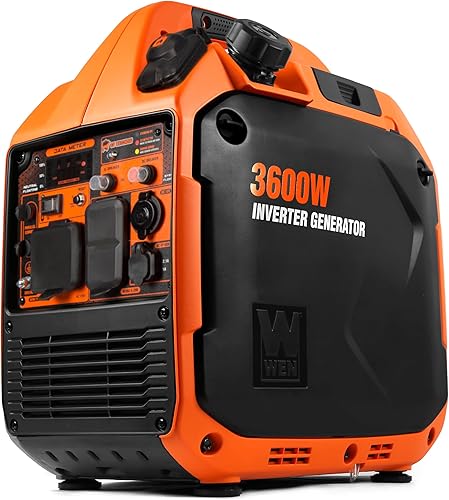
WEN Quiet and Lightweight 3600-Watt Dual Fuel
Best for dual-fuel RV flexibility - 7
 Check it
Oxseryn 2800W Portable Inverter Generator
Best for long light-load camping - 8
 Check it
AIVOLT 1750W Inverter Generator Portable Gas Generator
Best for one-person carrying - 9
 Best for compact RV-ready backupCheck it
The best portable generator inverter picks
We compared the listed power, fuel choices, outlets, weight, safety features and stated runtime for different portable generator jobs. The same wattage can mean very different daily use depending on outlet type and carry weight.
Our score weighs specs, features and buyer feedback against what you're shopping for. A model for home backup needs more sustained output, while a camping model needs lower weight and quieter light load operation.
Use the picks below as starting points, not as a substitute for adding up your own loads. Check running watts first, then starting watts, then whether the panel has the outlet your RV or appliances actually use.
| Product | Best for | Power | Fuel | Weight | Our score |
|---|---|---|---|---|---|
| Westinghouse 5000 Peak Watt Super Quiet Portable | RV and home backup balance | 5,000 peak W, 3,900 rated W | Gasoline | 104.7 lb | 9.7 |
| WEN Super Quiet 2350-Watt Portable Inverter Generator | lightweight clean power | 2,350 surge W, 1,900 rated W | Gasoline | 39 lb | 9.7 |
| Oxseryn Power Equipment 4400 Watts Inverter Generator | open-frame inverter value | 4,400 peak W, 3,400 running W | Gasoline | 56 lb | 9.5 |
| PowerSmart 4000 Watt Portable Inverter Generator | parallel-ready home use | 4,000 starting W, 3,200 running W | Gasoline | 50.7 lb | 9.4 |
| Westinghouse 8200 Peak Watt Tri-Fuel Portable Inverter | large multi-fuel backup loads | 8,200 peak W, 6,600 gasoline running W | Gasoline, propane and natural gas | 134.5 lb | 9.3 |
| WEN Quiet and Lightweight 3600-Watt Dual Fuel | dual-fuel RV flexibility | 3,600 gasoline surge W, 2,900 rated W | Gasoline and propane | 49 lb | 8.9 |
| Oxseryn 2800W Portable Inverter Generator | long light-load camping | 2,800 peak W, 2,000 running W | Gasoline | 40 lb | 8.8 |
| AIVOLT 1750W Inverter Generator Portable Gas Generator | one-person carrying | 1,750 peak W, 1,350 running W | Gasoline | 8.7 | |
| Generac | compact RV-ready backup | 2,500 running W, 3,300 starting W | Gasoline | 59.5 lb | 8.6 |
Westinghouse 5000 Peak Watt Super Quiet Portable: Best for RV and home backup balance
- 5,000 peak watts and 3,900 rated watts
- RV-ready TT-30R outlet
- Remote, electric and recoil start
- Up to 18 hours on a 3.4-gallon tank
This Westinghouse combines high rated output with an RV-ready outlet, remote start and a display that tracks fuel and runtime. It is the broadest fit here for travel trailers and emergency home use.
Pros
- RV-ready outlet
- Remote electric start
- Long stated runtime
Cons
- Heavier than compact inverter models
- Gasoline only
The Westinghouse iGen5000 is the best all-around fit when you need meaningful output without moving to the largest home-backup unit. It supplies 5,000 peak watts and 3,900 rated watts, with less than 3% THD.
That rated output is the number to use for everyday planning. Peak watts help with short motor startup surges, but sustained loads such as a refrigerator, lights and charging should stay comfortably within the rated figure.
The TT-30R outlet is useful for a travel trailer, while the 5–20R household outlet and 2 USB outlets cover common home and campsite devices. That range reduces the need for adapters in most RV and house setups.
Remote start, electric start and recoil start give you several ways to turn it on. Remote start is handy when the unit is placed away from the campsite area, while recoil start is a useful backup if the battery needs attention.
A rotating LED display shows fuel level, power output, remaining runtime, voltage and lifetime hours. In daily use that helps you plan refuels and oil service instead of guessing from a basic gauge.
The 3.4-gallon gasoline tank is rated for up to 18 hours, with ECO mode adjusting engine speed for lighter loads. Longer runtime matters most overnight or during an outage, when repeated refuelling is inconvenient.
At 104.7 lb, this is portable through its wheel and handle kit, but it is not the easiest model to lift into a vehicle. Choose it when outlet range and runtime matter more than minimum weight, and plan your loading path in advance.
WEN Super Quiet 2350-Watt Portable Inverter Generator: Best for lightweight clean power
- 2,350 surge watts and 1,900 rated watts
- 39 lb body
- Fuel shutoff
- Two 120V outlets, 12V DC and USB ports
The 39 lb WEN is easy to carry and supplies clean power for smaller electronics and light camping loads. Its fuel shutoff helps use remaining carburetor fuel before shutdown.
Pros
- Lightest full-size pick here
- Fuel shutoff
- USB and DC outputs
Cons
- Lower output than larger picks
- Gasoline only
The WEN 56235i is the easiest pick here to carry regularly. Its 39 lb body produces 2,350 surge watts and 1,900 rated watts, which fits phones, laptops, televisions and other smaller electronics.
At that size, storage is simple in a closet, trunk or RV compartment. You are more likely to actually use a generator you can move without help, which matters for weekend camping and short outages.
Two 120V receptacles, a 12V DC receptacle and 2 USB ports make the panel useful for basic camping and outage charging. The mix covers household plugs and direct device charging without needing extra adapters for many light loads.
The gasoline fuel shutoff uses remaining carburetor fuel before shutdown, which can help reduce stagnant fuel in the carburetor. That is a care benefit for units that sit between trips, since stale fuel is a common source of hard starting.
This model is better for light loads than refrigerators, air conditioners or several high-draw appliances at once. Check both running and starting watts before connecting anything with a motor, and leave room for startup demand.
Eco mode can help when the load is light by lowering engine speed. That supports quieter operation and better fuel use for overnight charging, but it does not turn a 1,900 rated watt unit into a whole house backup source.
Choose it when easy storage and carrying are central. For more output from an open-frame design, compare the best open frame inverter generator.
Oxseryn Power Equipment 4400 Watts Inverter Generator: Best for open-frame inverter value
- 4,400 peak watts and 3,400 running watts
- RV port
- Up to 14 hours at 25% load
- 56 lb body
This open-frame Oxseryn offers a strong power-to-weight balance for RV camping and emergency backup. ECO mode and a 2-gallon tank support longer light-load operation.
Pros
- 3,400 running watts
- RV port
- 56 lb weight
Cons
- Open-frame design
- Gasoline only
The Oxseryn 4400W gives you 3,400 running watts at a 56 lb weight, making it a practical middle ground for RV camping and home backup.
It has 2 120V AC ports, a 12V DC port and an RV port. That running wattage suits lights, charging and a small appliance, or a home outage load built around essentials.
ECO mode supports a stated runtime of up to 14 hours at 25% load from its 2-gallon tank. The fuel gauge shows the remaining level without guessing.
At 56 lb, it is far easier to load than the 100 lb plus models on this list. One person can manage it more readily with a planned lift.
Its open-frame design is not the choice when the smallest footprint or quietest operation is the priority. Under-72-dBA operation is stated from 23 ft away, which is higher than the quietest enclosed picks here.
Choose it for power plus portability rather than for minimum noise. Pair that trade off with a clear watt total for your essentials.
PowerSmart 4000 Watt Portable Inverter Generator: Best for parallel-ready home use
- 4,000 starting watts and 3,200 running watts
- Less than 3% THD
- 59 dBA at 23 ft
- Parallel connection support
PowerSmart fits buyers who want 3,200 running watts, clean power and the option to connect two matching units. A parallel kit is sold separately.
Pros
- Parallel-ready design
- 120V 30A twist-lock outlet
- Eco Mode
Cons
- Gasoline only
- Parallel kit sold separately
PowerSmart suits buyers who want 3,200 running watts, less than 3% THD and parallel support. Its 120V 20A duplex, 120V 30A twist-lock, 12V DC and dual USB ports cover several connection types.
That outlet mix is practical for both home and RV use. The twist-lock outlet can feed a trailer or backup panel, while the duplex and USB ports handle everyday devices without hunting for adapters.
The unit weighs 50.7 lb and operates at a stated 59 dBA from 23 ft away. That weight is manageable for one person with a planned lift, and the stated noise level suits campsites better than an open frame unit.
Eco Mode can reduce engine speed when the load is lighter. In daily use that means less fuel and less noise during charging or fan use, with more engine work only when a larger load starts.
Clean power under 3% THD makes it a fit for laptops, phones and tablets. You still should follow the manual for the devices you connect, but the stated output is aimed at sensitive electronics.
Two matching 4000W generators can be connected to increase output, but the parallel kit is sold separately. That makes this a good future-expansion choice if one unit handles your normal loads today.
Buy it for the single unit specs first, and treat parallel use as an option to add later. That keeps the upfront setup simple while leaving room to grow if a second unit becomes useful.
Westinghouse 8200 Peak Watt Tri-Fuel Portable Inverter: Best for large multi-fuel backup loads
- 6,600 gasoline running watts
- Gasoline, propane and natural gas
- 50A home-backup outlet
- CO sensor
The iGen8200TFc is the high-output choice for transfer-switch or interlock-ready home backup. Tri-fuel operation adds flexibility, but its 134.5 lb weight makes it less suited to frequent carrying.
Pros
- Tri-fuel operation
- 50A outlet
- High running output
Cons
- Heaviest pick here
- More generator than small camping loads need
The Westinghouse iGen8200TFc is the high-output choice for home backup with gasoline, propane or natural gas. On gasoline it provides 6,600 running watts and 8,200 peak watts, with lower stated outputs on propane and natural gas.
Fuel flexibility is the main reason to choose this class. Gasoline is widely available for a first run, propane adds a stored tank option, and natural gas can suit homes that already have a line and the right connection.
A 50A 120/240V outlet is transfer-switch or interlock-kit ready. That outlet is what moves this from campsite power to serious home backup, since it can feed circuits through a properly installed transfer setup.
The panel also includes an RV-ready TT-30R outlet and a GFCI 120V 5–20R duplex outlet. Those outlets let you run trailer loads or household plugs directly, while the 50A outlet handles the larger backup role.
This generator can run large home loads such as an air conditioner, refrigerator and sump pump according to its stated use case. You still need to total running watts and allow for motor startup, because even 6,600 running watts is not unlimited.
Its 134.5 lb weight and 27 x 20.9 x 21.7 in size make it a planned backup unit rather than a casual campsite carry. Wheels and a folding handle help on flat ground, but storage space and a loading ramp matter.
For broader fuel comparisons, see the best portable dual fuel generator for long runtime guide.
WEN Quiet and Lightweight 3600-Watt Dual Fuel: Best for dual-fuel RV flexibility
- Gasoline and propane operation
- 3,600 gasoline surge watts
- RV-ready TT-30R outlet
- CO Watchdog shutdown sensor
This WEN adds propane flexibility without moving into the weight of the largest models. Its RV-ready outlet, fuel shutoff and CO sensor suit travel and backup use.
Pros
- Dual-fuel operation
- RV-ready outlet
- 49 lb weight
Cons
- Lower propane output
- No natural gas option
The WEN DF360iX is the best fit when propane flexibility and RV use matter more than maximum output. It produces 3,600 surge watts and 2,900 rated watts on gasoline, or 3,500 surge watts and 2,600 rated watts on propane.
That propane drop is small but real. Plan your loads using the lower propane figure if propane will be your main fuel, so the unit is not overloaded when you switch tanks.
Its TT-30R RV receptacle, two 120V receptacles, 12V DC receptacle and 2 USB ports support common travel loads. The RV outlet is the key detail for trailer use, while the other outlets cover lights, charging and small appliances.
The tool-free LPG quick-connector makes propane connection part of the design. That helps at a campsite, where a simple connection is easier than reaching for tools in the dark.
Fuel shutoff helps limit stale fuel in the carburetor, while the CO Watchdog sensor shuts the unit down if dangerous carbon monoxide levels are detected. Neither feature replaces outdoor use, but both support safer and simpler ownership.
At 49 lb, it remains manageable for many RV setups. One person can carry it to a storage bay or campsite spot without the planning needed for the largest models here.
Choose it when you want fuel choice without moving to a much heavier backup unit. It is a travel focused pick, with enough output for moderate loads and enough flexibility for different fuel storage plans.
Oxseryn 2800W Portable Inverter Generator: Best for long light-load camping
- 2,800 peak watts and 2,000 running watts
- Up to 10 hours at 25% load
- 58 dB at 23 ft
- 40 lb body
The smaller Oxseryn focuses on portable camping power, with a stated 10-hour runtime at 25% load and USB plus Type-C charging. Its 2,000 running watts limit heavier loads.
Pros
- 10-hour light-load runtime
- 40 lb weight
- USB and Type-C ports
Cons
- Lower running output
- Gasoline only
The Oxseryn 2800W is aimed at lighter camping and overnight loads. It supplies 2,800 peak watts and 2,000 running watts, with a stated 10-hour runtime at 25% load.
That output fits tents, small trailers and outage charging for phones, laptops and lights. It is not sized for several motor driven appliances at once, so the watt total needs to stay modest.
The 40 lb body and handle make it easier to carry than the larger Oxseryn. You can move it from a vehicle to a campsite table area without a wheel kit or a second person.
Its 2 USB ports, Type-C port, 2 AC ports and 12V DC port cover small electronics and charging needs. Type-C is a useful addition for newer phones and laptops, while the AC ports cover a fan or small television.
A 10 hour stated runtime at 25% load suits overnight use on a light load. Heavier loads will use fuel faster, so treat that figure as a light load best case rather than a guarantee for a heater or refrigerator.
This model can be paralleled with another Oxseryn generator for more power, but its single-unit running output remains below the 3,000-watt class picks. Use a wattage total before connecting a refrigerator, heater or other motor-driven load.
Choose it for portability and long light load camping. If your essential list already includes a refrigerator plus other loads, step up to a higher running watt model instead.
AIVOLT 1750W Inverter Generator Portable Gas Generator: Best for one-person carrying
- 1,750 peak watts and 1,350 running watts
- 26.5 lb stated ultra-light design
- 52 dBA operation
- CO auto-shutoff
AIVOLT is the compact choice for phones, laptops, CPAP machines and light camping loads. Its lower output makes a watt check essential before connecting heaters or air conditioners.
Pros
- Very light carry design
- CO detection
- 52 dBA stated noise
Cons
- Lowest output here
- Engine oil is not included
AIVOLT is the best portable generator inverter here for one-person carrying. The design is stated at 26.5 lb, with 1,350 running watts and 1,750 peak watts.
That weight changes how you use it day to day. It can go from a closet to a truck to a campsite without a ramp, which suits tent camping, tailgating and small backup kits.
It produces less than 3% THD power and includes CO detection with automatic shutoff, low-oil shutdown and overload protection. Those safety features matter most in compact camping setups, where the unit may sit close to tents or seating areas.
The 0.66-gallon gasoline tank is rated for up to 7 hours at 25% load in ECO mode. ECO mode lowers engine speed for light loads, which helps both fuel use and noise during overnight charging.
The lower output fits phones, laptops, CPAP machines, televisions and light camping loads. A CPAP machine is a good example of a load that needs clean power but not high wattage, provided you check its specific draw.
It may not start most RV or window air conditioners, and engine oil is not included, so add oil before first startup. That missing oil is a set up step to complete at home, not at the campsite.
Choose it when carrying weight matters more than high output. Add up your loads first, and if a heater or air conditioner is essential, look at a larger running watt model.
Generac: Best for compact RV-ready backup
- 2,500 running watts and 3,300 starting watts
- Less than 3% THD
- COsense technology
- Up to 7 hours at 25% load
The Generac GP3300i combines 2,500 running watts with a 120V 30A twist-lock outlet, clean power and parallel capability. It suits moderate home, camping and RV loads.
Pros
- Clean sine-wave power
- COsense shutdown
- Parallel-ready
Cons
- Gasoline only
- RV TT-30R adapter is not included
The Generac GP3300i suits moderate RV, camping and outage loads with 2,500 running watts and 3,300 starting watts. TruePower technology produces less than 3% THD, and COsense monitors carbon monoxide near the unit.
The gap between starting and running watts is useful for motor loads. A refrigerator or RV air conditioner may need a short surge to start, and this model is stated to handle that surge while running other essentials.
Its 120V 20A household outlets, 120V 30A twist-lock outlet and USB-A ports support common devices. The twist-lock outlet is the RV connection point, but a standard RV TT-30R inlet needs an adapter that is not included.
The 1.06-gallon tank is rated for up to 7 hours at 25% load or 4.5 hours at 50% load. That gives you a clear way to plan an overnight outage, with runtime falling as the load rises.
Economy mode adjusts engine speed to match the load. That helps on light loads such as charging and lights, where full engine speed would waste fuel and add noise.
This gasoline-only unit can connect to another GP3300i through a separately sold parallel kit. It includes a molded carry handle, but its 59.5 lb weight is more demanding than the compact WEN or AIVOLT.
Choose it for clean power and a twist-lock RV outlet in a mid size package. Budget for the adapter if your trailer uses a TT-30R inlet, and confirm your watt total before adding motor loads.
How to choose an inverter generator for variable loads
Start with running watts, then check starting watts. Refrigerators, pumps, air conditioners and power tools can need extra watts for a short startup surge.
Add the running wattage of everything you expect to use together. Compare that total with the generator's rated output, leaving room for startup demand.
List your loads in two groups. Group one must run at the same time, such as a refrigerator plus lights and charging.
Group two can wait, such as a kettle or a second heater.
For a travel trailer, check the outlet before buying. The Westinghouse 5000W and WEN DF360iX include TT-30R RV outlets, while the Generac uses a 120V 30A twist-lock outlet and needs an adapter for a standard RV TT-30R inlet.
Outlet shape can decide the purchase as much as wattage. The adapter you need may not be included in the box.
If you want fuel flexibility, the WEN DF360iX supports propane, while the Westinghouse iGen8200TFc supports gasoline, propane and natural gas. Compare output by fuel, not just by the headline peak figure, because propane and natural gas output can be lower than gasoline.
Noise numbers need context because stated measurement distance and load affect the result. The AIVOLT is stated at 52 dBA, the PowerSmart at 59 dBA from 23 ft, and the Westinghouse 8200 at about 60 dBA at 25% load.
Weight and size also need a real world check. Measure your storage bay, doorway and vehicle loading path, and decide whether one person will lift it or wheels will do most of the work.
Safety features are worth comparing once wattage and outlets are settled. CO sensors, low oil shutdown and overload protection support safer operation, but none of them makes indoor use safe.
For a gas-only comparison, see the best gas powered inverter generator guide. For longer dual-fuel operation, compare the best dual fuel inverter generator for long runtime.
How to use and care for a portable inverter generator
Use every fuel-powered generator outdoors and keep exhaust away from doors, windows and vents. CO sensors can add protection, but they do not make indoor operation safe.
Place the unit where exhaust can disperse freely and where cords will not run across walkways. Think about wind direction, tent openings and RV vents before you start it for the night.
Before first use, follow the model manual for oil, fuel, grounding, startup and shutdown. The AIVOLT requires engine oil before its first start, while the Generac includes engine oil, an oil funnel and a tool kit.
Read the manual for your exact model rather than copying steps from another generator. Oil type and level, choke use and grounding needs can differ.
Keep the unit level and avoid overloading it. A level surface helps the engine and oil system work as designed, while staying within rated watts reduces strain and shutdown risk.
Let fuel-shutoff models finish using the carburetor fuel when practical, and follow the service schedule for oil, spark plugs, air filters and fuel storage. Store fuel safely and rotate it according to the manual.
Measure your storage space, doorway and vehicle loading path before choosing a larger model. The 134.5 lb Westinghouse tri-fuel unit and 104.7 lb Westinghouse 5000W need more planning than a 39 lb WEN.
Check cords and outlets before each use, since damaged insulation or loose connections can create a safety risk. A short pre trip routine helps: confirm oil and fuel, test start it at home, and load it the way you will at the campsite or during an outage.
Final verdict on the best portable generator inverter
The Westinghouse 5000 Peak Watt model is the best portable generator inverter for a broad mix of RV and home backup needs because it combines 3,900 rated watts, an RV outlet, remote start and a long stated runtime.
That combination covers the most common shopping priorities in one unit. You get sustained output for essentials, a TT-30R outlet for a travel trailer, and several ways to start it when the unit is placed away from you.
Pick the WEN 2350W or AIVOLT when one-person carrying matters most. The WEN gives more output at 39 lb, while the AIVOLT gives the lightest carry at a lower wattage.
Choose the WEN DF360iX for gasoline and propane flexibility, PowerSmart for parallel expansion, or the Westinghouse iGen8200TFc when natural gas and larger home loads justify the size. Each of those trades portability for a specific capability.
Match the final choice to your outlet and your lift. A TT-30R inlet, a twist-lock outlet or a 50A backup outlet will point you to different models even when wattage looks similar.
If your backup plan is centered on multiple appliances, compare the best portable dual fuel generator for long runtime before choosing a final wattage class. For brand research, our guide on where are Kohler generators made covers a separate manufacturer question.
Our top 3 picks at a glance
-
1
Best for RV and home backup balance
Westinghouse 5000 Peak Watt Super Quiet Portable
9.7/10 our score
See it on Amazon -
2
Best for lightweight clean power
WEN Super Quiet 2350-Watt Portable Inverter Generator
9.7/10 our score
See it on Amazon -
3
Best for open-frame inverter value
Oxseryn Power Equipment 4400 Watts Inverter Generator
9.5/10 our score
See it on Amazon
Frequently asked questions
What is the best portable generator inverter for most buyers?
The Westinghouse 5000 Peak Watt model is the strongest general pick here because it combines 3,900 rated watts, an RV-ready TT-30R outlet, remote start and a stated runtime of up to 18 hours. Choose a smaller WEN or AIVOLT when carrying weight matters more than output.
What is the difference between peak and rated generator watts?
Peak watts cover short starting surges from motor-driven equipment. Rated or running watts are the sustained output.
Add the running watts of the devices you need at the same time, then allow extra room for startup demand before choosing a generator.
Are inverter generators safe for sensitive electronics?
Inverter generators are designed to produce cleaner, more stable power than many conventional generator designs. Several picks here state less than 3% total harmonic distortion.
Still, follow the generator manual and use suitable surge protection for your equipment.
Is dual-fuel better than gasoline only?
Dual-fuel gives you gasoline and propane as operating choices, which can help when one fuel is easier to store or find. Gasoline-only models can be lighter or simpler.
Compare each fuel's rated output because propane output may be lower.
Can I run a portable inverter generator indoors?
No. Never run a fuel-powered generator indoors, in a garage, or in another enclosed space because carbon monoxide can build up.
Place it outdoors according to the manual, keep exhaust away from openings, and use CO safety equipment where appropriate.