8 Best A-iPower Generators for Portable Power (November 2026)
The best ai power generator reviews include the BLUETTI Elite 30 V2 Portable Power Station for compact battery backup, the PowerSmart 4000 Watt Portable Inverter Generator for quiet home backup, and the Oxseryn 4400-Watts Inverter Generator for RV ready output.
On this page (9 sections)
- The A-iPower models in these A-iPower generator reviews
- Side by side: A-iPower generator reviews by key specs
- How we compared these A-iPower generator reviews
- What is a dual fuel inverter generator and how does it work?
- How much power do you need for home backup?
- Are A-iPower generators quiet enough for camping?
- Should you compare A-iPower with other inverter brands?
- How should you set up and care for a portable generator?
- What is the verdict on these A-iPower generator reviews?
The best A-iPower generator for most buyers is the A-iPower 2300W Dual Fuel Inverter Generator, with 1,800 running watts on gasoline and 1,600 running watts on propane. For another brand's dual-fuel options, compare Pulsar dual-fuel generators.
It gives clean power, a 61 dB sound level and RV ready outlets in a 40.3 lb package.
Choose the A-iPower 5000-Watt model if you need 4,000 running watts and a 6.3 gallon tank for longer backup runs.
These A-iPower generator reviews cover two very different jobs. The 2300W model is a light inverter generator for camping, RV use and essential home loads.
The 5000-Watt model is a heavy duty gas generator for jobsite work and larger backup loads. That split matters more than brand name alone.
Our score weighs specs, features and buyer feedback against what you are shopping for. We compared the A-iPower models against battery stations and other inverter generators in this group.
We looked at output, fuel choice, noise, weight, outlets and run time.
If you want a wider market view first, see the best portable generator brands guide. It helps you place A-iPower against other brands before you choose a model.
Our picks at a glance
-
1
 Best for compact battery backup
BLUETTI Elite 30 V2 Portable Power Station
9.4/10 our score
See it on Amazon -
2
 Best for quiet home backup
PowerSmart 4000 Watt Portable Inverter Generator
9.4/10 our score
See it on Amazon -
3
- 4
 Check it
A-iPower 2300W Dual Fuel Inverter Generator
Best for dual fuel flexibility - 5
 Check it
A-iPower 5000-Watt Portable Generator Gas Powered
Best for jobsite and home backup - 6
 Check it
DYNESS Portable Power Station 300W
Best for small solar backup - 7
 Check it
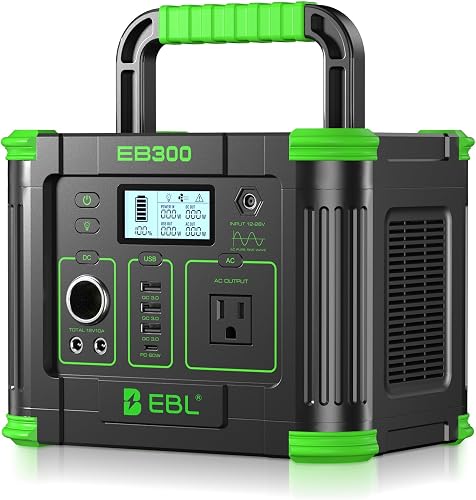
EBL 330W Portable Power Station 288.6Wh Solar
Best for portable emergency light - 8
 Check it
Westinghouse 1500 Peak Watt Super Quiet
Best for lightest inverter pick
The A-iPower models in these A-iPower generator reviews
The 2300W dual fuel inverter generator is the best fit for most portable power needs in this group. The 5000-Watt gas model wins on output and tank size, while the other picks win on quiet battery power or lower wattage.
BLUETTI Elite 30 V2 Portable Power Station: Best for compact battery backup
- 288Wh capacity
- 600W continuous and 1500W surge power
- 9.4 lb weight
- 10ms UPS switch
A light battery unit for phones, laptops, CPAP machines and small appliances. It suits camping and short outages better than moving a fuel generator.
Pros
- Light enough to carry upstairs
- Fast wall charging
- UPS mode for critical devices
Cons
- 288Wh is small for larger appliances
- Battery runtime drops fast at high wattage
The BLUETTI Elite 30 V2 Portable Power Station suits buyers who want backup power without fuel, exhaust or engine noise. It weighs 9.4 lb, measures 9.8 by 7 by 6.6 inches and gives 288Wh of storage with 600W continuous output and 1500W surge power.
That combination fits laptops, CPAP machines, routers, camping lights, speakers, car fridges and a small kettle or toaster in short bursts. Runtime comes from capacity divided by device watts, so a lower watt device will run far longer than one near the 600W limit.
Power Lifting Mode raises the ceiling to 1500W when a motor or heating element needs a brief surge. The 10ms UPS switch helps protect data and keep critical devices running when power cuts suddenly, with four modes including Standard, Time-of-Use, PV Priority and Custom.
Wall charging uses up to 380W and reaches 80% in 45 minutes, with solar, car and combined inputs also supported. Its trade-off against A-iPower fuel models is capacity.
A battery station is quiet and clean, but 288Wh is small for a fridge or tools, so choose it for light loads, not whole home backup.
PowerSmart 4000 Watt Portable Inverter Generator: Best for quiet home backup
- 4000 starting watts and 3200 running watts
- Under 3% THD
- 59 dBA from 23 feet
- Parallel ready
A quiet gasoline inverter generator with clean power for laptops and phones. It fits home backup and camping where noise matters.
Pros
- Quiet for its output
- Clean power under 3% THD
- Can pair with a second unit
Cons
- Gasoline only
- 50.7 lb weight limits one person moves
The PowerSmart 4000 Watt Portable Inverter Generator suits home backup and camping where noise matters and loads are bigger than a battery station can handle. It gives 4,000 starting watts and 3,200 running watts with THD under 3%, which makes clean power for laptops, mobile phones and tablets.
It runs at 59 dBA from 23 feet, which is quiet for this wattage class. For more compact low-noise choices, see small quiet generators.
The 149cc four stroke engine uses Cold Start Technology and Low Oil Shutdown, and Eco Mode helps cut fuel use when the load is light.
The panel has a 120V 20A 5-20R duplex, a 120V 30A L5-30R twist lock, a 12V 8A DC outlet and dual 5V 2.1A USB ports. That mix covers RV adapters, battery charging and phone charging without hunting for extra cables.
Parallel connection can double output with a second matching 4000W unit, though the parallel kit is sold separately. At 50.7 lb with a built in handle, it moves well between home and camp.
Its trade-off is fuel and weight. It runs on gasoline only, so against the A-iPower 2300W model it gives more watts but no dual fuel choice and a heavier carry.
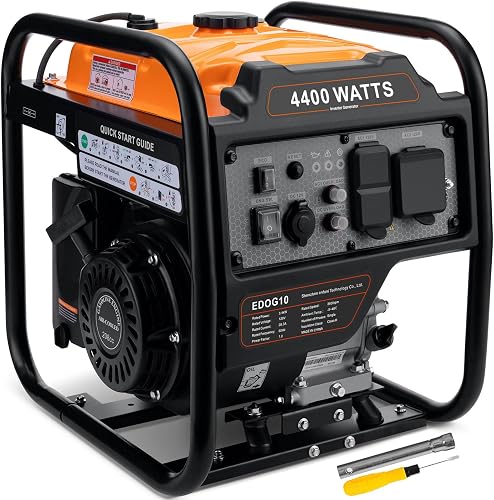
Oxseryn 4400-Watts Inverter Generator: Best for RV ready output
- 4400 peak watts and 3400 running watts
- 30A RV port
- 14 hours at 25% load
- 56 lb weight
A gasoline inverter generator with a dedicated RV outlet and 14 hours at light load. It suits RV use and home backup at camping spots.
Pros
- RV ready 30A outlet
- Long light load runtime
- Inverter power for sensitive devices
Cons
- Gasoline only
- Open frame design is less enclosed
The Oxseryn 4400-Watts Inverter Generator suits RV users and home backup buyers who want a dedicated 30A RV outlet and long light load run time. It gives 4,400 peak watts and 3,400 running watts on gasoline, with inverter technology for cleaner power.
A 2 gallon tank gives 14 hours at 25% load, which helps when you rotate a fridge, lights and charging loads through an outage. Eco Mode, overload protection, low oil shutdown and Cold Start Technology protect devices and the engine during shifting loads.
The outlet mix includes two 120V AC ports, one 30A RV port and one 12V DC port. That mix suits RV hookups, camping appliances, battery charging and small tools at a campsite or jobsite trailer.
At 57 lb and an open frame design, it is portable for truck bed and camp use, though it is not a light one person carry over long distances. EPA compliance and electronic ignition add convenience for regular use.
Its trade-off against A-iPower fuel models is fuel choice and enclosure. It is gasoline only, while the A-iPower 2300W model offers propane as well.
Choose the Oxseryn for RV ready output and higher running watts, and choose the A-iPower model if dual fuel storage matters more.
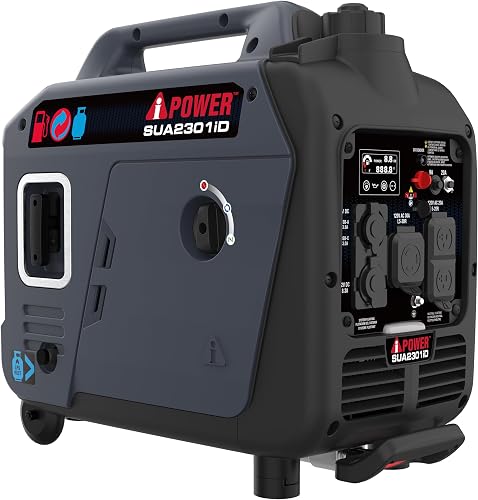
A-iPower 2300W Dual Fuel Inverter Generator: Best for dual fuel flexibility
- 2300 starting watts on gas
- 2000 starting watts on propane
- 61 dB sound level
- 40.3 lb weight
The core A-iPower pick here, with gas or propane choice, clean inverter power and a telescoping handle. It suits RV, camping and home backup without moving to a heavy frame generator.
Pros
- Dual fuel choice
- Light for an inverter generator
- CO sensor and RV ready outlets
Cons
- Lower output on propane
- Not enough for whole home loads
The A-iPower 2300W Dual Fuel Inverter Generator suits RV, camping and home backup buyers who want fuel choice and clean power in a carryable frame. It gives 2,300 starting watts with 1,800 running watts on gasoline, and 2,000 starting watts with 1,600 running watts on propane.
Its 80cc OHV four stroke engine, 61 dB sound level and 3% THD clean power make it fit laptops, TVs, phone chargers and sensitive power tools. Low Idle Technology helps at light load, and Fuel Sense Technology supports efficient use across fuels.
At 40.3 lb with a telescoping handle and wheels, it is much easier to move than a full size frame generator. The compact 19.7 by 10.7 by 18.5 inch body fits a truck bed, RV compartment or home storage closet.
The control panel has a CO sensor indicator, LED light, data center display, two USB 5VDC ports, one 12VDC 8.3A port, one L5-30R 30A outlet and one duplex 5-20R outlet. The kit includes oil, funnel, tool kit, 30A RV adaptor, 12V cables, parallel cable, LPG hose and regulator.
Its trade-off is output. It will not run a whole home, and propane output is lower than gasoline output.
For essential loads, it is the strongest A-iPower balance here.
A-iPower 5000-Watt Portable Generator Gas Powered: Best for jobsite and home backup
- 5000 starting watts and 4000 running watts
- 223cc OHV engine
- Up to 20 hours at 25% load
- 6.3 gallon tank
A heavy duty gas generator with strong output and a large tank. It suits jobsite work, RV use and home backup where long run time matters more than quiet inverter power.
Pros
- High running watts
- Large tank for long light load runs
- CO sensor shutdown
Cons
- 111.6 lb weight
- 68 dB sound level
- Gasoline only
The A-iPower 5000-Watt Portable Generator Gas Powered suits jobsite, RV and home backup use where output and run time matter most. It gives 5,000 starting watts with 4,000 running watts on gasoline, the highest running watts in this group.
Its 223cc OHV engine has a cast iron sleeve for long life and heat dissipation. Automatic Idle Control helps match engine speed to load, while a CO sensor indicator light and data center display support safety and monitoring.
A 6.3 gallon tank gives up to 20 hours at 25% load. That long light load run time helps during outages when you rotate a fridge, lights, fans and small appliances instead of running everything at once.
The panel has two 5-20R duplex 20A outlets, one L5-30R 30A outlet and one TT-30R 30A RV outlet. That mix covers jobsite tools, RV connections and home extension cords without a separate outlet box.
At 111.6 lb and 68 dB, this is a heavy, louder machine that needs a truck, ramp or two people to move. It is gasoline only, so it does not give the fuel choice of the 2300W dual fuel model.
Choose it for large loads and long runs, not for quiet camping or one person carries.
DYNESS Portable Power Station 300W: Best for small solar backup
- 256Wh LiFePO4 battery
- 300W continuous power
- 6 output ports
- Solar rechargeable
A compact battery station for laptops, routers and mini fridges. It suits quiet indoor backup and camping where you want no fuel or exhaust.
Pros
- LiFePO4 battery
- Multiple ports for small devices
- Can charge while in use
Cons
- 300W limits device size
- 256Wh runs out quickly at full load
The DYNESS Portable Power Station 300W suits camping, home backup and RV use for small devices where quiet, fuel free power matters. It has a 256Wh LiFePO4 battery and 300W continuous power, with 600W starting power in the specs.
That fits a laptop, router, mini fridge, camera and other small appliances under 300W total. LiFePO4 chemistry helps with long cycle life and stable storage for regular travel and emergency kit use.
It has 6 output ports in total, including 1 AC outlet, USB-C, USB-A, 2 DC outputs and 1 car outlet. You can power phones, tablets and car accessories at the same time without a hub.
Recharging options include AC wall outlet, compatible solar panel, car charger or dual input. It can charge while in use, which helps when solar input is slow and you still need a device powered.
Runtime follows a simple rule: 256Wh times 87% divided by device watts. A 50W device gives about 4.5 hours in that example, while a device near 300W will drain it far faster.
Full charge takes about 3.5 to 4 hours by AC or a 100W panel, and about 2 hours with dual input.
Its trade-off is power and capacity. It cannot run larger appliances or tools, so choose it for light backup, not jobsite power.
EBL 330W Portable Power Station 288.6Wh Solar: Best for portable emergency light
- 288.6Wh capacity
- 330W rated output and 600W peak
- 7.94 lb weight
- LED light and SOS mode
A light power station with a built in light, SOS mode and wireless charging pad. It suits camping and emergency kits for phones, TVs and small devices.
Pros
- Very light and compact
- Emergency light and SOS mode
- Wireless charging pad
Cons
- 330W output is modest
- Wall charge takes 6 to 7 hours
The EBL 330W Portable Power Station 288.6Wh Solar suits outdoor and home emergency use for small devices. It gives 288.6Wh of storage with 330W rated output and 600W peak surge power.
It can power a 32-inch TV for 4+ hours, a CPAP machine for 16+ hours or recharge a smartphone up to 25 times in the stated examples. Those examples show where this size works best, with low to moderate draw devices.
Ports include 2 DC 5521 ports, 1 12V cigarette lighter port, dual USB-A and USB-C ports, a 330W AC outlet and a 5W wireless charging pad. The USB-C port supports diverse device protocols, and the cigarette lighter port suits car accessories like inflators or mini fridges.
At 7.94 lb, measuring 9.61 by 6.73 by 6.96 inches with a foldable handle, it fits in a backpack or car trunk. Recharging options are 120V wall adapter, 12V car charger and 60 to 120W solar panels.
A 3W LED light and standalone SOS mode help at night and during storms without needing main power first. Auto cooling, overload and short circuit protection add safety at high load.
Its trade-off is charging time and output. Wall charging takes 6 to 7 hours, and 330W limits device size.
It suits phones, tablets, cameras and small emergency loads.
Westinghouse 1500 Peak Watt Super Quiet: Best for lightest inverter pick
- 1500 peak watts and 1000 rated watts
- As low as 52 dBA
- 12 hour run time on 0.79 gallon tank
- 32 lb weight
A light gasoline inverter generator for home essentials and camping. It suits buyers who want quiet, low watts and an easy carry.
Pros
- Lightest fuel model here
- Very quiet at low load
- Parallel capable
Cons
- Only 1000 rated watts
- Small 0.79 gallon tank
The Westinghouse 1500 Peak Watt Super Quiet suits buyers who want the lightest fuel generator here for home essentials and camping. It gives 1,500 peak watts and 1,000 rated watts at less than 3% THD, with clean power for TVs, laptops and mobile devices.
It weighs 32 lb in the bullets and 30.1 lb in the specs, with a built in carrying handle and compact 18.5 by 12.5 by 17 inch body. That makes it the easiest fuel model in this group to carry up stairs or into an RV.
It runs as low as 52 dBA, which is quieter than normal conversation in the product description. A 0.79 gallon tank gives 12 hours in Economy Mode, and the engine automatically adjusts speed to the load for fuel efficiency.
Two 120V 20A outlets and two USB outlets cover lights, phones, laptops and small appliances. It is parallel capable with a Westinghouse parallel cord, and it has low oil shutdown and overload protection.
Westinghouse backs it with 3-year limited service, labor and parts coverage. Its trade-off is low output and a small tank.
It will not match the A-iPower 2300W model on watts or fuel choice, so choose it for light loads, quiet use and easy carry.
Side by side: A-iPower generator reviews by key specs
The table shows the main split in one view. Battery stations give quiet light power, inverter generators give clean fuel power, and the A-iPower 5000-Watt model gives the highest running watts.
| Product | Best for | Capacity | Output | Weight | Our score |
|---|---|---|---|---|---|
| BLUETTI Elite 30 V2 Portable Power Station | compact battery backup | 288Wh | 600W continuous | 9.4 lb | 9.4 |
| PowerSmart 4000 Watt Portable Inverter Generator | quiet home backup | 9.4 | |||
| Oxseryn 4400-Watts Inverter Generator | RV ready output | 9.2 | |||
| A-iPower 2300W Dual Fuel Inverter Generator | dual fuel flexibility | 40.3 lb | 9.0 | ||
| A-iPower 5000-Watt Portable Generator Gas Powered | jobsite and home backup | 8.6 | |||
| DYNESS Portable Power Station 300W | small solar backup | 256Wh | 300W | 8.6 | |
| EBL 330W Portable Power Station 288.6Wh Solar | portable emergency light | 288.6Wh | 330W | 7.94 lb | 8.1 |
| Westinghouse 1500 Peak Watt Super Quiet | lightest inverter pick | 8.0 |
How we compared these A-iPower generator reviews
We checked specs first, then features, then how each model fits the search intent. Starting watts matter for motor loads, running watts matter for the devices you keep on.
We gave more weight to inverter models for electronics, because THD under 3% is a clear spec for clean power. We also weighed noise, weight and fuel choice, since those decide if you will use the unit at camp or at home.
Battery stations scored well for portability and quiet use, but they lost points for capacity. A 256Wh to 288.6Wh station cannot match a fuel generator on long runs or larger appliances.
We did not test these units hands on. We compared the stated specs and buyer patterns, and we label maker claims as claims where they matter.
Why running watts drive the ranking
Running watts set how many devices you can keep on at once. Starting watts only cover the brief surge when a motor starts.
A model with higher running watts, like the 5000-Watt A-iPower unit, can support more simultaneous loads.
What is a dual fuel inverter generator and how does it work?
A dual fuel inverter generator runs on gasoline or propane and uses inverter technology to make clean power. The A-iPower 2300W model is the clear example here, with 1,800 running watts on gas and 1,600 running watts on propane.
Fuel choice changes output, run time and storage. Propane often suits owners who prefer sealed fuel storage, while gasoline gives higher watts in this model.
Our guide on What Is a Dual Fuel Inverter Generator and How Does It Work? explains the trade-offs in more depth.
Gasoline output versus propane output
Gasoline gives more starting and running watts on the A-iPower 2300W model. That helps with motor loads such as a small fridge or power tool.
Propane gives lower watts but a different fuel option for storage and availability.
Clean power for electronics
The 2300W model gives 3% THD, which makes it a fit for laptops, TVs and chargers. That is a key reason it beats a conventional generator for RV and home use with electronics.
How much power do you need for home backup?
Most home backup buyers should add up running watts for the devices they want on at the same time. Starting watts only cover the brief surge when a motor starts.
The A-iPower 2300W model suits essentials such as lights, phones, laptops and a small fridge. The A-iPower 5000-Watt model suits larger loads with 4,000 running watts and a long light load run time.
Our guide to the Best Dual Fuel Inverter Generator For Power Outages helps if outages are your main use. It focuses on models and features that matter when the grid goes down.
Essential loads for a 2300W inverter generator
A 2300W inverter generator fits phones, laptops, TVs, lights and a small fridge with careful load management. It does not fit a whole home load list at once.
Add watts first, then match the model.
Larger loads for a 5000 watt gas generator
The A-iPower 5000-Watt model fits more home loads, jobsite tools and RV use. Its 6.3 gallon tank helps on long outages at light load.
Its weight and noise are the price of that output.
Are A-iPower generators quiet enough for camping?
The A-iPower 2300W dual fuel inverter generator runs as low as 61 dB. That sound level makes it a camp friendly choice compared with the 68 dB A-iPower 5000-Watt model.
Noise matters more at night and at shared campgrounds. Inverter models also use Eco Mode or Low Idle Technology to cut engine speed at light load.
Inverter generators for RV and camp use
Inverter models give clean power for RV electronics and quieter light load use. The 2300W A-iPower model has RV ready outlets and a 30A RV adaptor in the kit.
That helps with direct RV connections.
Battery stations for silent power
Battery stations make no exhaust and no engine noise. The BLUETTI, DYNESS and EBL models here suit small devices and quiet indoor backup.
They lose on capacity and run time for larger loads.
Should you compare A-iPower with other inverter brands?
Yes, because price, parts and parallel options differ by brand. A close comparison helps you see if A-iPower gives the best fit for your use or if another brand fits better.
Our best pulsar inverter generator guide gives a useful brand comparison point. It shows how another inverter line stacks up on output and features.
Our are predator inverter generators any good guide is another useful check. It helps you compare buyer feedback and value claims across brands.
Our best genmax inverter generator guide rounds out the comparison set. Use these sibling guides to check parallel options, outlet mix and warranty before you buy.
Brand comparison points that matter
Check running watts, not just starting watts. Check THD for electronics, noise for camping, and weight for transport.
Check the outlet types against your RV or home plugs.
Parallel power and future upgrades
Some models here are parallel ready. The A-iPower 2300W model includes a parallel cable, and the Westinghouse model is parallel capable with a separate cord.
Parallel power can help if your loads grow later.
How should you set up and care for a portable generator?
Set up matters for safety and power quality. Run fuel generators outdoors only, away from windows and doors.
Keep the CO sensor in mind and never run a fuel unit in a garage or enclosed space.
Check oil before first use and follow the manual for oil type and change intervals. Store fuel safely, run the unit now and then, and let it cool before refueling.
Safe placement and ventilation
Place fuel generators outdoors with exhaust pointed away from people. Keep them dry, level and clear of fuel containers.
Battery stations need ventilation too, but they do not make exhaust.
Load management and run time
Start with the largest motor load first, then add smaller loads. Use Eco Mode for light loads and watch fuel or battery level.
A simple load list prevents overload trips and short runtimes.
What is the verdict on these A-iPower generator reviews?
Pick the A-iPower 2300W Dual Fuel Inverter Generator if you want the best all around A-iPower fit for RV, camping and essential home backup. Pick the A-iPower 5000-Watt model if you need 4,000 running watts, a 6.3 gallon tank and jobsite output.
Pick a battery station if you want quiet, fuel free power for phones, laptops and small devices. Pick the PowerSmart or Oxseryn models if you want more inverter watts without staying inside the A-iPower line.
Use these A-iPower generator reviews as a shortlist, then match the final pick to your load list. Check outlets, fuel choice, noise and weight before you buy, and plan for safe outdoor use.
Our top 3 picks at a glance
-
1
Best for compact battery backup
BLUETTI Elite 30 V2 Portable Power Station
9.4/10 our score
See it on Amazon -
2
Best for quiet home backup
PowerSmart 4000 Watt Portable Inverter Generator
9.4/10 our score
See it on Amazon -
3
Frequently asked questions
Are A-iPower generators good for home backup?
A-iPower models here cover light home backup in two different ways. The 2300W dual fuel inverter generator suits phones, laptops, TVs and small appliances with clean inverter power.
The 5000-Watt gas model suits larger loads with 4,000 running watts, but it is heavier and louder.
Match the watts to the loads you plan to run first.
Is the A-iPower 2300W dual fuel model better on gas or propane?
Gasoline gives the 2300W model 2,300 starting watts and 1,800 running watts. Propane gives 2,000 starting watts and 1,600 running watts.
Choose gasoline for the highest output and propane for fuel choice and storage preference.
Check A-iPower guidance for fuel use in cold weather before you rely on one fuel in winter.
How long will an A-iPower generator run?
Run time depends on load, tank size and fuel. The A-iPower 5000-Watt model runs up to 20 hours at 25% load with a 6.3 gallon gasoline tank.
The 2300W dual fuel model is built for fuel efficient inverter use, but run time changes with load and fuel.
Always plan by running watts, not starting watts.
Can I run sensitive electronics on an A-iPower inverter generator?
The A-iPower 2300W dual fuel inverter generator gives 3% THD clean power for laptops, TVs and phone chargers. That makes it a better fit for electronics than a standard portable generator.
The A-iPower 5000-Watt model is a conventional portable generator, so check your device needs before using it for sensitive electronics.
What is the difference between an inverter generator and a portable generator?
An inverter generator produces cleaner power with lower THD and usually runs quieter at light load. A conventional portable generator gives more watts for the size, but power quality can be rougher.
Choose inverter power for electronics and camping noise limits.
Choose a larger portable generator for jobsite tools and larger home loads.