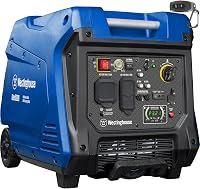
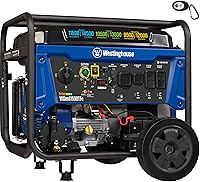
5 Best Westinghouse Propane Generators (November 2026)
The best Westinghouse propane generators include the Westinghouse 12500 Watt Dual Fuel Home Backup for whole home backup, the Westinghouse 4650 Peak Watt Dual Fuel Portable for RV camping, and the Westinghouse 12000 Peak Watt Dual Fuel Portable for quiet home backup.
On this page (9 sections)
- The best Westinghouse propane generators for home, RV and camping
- Best Westinghouse propane generator: side by side comparison
- How we compared these Westinghouse propane generators
- How much propane power do you need?
- Is propane or gasoline better for a dual fuel generator?
- Which start type is worth paying for?
- Inverter or open frame: which should you buy?
- How should you set up and care for a propane generator?
- Verdict: which Westinghouse propane generator should you buy?
The best Westinghouse propane generator for most homes is the Westinghouse 12500 Watt Dual Fuel Home Backup, with 8500 running watts on propane and remote start. If you want cleaner and quieter power for home backup, pick the 12000 Peak Watt inverter.
If you camp in an RV and need a 30A outlet, pick the 4650 Peak Watt model.
Propane gives you fuel flexibility, cleaner burning and easier storage than gasoline. The trade off is lower output on propane for every dual fuel model here.
Always size your load to the propane rating, not the gasoline rating.
Our score weighs specs, features and buyer feedback against what you are shopping for. We compared propane output, runtime, noise, weight, outlets, start type and safety features across these five models.
Start with the best westinghouse portable generators if you want more portable options. For start features, see the best westinghouse remote start generator guide.
Our picks at a glance
-
1
 Best for whole home backup
Westinghouse 12500 Watt Dual Fuel Home Backup
9.7/10 our score
See it on Amazon -
2
 Best for RV camping
Westinghouse 4650 Peak Watt Dual Fuel Portable
9.6/10 our score
See it on Amazon -
3
 Best for quiet home backup
Westinghouse 12000 Peak Watt Dual Fuel Portable
9.4/10 our score
See it on Amazon
- 4
 Check it
Westinghouse 2550 Peak Watt Super Quiet
Best for light camping - 5
 Check it
Westinghouse 4000 Peak Watt Super Quiet Dual
Best for RV and home essentials
The best Westinghouse propane generators for home, RV and camping
The five picks cover three clear jobs. Two large models cover whole home backup.
Two quiet inverters cover camping and essentials. One mid size open frame model covers RV use at a lower cost.
Westinghouse 12500 Watt Dual Fuel Home Backup: Best for whole home backup
- 9500 running watts and 12500 peak watts on gasoline
- 8500 running watts and 11200 peak watts on propane
- Remote start with included key fob
- Up to 12 hours on 6.6 gallon tank
- Transfer Switch Ready 30A and RV Ready 50A outlets
The strongest propane output here, with remote start and transfer switch readiness for whole home backup.
Pros
- Highest propane running watts in this group
- Remote start with key fob included
- 50A and 30A outlets for major appliances
Cons
- Large open frame cabinet
- Most fuel use at high load
This model suits a home that needs power for a refrigerator, sump pump, lights and a large appliance at the same time. It gives 8500 running watts on propane, the highest propane output in this group.
The 457cc engine runs up to 12 hours on a 6.6 gallon tank for gasoline use. At a heavy home load you should expect shorter runtime and plan for refills.
A fuel gauge and digital hour meter help you track use and schedule maintenance.
Remote start with an included key fob is handy during a storm. You can start it from a distance without going outside in bad weather.
Electric and recoil start give you a backup if the battery runs low and keep you from pulling a cord in cold conditions.
The outlet set includes two GFCI household outlets, a Transfer Switch Ready 30A outlet and a 50A RV Ready outlet. That mix suits home backup through a transfer switch and larger RV hookups.
All outlets have rubber covers for added safety.
The trade off is size and fuel use. This is a large open frame unit for a garage or shed, not a small camping generator.
It also uses more fuel than the inverters at the same load, so propane tanks or gasoline cans need planning.
Westinghouse 4650 Peak Watt Dual Fuel Portable: Best for RV camping
- 4650 peak watts on gasoline and propane
- 3600 rated watts on gasoline, 3240 on propane
- 4 gallon tank, up to 14 hours per tank
- RV Ready TT 30R and L5 30R 30A outlets
- CO sensor and automatic low oil shutdown
A mid size RV pick with a 30A outlet, CO sensor and long stated runtime on a 4 gallon tank.
Pros
- RV Ready 30A outlet included
- CO sensor for added safety
- Long runtime per tank
Cons
- 108 lb weight
- No remote start
This model suits RV owners who want a 30A outlet and a CO sensor without paying for a large home backup unit. It gives 3240 rated watts on propane and 3600 rated watts on gasoline, so plan for the lower propane figure.
The 212cc engine runs up to 14 hours on a 4 gallon tank. Westinghouse also states up to 16.5 hours on a 20 lb propane tank.
That long runtime suits overnight camping and weekend trips where refills are a chore.
Outlets include one household duplex, one RV Ready TT 30R 30A outlet and one L5 30R 30A outlet. Rubber covers protect the outlets from dust and debris.
The 30A outlets hook to a travel trailer with enough power for a 15,000 BTU air conditioner plus other basics.
Automatic low oil shutdown and a CO sensor add safety for enclosed campsite areas. A digital readout shows voltage, frequency and lifetime hours.
Overload protection helps protect the unit when you plug in too much at once.
The trade off is weight and start type. At 108 lb, it is not a one hand carry.
It also has magneto ignition with no remote or electric start, so you start it at the unit with a recoil pull.
Westinghouse 12000 Peak Watt Dual Fuel Portable: Best for quiet home backup
- 12000 peak and 9000 running watts on gasoline
- 11000 peak and 8100 running watts on propane
- Less than 3% THD for sensitive electronics
- As low as 64 dBA with Eco Mode
- Up to 19 hours at 25% load on 7.9 gallon tank
An inverter with 8100 running watts on propane, low THD and 64 dBA operation for neighborhood friendly backup.
Pros
- Clean power under 3% THD
- Parallel ready to double output
- Remote start and transfer switch ready outlets
Cons
- 187.4 lb weight
- Large footprint
This inverter suits a home that wants whole home backup with cleaner power for electronics. It gives 8100 running watts on propane with less than 3% THD, close to the 8500 watts from the open frame leader.
Westinghouse says operation can be as low as 64 dBA with Eco Mode, insulation and mufflers. That is quieter than the open frame models here.
It still needs outdoor placement and distance from sleeping areas, since 64 dBA is low for a generator but not silent.
The 457cc engine runs up to 19 hours at 25% load on a 7.9 gallon tank. Inverter technology matches engine speed to demand, which cuts fuel use at light loads.
That large tank and Eco Mode together give the longest stated runtime in this group at light load.
Remote start, a 50A outlet and a 30A twist lock outlet make it transfer switch or interlock kit ready. It is also parallel ready to double output with a second unit.
A GFCI duplex outlet gives you a standard household socket for smaller loads.
The trade off is weight and size. At 187.4 lb, you need a truck bed, ramp or lift to move it.
The LED data center helps track fuel and runtime, but it does not replace regular oil checks or air filter care.
Westinghouse 2550 Peak Watt Super Quiet: Best for light camping
- 2550 peak watts and 1900 rated watts
- Less than 3% THD
- 42 lb weight
- As low as 52 dBA
- Up to 11 hours on 1.16 gallon tank at 25% load
The lightest and quietest pick, with clean power and RV Ready outlet for essentials and electronics.
Pros
- Only 42 lb
- 52 dBA operation
- Parallel capable
Cons
- Low output for major appliances
- Small 1.16 gallon tank
This inverter suits campers and light home backup needs where weight and noise matter most. It gives 1900 rated watts with less than 3% THD for sensitive electronics like TVs, laptops and tablets.
At 42 lb, it is the lightest model here by a wide margin. A built in carrying handle makes it easy to move from a car to a campsite or from a garage to a patio.
That weight makes a real difference for older users or for stairs and truck beds.
Westinghouse says noise can be as low as 52 dBA, which is quieter than average conversation. Economy Mode lowers engine speed at light loads to save fuel.
The engine adjusts to produce only the power needed at that moment.
Runtime is up to 11 hours on a 1.16 gallon tank at 25% load. Outlets include one RV Ready 30A outlet, two household outlets and two USB outlets.
The RV outlet hooks to a travel trailer for air conditioning and travel basics.
The trade off is power and tank size. It can run essentials and smaller appliances, but it will not run a whole home or a large air conditioner.
It is parallel capable if you need more output later by pairing another inverter.
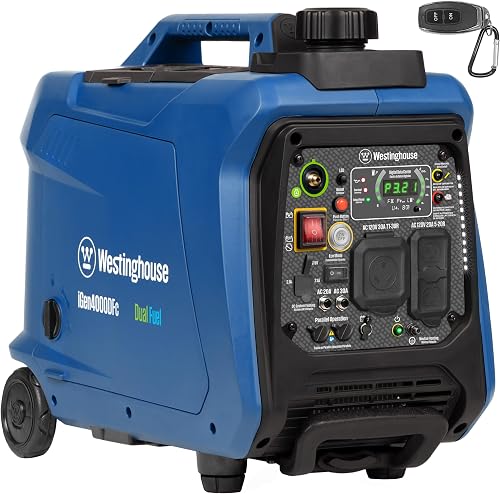
Westinghouse 4000 Peak Watt Super Quiet Dual: Best for RV and home essentials
- 4000 peak watts and 3300 rated watts
- Less than 3% THD
- Remote start with key fob
- As low as 52 dBA
- Up to 7 hours on 1.69 gallon tank
A quiet inverter with remote start and enough power for RV essentials, travel and home backup.
Pros
- Remote start included
- Less than 3% THD
- Telescoping handle and never flat wheels
Cons
- 7 hour runtime is shortest here
- 62.8 lb weight
This inverter suits RV and home essential loads where remote start and clean power matter. It gives 3300 rated watts with less than 3% THD, which is well above the 2550 model and below the large home backup units.
Remote start with an included key fob, plus electric and recoil start, gives you options if you need to start it from inside a tent or RV. The LED data center shows fuel, output, remaining runtime, voltage and lifetime hours.
That display removes guesswork about when to refuel.
Westinghouse says noise can be as low as 52 dBA. Economy Mode helps fuel use at light loads.
Runtime is up to 7 hours on a 1.69 gallon tank, the shortest in this group, so long trips need extra fuel on hand.
Outlets include a household duplex, an RV Ready 30A outlet and two USB outlets. A telescoping handle and never flat wheels help with transport over parking lots and campsites.
Automatic low oil and CO shutdown add safety for close quarters.
The trade off is runtime and weight. A 1.69 gallon tank means more refills on long trips.
At 62.8 lb, it is also heavier than the 2550 Peak Watt model, though still far lighter than the open frame and large inverter models.
Best Westinghouse propane generator: side by side comparison
| Product | Best for | Running watts (propane) | Peak watts (gasoline) | Engine | Our score |
|---|---|---|---|---|---|
| Westinghouse 12500 Watt Dual Fuel Home Backup | whole home backup | 8500 | 12500 | 457cc 4-stroke OHV | 9.7 |
| Westinghouse 4650 Peak Watt Dual Fuel Portable | RV camping | 3240 | 212cc 4-stroke OHV | 9.6 | |
| Westinghouse 12000 Peak Watt Dual Fuel Portable | quiet home backup | 8100 | 12000 | 457cc 4-stroke OHV | 9.4 |
| Westinghouse 2550 Peak Watt Super Quiet | light camping | 9.1 | |||
| Westinghouse 4000 Peak Watt Super Quiet Dual | RV and home essentials | 8.9 |
The table shows the real gap between propane and gasoline output. The two large models give more than twice the propane power of the quiet inverters.
The inverters give cleaner power and lower noise.
Weight is the other clear split. The 12000 Peak Watt inverter weighs 187.4 lb.
The 2550 Peak Watt inverter weighs 42 lb. Pick by how you will move it, not only by watts.
Tank size and runtime also split the group in a useful way. The 12000 model pairs a 7.9 gallon tank with up to 19 hours at 25% load.
The 4000 model pairs a 1.69 gallon tank with 7 hours, so you trade runtime for a smaller, lighter package.
Start type is a third split that matters in daily use. Remote start appears on the 12500, 12000 and 4000 models.
The 4650 and 2550 models require you to walk to the unit, which is fine for camping but less handy in a storm.
Safety features follow a similar pattern. CO sensors appear on the 4650, 12000, 2550 and 4000 models.
Low oil shutdown appears across the group, and the large models add GFCI outlets and rubber covers for extra protection.
How we compared these Westinghouse propane generators
We checked propane running watts first, because that is the power you will use on propane. We then checked runtime at stated loads, tank size, noise where listed and weight.
We also checked outlet type, start type and safety features. A 30A RV outlet, a 50A home outlet, remote start and a CO sensor each suit a different job.
We used buyer feedback patterns to help set scores. We did not test these units by hand.
All specs come from Westinghouse data for each model.
We gave extra weight to propane output for home backup picks because a refrigerator or sump pump will not wait for a refill. We gave extra weight to noise and weight for camping picks because a loud or heavy unit changes where you can use it.
We checked included parts as well, since oil, a funnel, a propane hose and a battery charger affect how fast you can start using a new generator. Most models here include the basics for a plug and play start with minimal assembly.
We also looked at warranty and support terms in the product data. Each model lists 3 year limited service, labor and parts coverage with lifetime technical support through a nationwide network.
How much propane power do you need?
Start with your largest appliance, then add the rest. A refrigerator, air conditioner or sump pump needs peak start power.
Running watts cover steady loads.
The 12500 Watt model gives 8500 running watts on propane. The 12000 Peak Watt inverter gives 8100 running watts on propane.
Both suit whole home backup.
Whole home loads
Pick the 12500 Watt or 12000 Peak Watt model for home backup. Both have transfer switch ready outlets.
You still need a transfer switch or interlock kit for safe home wiring.
Think about what you will run at once. A refrigerator, lights, phones and a sump pump fit well within 8100 to 8500 watts.
Adding a large air conditioner pushes you toward careful load management and the higher end of the range.
RV and camping loads
Pick the 4650 Peak Watt model for a 30A RV outlet and long runtime. Pick the 4000 Peak Watt inverter for quieter RV power with remote start.
Pick the 2550 Peak Watt inverter for light loads and easy carry.
For RV use, check your trailer air conditioner size and your other loads together. A 30A outlet does not mean every appliance can start at the same second.
Stagger large loads and let the generator steady out between starts.
For more propane runtime detail, see our guide to watt dual fuel generator for propane runtime and the updated watt dual fuel generator for propane runtime list.
Is propane or gasoline better for a dual fuel generator?
Propane stores better and burns cleaner, but gasoline gives more watts. Every model here gives lower running watts on propane than on gasoline.
Propane also avoids stale fuel in storage. That helps if you store a generator for storms or seasonal camping.
Gasoline gives more power for a large load.
How to choose fuel for a storm
Use propane if you want longer storage and simpler refills. Use gasoline if you need the highest output for a short outage.
Both fuels are fine for these models.
In a long outage, propane tanks can be swapped quickly and stored upright in a ventilated space. Gasoline needs stabilizer and careful storage, but it packs more energy per gallon for the same tank.
If you want a third fuel option for later, see the best westinghouse tri fuel generator guide.
Which start type is worth paying for?
Remote start is worth it for home backup and cold weather. The 12500 Watt, 12000 Peak Watt and 4000 Peak Watt models include remote start.
Electric start alone is still handy. It saves pulling a recoil cord.
The best westinghouse generator with electric start guide covers models with that feature.
Recoil start is a useful backup. Keep the battery charged for electric and remote start.
A 12V battery charger is included with the large models.
When start type matters most
Remote start matters most when the generator sits outside and weather is poor. It also helps when you need power quickly for medical devices or a sump pump at night.
Electric start matters for daily camping use where you start and stop often. Recoil start matters as a fallback if the battery is flat after storage, so keep the charger handy.
Inverter or open frame: which should you buy?
Pick an inverter for clean power and low noise. The 12000, 2550 and 4000 Peak Watt inverters give less than 3% THD.
Clean power suits laptops, TVs, tablets and phones. Inverters also match engine speed to load, which saves fuel at light loads.
Open frame advantage
Open frame models cost less per watt and give strong output. The 12500 Watt and 4650 Peak Watt models suit large loads and RV towing.
The trade off is noise and power quality. Open frame models do not list a THD figure here.
Noise in real use
Inverters in this group list 52 to 64 dBA. Open frame models do not list a noise figure, but their exposed engine design generally runs louder and steadier at high speed.
If you camp near other people or run a generator at night, the quieter inverter is worth the premium. If you need maximum watts for a jobsite or home backup, the open frame trade off makes sense.
How should you set up and care for a propane generator?
Run it outdoors, away from windows and doors. Keep it on dry, level ground under cover if possible.
Check oil before each use. Westinghouse includes oil and a funnel with these models.
Change oil on the schedule in your user manual.
Let the engine warm up before you plug in a load. Plug in appliances after the generator runs steady.
Turn off the generator before you refuel it.
Store propane tanks upright in a ventilated area. Keep the generator dry and clean.
Run it for a short period every few months to keep parts moving.
Storage and maintenance habits
Keep the air filter clean and check it before long trips or dusty jobsite use. A clogged filter lowers output and raises fuel use.
Track lifetime hours on the digital display where fitted. That hour meter helps you plan oil changes and service before small issues turn into a failed start.
Check rubber outlet covers, cords and the propane hose for cracks or wear. Replace damaged parts before you rely on the unit in a storm or in camp.
Verdict: which Westinghouse propane generator should you buy?
Pick the Westinghouse 12500 Watt Dual Fuel Home Backup for whole home power. It gives the most propane watts here with remote start and transfer switch readiness.
Pick the 12000 Peak Watt inverter if you want cleaner, quieter home backup. Pick the 4650 Peak Watt model for RV camping with a 30A outlet.
Pick the 2550 Peak Watt inverter for light, quiet camping. Pick the 4000 Peak Watt inverter for remote start and RV essentials.
Match the propane rating to your load, plan for the weight and store the unit where you can move it fast.
Our top 3 picks at a glance
-
1
Best for whole home backup
Westinghouse 12500 Watt Dual Fuel Home Backup
9.7/10 our score
See it on Amazon -
2
Best for RV camping
Westinghouse 4650 Peak Watt Dual Fuel Portable
9.6/10 our score
See it on Amazon -
3
Best for quiet home backup
Westinghouse 12000 Peak Watt Dual Fuel Portable
9.4/10 our score
See it on Amazon
Frequently asked questions
Is propane better than gasoline for a Westinghouse generator?
Propane burns cleaner and stores well, but running watts are lower on propane for these models. The 12500 Watt model gives 8500 running watts on propane versus 9500 on gasoline.
Check the propane rating for your load before you choose a fuel.
Can a Westinghouse propane generator run a house?
The 12500 Watt and 12000 Peak Watt models can support home backup with transfer switch ready outlets. They still need a transfer switch or interlock kit for safe home wiring.
Smaller inverter models suit essentials, not whole home loads.
How long will a Westinghouse dual fuel generator run on propane?
Runtime depends on load and tank size. The 4650 Peak Watt model is stated at up to 14 hours per 4 gallon tank on gasoline and 16.5 hours on a 20 lb propane tank.
Inverter models list runtime at 25% load.
Do I need an inverter for sensitive electronics?
An inverter gives cleaner power with less than 3% THD, which suits laptops, TVs and similar electronics. The 12000, 2550 and 4000 Peak Watt models here list less than 3% THD.
Open frame models do not list a THD figure.
What outlet do I need for an RV?
Look for an RV Ready TT 30R 30A outlet for most travel trailers. The 4650, 2550 and 4000 Peak Watt models include that outlet.
The larger home backup models give 50A outlets for home or larger RV loads.