9 Best Solar Generators with Panels for RVs (November 2026)
The best RV solar panels and generators include the MARBERO 237Wh Solar Generator with Solar Panel for compact overnight power, the Jackery Solar Generator 1000 v2 and 200W for most RV travelers, and the MARBERO 111Wh Solar Generator with Panels Included for lightest travel kit.
On this page (7 sections)
- Which RV solar generator is best for your travel style?
- Best RV solar generators with panels
- How much battery capacity does an RV need?
- What solar panel size works best for RV travel?
- Can an RV solar generator run a 30-amp setup?
- How should you set up solar panels at an RV campsite?
- Best RV solar panels and generators: final picks
The best RV solar panels and generators for most travelers are the Jackery Solar Generator 1000 v2 and 200W bundle, because its 1,070Wh battery and 1,500W AC output cover more RV needs than compact 100W to 300W stations.
That middle ground matters on the road. You get room for laptops, lights, fans and repeated phone charging without giving up a large share of your storage space.
Smaller MARBERO and Jackery kits are easier to carry and slip into a tote or a side compartment.
They suit short stops, tent nights beside the RV and trips where personal electronics are the main load.
The EcoFlow DELTA Pro 3 sits at the other end of this list.
Its larger battery and higher output are built for serious backup loads, but its weight changes how you plan storage and handling.
We compared portable solar battery bundles by capacity, output, included panel size, portability and the type of RV use they support.
Capacity alone did not decide the order.
A station also needs ports that match your devices, a panel that can recharge it in daylight and a weight you can actually move from the RV to a picnic table.
For another focused list, see our guide to the best portable solar panel generator.
Use that guide if you want a broader view of portable panels before you compare the RV specific bundles here.
It can help you see how panel size and connector choice affect charging speed.
Our picks at a glance
-
1
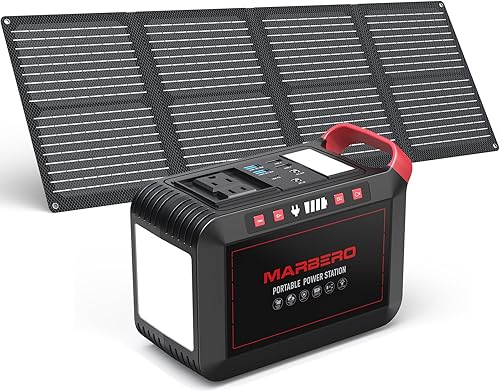 Best for compact overnight power
MARBERO 237Wh Solar Generator with Solar Panel
9.7/10 our score
See it on Amazon -
2
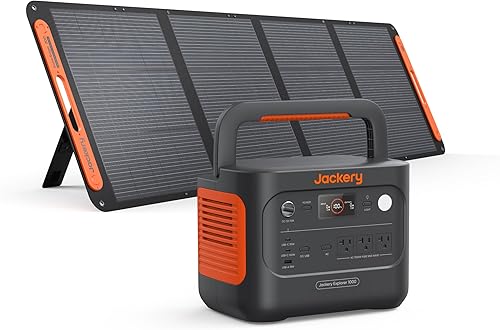 Best for most RV travelers
Jackery Solar Generator 1000 v2 and 200W
9.6/10 our score
See it on Amazon -
3
 Best for lightest travel kit
MARBERO 111Wh Solar Generator with Panels Included
9.5/10 our score
See it on Amazon
- 4
 Check it
Jackery Solar Generator 300 and 40W Solar
Best for weekend electronics - 5
 Check it
OUPES Mega 1 Solar Generator with 100W
Best for expandable RV power - 6
 Check it
Apowking Solar Powered Generator 100W
Best for basic camping loads - 7
 Check it
EF ECOFLOW DELTA Pro 3 Solar Generator
Best for whole-RV backup power - 8
 Check it
DaranEner Solar Generator with Panels Included
Best mid-size LiFePO4 bundle - 9
 Check it
GRECELL 100W Portable Solar Panel for Power
Best for adding solar input
Which RV solar generator is best for your travel style?
The MARBERO 237Wh is the highest-scoring compact bundle, while the Jackery 1000 v2 is the strongest all-around choice for most RV travelers. Your best fit depends on whether you need light electronics, longer runtime or high-wattage backup.
Our score weighs specs, features and buyer feedback against what you're shopping for. A higher score here reflects a better match for RV solar panels and generators, not a promise that one unit can run every RV appliance.
For more focused comparisons, read our guide to the best solar generator for RV and our list of the best solar generator for 30 amp RV.
| Product | Best for | Battery | Output | Solar panel | Our score |
|---|---|---|---|---|---|
| MARBERO 237Wh Solar Generator with Solar Panel | compact overnight power | 237Wh | 300W rated, 375W peak | 60W foldable panel included | 9.7 |
| Jackery Solar Generator 1000 v2 and 200W | most RV travelers | 1,070Wh | 1,500W AC, 3,000W surge | 200W included | 9.6 |
| MARBERO 111Wh Solar Generator with Panels Included | lightest travel kit | 111Wh | 80W running, 120W peak | 30W included | 9.5 |
| Jackery Solar Generator 300 and 40W Solar | weekend electronics | 292Wh | 300W rated, 600W peak | 40W included | 9.3 |
| OUPES Mega 1 Solar Generator with 100W | expandable RV power | 1,024Wh, expandable to 5,120Wh | 2,000W, 4,500W surge | 100W included | 9.1 |
| Apowking Solar Powered Generator 100W | basic camping loads | 146Wh | 100W rated, 200W peak | 40W included | 9.1 |
| EF ECOFLOW DELTA Pro 3 Solar Generator | whole-RV backup power | 4,096Wh, expandable to 48kWh | 4,000W, 8,000W starting wattage | 9.0 | |
| DaranEner Solar Generator with Panels Included | mid-size LiFePO4 bundle | 576Wh LiFePO4 | 600W rated, 1,200W peak | 100W included | 8.7 |
| GRECELL 100W Portable Solar Panel for Power | adding solar input | 8.0 |
Best RV solar generators with panels
These products are ordered by score. The write-ups explain what each bundle can handle and where its limits matter for RV travel.
MARBERO 237Wh Solar Generator with Solar Panel: Best for compact overnight power
- 237Wh battery
- 300W pure sine wave output
- 60W foldable solar panel
- 2 AC outlets and USB ports
This compact MARBERO bundle covers small electronics, lights and short off-grid stops. Its 300W output and 237Wh battery make it easier to carry than the larger choices.
Pros
- 60W panel included
- Pure sine wave AC output
- LED flashlight with 3 modes
Cons
- Not for devices over 300W
- Less battery capacity than larger picks
The MARBERO 237Wh bundle is the best fit for compact overnight power.
Its 300W rated output and 375W peak output cover small electronics, while the 60W foldable panel gives you a built-in way to recharge away from an outlet.
The station has 2 pure sine wave AC outlets, USB-A ports, a USB-C port and a DC output.
That mix suits phones, tablets, laptops, headphones, lights and similar low-draw gear.
It is a good match for one or two travelers who mainly need to keep personal devices charged through a night at a dry campsite.
The 237Wh battery is more useful for a short stop than for running large kitchen appliances.
Devices above 300W can damage the unit, so check the wattage of anything with a heating element before connecting it.
Peak output helps with brief start up demand, but rated output is the safer guide for daily use.
The built-in flashlight has flashlight, strobe and SOS modes.
The panel uses a smart chip and has a stated 21.5% to 23.5% conversion rate.
Jackery Solar Generator 1000 v2 and 200W: Best for most RV travelers
- 1,070Wh capacity
- 1,500W AC output
- 200W solar panel
- 3 pure sine wave AC ports
The Jackery 1000 v2 balances useful battery capacity with a manageable 23.8 lb weight. It suits RV travelers who need more than phone charging without moving to a large home-backup unit.
Pros
- Large capacity for its weight
- 200W panel included
- App charging controls
Cons
- Generator and panel ship separately
- Larger than compact 300W units
The Jackery Solar Generator 1000 v2 is the best choice for most RV travelers who want a larger battery without moving to a heavy home-backup station.
It combines 1,070Wh of capacity, 1,500W AC output and a 200W solar panel.
Three pure sine wave AC ports join 2 USB-C ports, a USB-A port and a DC car port.
That layout lets you charge several devices at once, while the 100W USB-C output can power compatible laptops without a separate adapter.
It suits longer RV trips where you want daytime solar charging plus enough stored power for evening electronics.
Jackery gives the unit a 3,000W surge peak and a 23.8 lb weight.
The power station and panel ship separately, so check that both parts arrive before planning a trip.
The app includes emergency charging, quiet overnight charging and energy efficiency modes.
Jackery also states that the LFP battery maintains more than 70% capacity after 4,000 charge cycles.
MARBERO 111Wh Solar Generator with Panels Included: Best for lightest travel kit
- 111Wh lithium battery
- 30W foldable solar panel
- 80W running output
- 4 USB-A and 1 USB-C port
This MARBERO kit is built around portability, with a 2.3 lb power station and 1.8 lb panel. It fits phone, camera, light and small laptop charging better than high-draw RV appliances.
Pros
- Very light power station
- Panel and charging cables included
- Multiple USB ports
Cons
- 80W running output
- Smallest battery among the main power stations
The MARBERO 111Wh kit is the best fit when carrying weight matters most.
The power station weighs 2.3 lb, the foldable 30W panel weighs 1.8 lb, and the kit includes a power adapter, car charger and cigarette lighter output.
Its 80W running output and 120W peak output suit phones, cameras, lights and other small electronics.
Four USB-A ports and 1 USB-C port are useful when several small devices need power at the same time.
That makes it practical for a couple on a short trip who charge phones and a camera, then pack the kit away in a small drawer.
The 111Wh battery is not a substitute for a large RV backup unit.
Choose it for personal electronics and short stops, especially when the station needs to fit in a small storage space.
The panel folds to 8.3 x 12 x 1.18 inches and unfolds to 25.4 x 12 x 0.78 inches.
Its stated conversion rate is 21.5% to 23.5%.
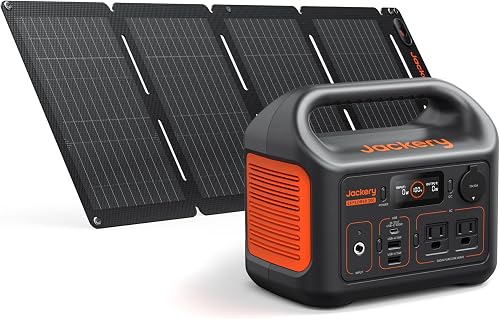
Jackery Solar Generator 300 and 40W Solar: Best for weekend electronics
- 292Wh capacity
- 300W output
- 40W solar panel
- 100W USB-C PD port
The Jackery 300 gives weekend campers a useful step up from tiny power banks. Its 292Wh capacity supports laptops, cameras and other electronics while staying portable.
Pros
- 300W output
- 40W panel included
- 7.5 lb weight stated in product data
Cons
- Small panel charges more slowly
- Not intended for high-draw appliances
The Jackery Solar Generator 300 is the best option for weekend electronics and moderate portable power.
Its 292Wh battery and 300W output provide more room than the smallest kits while keeping the system suited to camping and travel.
It includes a 40W Air Solar Panel, AC adapter and car charger cable.
The station has 2 AC outlets, a 100W USB-C PD port, 2 USB-A ports and a 120W car port.
That port mix suits laptops, cameras, phones and lights without forcing you to carry a much larger station.
Jackery states a 600W peak surge and a 7.5 lb weight in the product description, while the specification data gives a 12.9 lb item weight.
Treat the weight as something to confirm before packing it into a tight RV storage area.
The 40W panel is useful for maintaining smaller electronics, but it will recharge more slowly than the 100W and 200W panels in this roundup.
OUPES Mega 1 Solar Generator with 100W: Best for expandable RV power
- 1,024Wh LiFePO4 battery
- 2,000W output
- 100W solar panel
- Expandable to 5,120Wh
The OUPES Mega 1 is for RV travelers who want high output now and more capacity later. Its 27.8 lb weight is higher than compact units, but it supports heavier loads and expansion.
Pros
- 2,000W pure sine wave output
- Expandable capacity
- 13 charging ports
Cons
- Heavier than small RV kits
- The included panel is only 100W
The OUPES Mega 1 is the best pick for expandable RV power.
It starts with a 1,024Wh LiFePO4 battery and 2,000W pure sine wave output, then allows expansion to 5,120Wh with 2 extra batteries.
Its 4,500W surge rating is aimed at demanding start-up loads.
The station includes 4 AC ports, 2 USB-C PD 100W ports, 4 USB-A QC3.0 ports, 2 DC ports and a car socket.
A 100W solar panel is included, although the station supports up to 800W of solar input.
The larger solar input figure describes the station's maximum capability, not the output of the included panel.
At 27.8 lb, the OUPES is still portable for a large unit, but it is less convenient than the MARBERO and Jackery 300 kits.
Its app, LCD display and UPS feature add value when you need more control during longer stays.
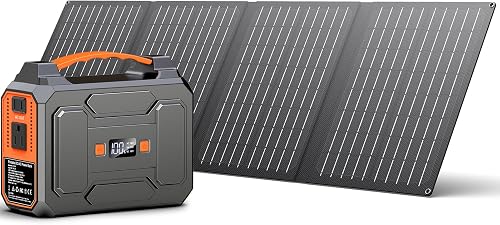
Apowking Solar Powered Generator 100W: Best for basic camping loads
- 146Wh capacity
- 100W output
- 40W solar panel
- 7 output ports
The Apowking kit handles phones, tablets, cameras, lights and small fans. At 3.3 lb, it works well when you want a simple solar bundle for short RV stops.
Pros
- Lightweight station
- 40W panel included
- AC, USB and DC outputs
Cons
- 100W running output
- Not suited to larger RV appliances
The Apowking 100W bundle is best for basic camping loads.
Its 146Wh battery, 100W running output and 40W solar panel cover phones, tablets, cameras, lights, fans and selected small devices.
The 7-port layout includes 2 AC outlets, USB-A ports, a USB-C quick-charge output and a 12V DC output.
The unit weighs 3.3 lb, which makes it practical for a day trip or a short RV stop.
It is a simple option when you want one small kit for phones, a camera and a light, rather than a station for larger appliances.
The panel uses monocrystalline solar cells with a stated 20.5% conversion efficiency.
Ten DC connectors are included for compatibility with many portable solar generators, but check the connector and input requirements of your own station.
The 200W peak figure gives some start-up room, but the continuous 100W limit still determines what you can run for more than a moment.
EF ECOFLOW DELTA Pro 3 Solar Generator: Best for whole-RV backup power
- 4,096Wh battery
- 4,000W output
- Two 400W solar panels
- 120/240V support
The EcoFlow DELTA Pro 3 is the largest choice here, with 4,096Wh and 4,000W output for serious backup needs. Its 115 lb weight makes it better for a parked RV or home backup plan than frequent carrying.
Pros
- Largest battery and output here
- Two 400W panels included
- 120/240V output
Cons
- Very heavy
- Panels and power station ship separately
The EcoFlow DELTA Pro 3 is the best choice for whole-RV backup power when weight is manageable.
Its 4,096Wh LFP battery, 4,000W output and two 400W solar panels put it far above the compact travel units in this roundup.
The system supports 120V and 240V output, with an 8,000W starting wattage.
EcoFlow states that capacity can expand to 48kWh with extra batteries or smart generators.
That scale suits a parked RV, a home backup plan or a basecamp where the unit stays in one place.
This is a parked-RV or home-backup solution more than a carry-to-the-campsite unit.
The power station weighs 115 lb, and its dimensions are 16.16 x 13.43 x 27.38 inches.
The DELTA Pro 3 includes app control, a 10 ms switch-over time and X-Quiet operation as low as 30 dB.
The two 400W panels and station ship in separate packages.
DaranEner Solar Generator with Panels Included: Best mid-size LiFePO4 bundle
- 576Wh capacity
- 600W output
- 100W solar panel
- 7 ports
The DaranEner Cubus 600L fills the middle ground between compact electronics kits and large RV backup stations. Its 576Wh battery and 600W output suit laptops, lights, cameras and selected small appliances.
Pros
- 600W pure sine wave output
- 100W panel included
- 13.7 lb weight
Cons
- Car cables sold separately
- Less capacity than the 1,000Wh-class picks
The DaranEner Cubus 600L is the best mid-size LiFePO4 bundle.
It gives you 576Wh of capacity, 600W continuous output and a 100W solar panel without the size of a 1,000Wh-class station.
Three 110V AC outlets, a 100W USB-C port, 2 USB-A ports and a 120W car socket provide 7 total ports.
The product data names laptops, CPAP machines, phones, cameras, mini-fridges, air pumps, heating pads and power tools as possible uses, but each device must stay within the output limits.
That middle range suits RV travelers who need more than phone charging, yet do not want the weight of a large backup station.
The station weighs 13.7 lb and supports 130W AC, 120W car and 100W solar charging.
Pass-through charging lets connected devices run while the station recharges.
Car cables are sold separately.
That matters if you plan to recharge from the RV or vehicle between solar sessions.
GRECELL 100W Portable Solar Panel for Power: Best for adding solar input
- 100W output
- 20V monocrystalline panel
- MC4 connector
- Foldable waterproof design
The GRECELL is a panel-only option for an RV traveler who already owns a compatible power station. Its adapters cover several common DC connections, but you must match the connector and input limits first.
Pros
- 100W panel output
- MC4 and multiple adapters
- Series and parallel connection support
Cons
- Power station not included
- 10.3 lb panel weight
The GRECELL 100W panel is the best add-on for an RV traveler who already owns a compatible power station.
It produces up to 100W at 20V and folds into a briefcase-style shape for storage.
An MC4 connector and several adapters support connections used by Jackery, EcoFlow, Bluetti, Paxcess, Suaoki, Flashfish and other brands named in the product data.
Compatibility still depends on your power station's input connector, voltage and current limits.
Check those limits before you connect it, because adapters solve shape differences rather than power limits.
The panel weighs 10.3 lb and uses monocrystalline silicon cells with a stated efficiency of up to 23.5%.
Two kickstands help position it on a flat surface, while reinforced grommets allow hanging or tie-down use.
GRECELL says the panel supports series and parallel connections with another panel.
The extra panel, cable and power station are not part of this panel-only purchase.
How much battery capacity does an RV need?
A 100Wh to 300Wh battery is enough for short stops focused on phones, lights and cameras.
A 576Wh to 1,070Wh station gives more room for laptops, fans and repeated charging, while 2,000Wh or more suits heavier or longer backup needs.
Think about how you travel before you look at the largest number in a listing.
A weekend trip with one laptop and two phones has a different need from a week off grid with a fan, lights and a small fridge.
Battery capacity is measured in watt-hours, while appliances use watts.
A device's running wattage tells you whether the generator can power it, and the battery capacity helps estimate how long the charge may last.
Output and capacity work as a pair.
Output decides what can run, capacity decides how long the stored charge can support that load.
Do not use the battery number as a promise of exact runtime.
Conversion losses, charging behavior and the device's changing power draw affect the result.
Start up demand can also change the picture, especially for motor driven or heating devices.
So add up the watts of the devices you plan to use together, then compare that total with the station's rated output.
If the total sits close to the limit, choose a larger station or run fewer devices at once.
For RV use, also consider how often you will recharge from solar.
A smaller battery can work well if your panel keeps it topped up during the day.
A larger battery gives you more margin for cloudy weather, shade and longer evenings.
What solar panel size works best for RV travel?
A 30W to 60W panel is convenient for small batteries, while 100W to 200W panels better match mid-size RV power stations. The EcoFlow bundle uses two 400W panels because its battery is much larger.
Panel wattage is a maximum under suitable conditions. Shade, clouds, angle and heat can reduce the actual input, so place the panel in direct sunlight and reposition it as the sun moves.
Match the panel's connector and voltage to the power station. The GRECELL includes several adapters, but adapters do not remove the need to check the station's input limits.
For camping-focused options, compare this list with the best camping solar generator with solar panel.
Can an RV solar generator run a 30-amp setup?
A portable solar generator can power selected RV devices through suitable outlets, but a 30-amp RV connection and the appliances connected to it may demand more power than a small station can provide.
Check running and starting wattage before using an adapter.
The OUPES Mega 1 and EcoFlow DELTA Pro 3 have the most output in this group.
The MARBERO 111Wh, Apowking 100W and Jackery 300 are better for individual electronics than for an entire RV electrical system.
A 30-amp plug does not tell you the exact load at every moment.
Turn off unnecessary appliances and avoid connecting a high-draw heating device to a station below its required wattage.
How should you set up solar panels at an RV campsite?
Place the panel in direct sunlight, connect the correct cable, and confirm that the station shows solar input before leaving it to charge.
Keep cables dry, avoid shaded positions and protect the panel from being driven over or sharply bent.
Start with the panel facing clear sky, then check the station display after a few minutes.
If the input is low, move the panel out of shade from trees, awnings or nearby RVs.
Angle matters too, so turn the panel to follow the sun as the day moves on.
Foldable panels need a stable surface or secure tie-down points.
The MARBERO, Jackery and GRECELL panels each have portable designs, but their sizes and weights differ enough to affect where you store and position them.
Use kickstands, grommets or tie downs where the design provides them, and keep the panel from sliding on gravel or wet ground.
Do not let the panel sit where people will trip over the cable or where a door can close on it.
Keep the power station ventilated and follow its instructions for charging modes.
Store cables with the panel and station so connectors stay clean and dry between trips.
Before a trip, charge the station, inspect cables and confirm that the panel and generator use compatible connections.
Pack the panel where it will not be bent, and keep the station upright and secure during travel.
At camp, set the station in a dry spot with airflow around its vents.
Avoid leaving connections exposed to rain, and unplug or cover them when you are not charging.
If you move the panel later in the day, check the input again after you reconnect it.
Small changes in position can make a clear difference in how fast the battery fills.
For a longer stay, choose a spot that gets sun for most of the day rather than only a brief window.
That habit helps a smaller panel keep up with phones, laptops and lights without constant repositioning.
Best RV solar panels and generators: final picks
Choose the MARBERO 237Wh for the strongest compact bundle, the Jackery 1000 v2 for most RV travelers, and the EcoFlow DELTA Pro 3 when you need high output and long backup time.
The MARBERO suits short stops and light electronics.
The Jackery 1000 v2 gives the best balance of capacity, output and portability for general RV use.
The EcoFlow is the pick when weight is acceptable and backup time matters more than easy carrying.
For a lighter step up from a power bank, the Jackery 300 and DaranEner Cubus 600L also fit many weekend trips.
Pick the GRECELL 100W if you already have a compatible station and only need more solar input.
That panel only route can save space if your current station still has years of use left.
For a second fuel-based backup option, compare the top 7 watt dual fuel generator for RV use and its related guide for RV generator planning at /watt-dual-fuel-generator-for-rv-use-2/.
A fuel generator can support longer cloudy stretches, while a solar station suits quiet campsites and portable device charging.
The right choice depends on whether your main need is quiet daily power, extended backup or a mix of both.
Our top 3 picks at a glance
-
1
Best for compact overnight power
MARBERO 237Wh Solar Generator with Solar Panel
9.7/10 our score
See it on Amazon -
2
Best for most RV travelers
Jackery Solar Generator 1000 v2 and 200W
9.6/10 our score
See it on Amazon -
3
Best for lightest travel kit
MARBERO 111Wh Solar Generator with Panels Included
9.5/10 our score
See it on Amazon
Frequently asked questions
What size solar generator is best for an RV?
A 300Wh to 1,070Wh solar generator suits many RV electronics, lights and small devices. Choose 2,000W or more when you need heavier loads, and use a 4,096Wh unit for extended backup.
Check each appliance's running and starting wattage before connecting it.
Can a solar generator run an RV air conditioner?
Some larger units may support an RV air conditioner if the air conditioner's running and starting wattage fit the generator. The OUPES Mega 1 provides 2,000W output, while the EcoFlow DELTA Pro 3 provides 4,000W.
Confirm the appliance requirements before buying.
Is a 100W solar panel enough for RV travel?
A 100W panel can help recharge a compatible power station during daylight, but actual charging depends on sunlight, panel position and the station's solar input limits.
A 100W panel is better for maintaining smaller loads than for quickly refilling a large 4,096Wh battery.
What should you check before buying an RV solar generator?
Check battery capacity, running output, surge output, solar panel wattage, ports, weight and connector compatibility. Also compare the generator with the appliances you plan to use.
A compact 237Wh unit may be easier to carry, while a 4,096Wh unit offers much longer backup.