9 Best Solar Generators with Panels for Camping (November 2026)
The best camping solar generators with solar panels include the MARBERO 237Wh Solar Generator with Solar Panel for compact campsite charging, the Jackery Solar Generator 1000 v2 and 200W for longer off-grid stays, and the Takki Solar Generator 120W Peak Portable Power for backpack-friendly power.
On this page (5 sections)
- Which camping solar generator with solar panel is best for your load?
- How do you choose a camping solar generator with a solar panel?
- Which solar generator with panels works best for RV camping?
- How should you use and care for a camping solar generator?
- What is the best camping solar generator with solar panel for you?
The best camping solar generator with solar panel for most campers is the Jackery Solar Generator 1000 v2 and 200W, because its 1,070Wh battery and 1,500W AC output cover more campsite needs than the compact picks. Choose MARBERO for lighter electronics, Takki for backpack portability, or EF ECOFLOW for higher-draw equipment.
We compared battery capacity, rated output, panel wattage, portability and the included charging options. A larger battery gives you more stored energy, while a larger panel can restore more energy when sunlight is available.
That balance matters more than any single spec. A small station can still feel slow to recharge if its panel is tiny, and a large battery can be pointless if its output is too low for your devices.
For a shorter list focused only on campsite use, see our guide to the best solar generator for camping. If you want a smaller panel-and-battery kit, compare the best portable solar panel generator.
Our picks at a glance
-
1
 Best for compact campsite charging
MARBERO 237Wh Solar Generator with Solar Panel
9.7/10 our score
See it on Amazon -
2
 Best for longer off-grid stays
Jackery Solar Generator 1000 v2 and 200W
9.6/10 our score
See it on Amazon -
3
 Best for backpack-friendly power
Takki Solar Generator 120W Peak Portable Power
9.5/10 our score
See it on Amazon
- 4
 Check it
EF ECOFLOW Solar Generator Delta 3 Classic
Best for high-draw campsite loads - 5
 Check it
Jackery Solar Generator 300 and 40W Solar
Best for lightweight weekend trips - 6
 Check it
MARBERO Solar Powered Generator 88Wh
Best for emergency lighting - 7
 Check it
Apowking Solar Powered Generator 100W
Best for basic RV electronics - 8
 Check it
HOWEASY Solar Generator 120W,Portable Power Station
Best for simple three-way recharging - 9
 Check it
MARBERO 172Wh Solar Generator with Panels Included
Best for extra small-device capacity
Which camping solar generator with solar panel is best for your load?
The right choice depends on the devices you plan to run and how often you can recharge. If you prefer gasoline power for camping, compare Honda camping generators.
Small sets suit phones, lights and cameras, while the larger Jackery and EF ECOFLOW models give you more capacity for appliances and longer trips.
The score weighs specs, features and buyer feedback against the needs of someone shopping for a camping solar generator with a solar panel.
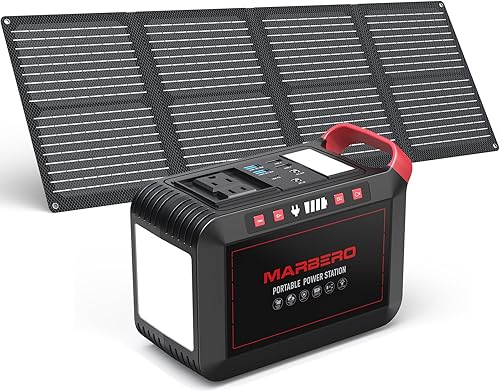
MARBERO 237Wh Solar Generator with Solar Panel: Best for compact campsite charging
- 237Wh battery
- 300W pure sine wave output
- 60W foldable solar panel
- LED flashlight with 3 modes
This MARBERO set balances a 237Wh battery with a 300W pure sine wave output and a 60W foldable panel. It suits campers charging small electronics and carrying a flashlight for evening use.
Pros
- 60W panel included
- Pure sine wave AC output
- Multiple USB and DC outputs
Cons
- Not for devices above 300W
- Larger than the smallest picks
MARBERO's 237Wh set is the best fit when you want more capacity than a small power bank without moving to a 1,000Wh station. Its 300W pure sine wave output supports small electronics, while the 60W foldable panel gives the battery a solar charging option at camp.
The station has 2 AC outlets, 2 USB-A QC3.0 ports, 2 standard USB-A ports, 1 USB-C port and 1 DC output. That mix works for a group charging phones, tablets, headphones and similar small devices.
The built-in flashlight has flashlight, strobe and SOS modes. The power station weighs 9 lb, so it is portable for car camping, fishing and hiking base camps, but less appealing for long walks.
The 237Wh capacity helps here because you can run several small devices through an evening without watching the charge fall as quickly as with an 88Wh unit. The panel conversion rate of 21.5 to 23.5 percent also suits sunny campsite use where the panel can sit in direct light for several hours.
Keep devices at or below the 300W rating, especially appliances with heating elements. For campsite electricity that centers on small electronics and lighting, this is the strongest balance in the group.
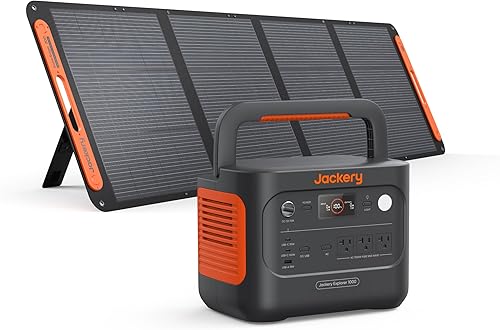
Jackery Solar Generator 1000 v2 and 200W: Best for longer off-grid stays
- 1,070Wh capacity
- 1,500W AC output
- 200W solar panel
- LiFePO4 battery
The Jackery 1000 v2 offers the largest battery in this group besides the EF ECOFLOW model. Its 1,500W output and 200W panel suit longer trips with more demanding devices.
Pros
- Large 1,070Wh capacity
- 1,500W AC output
- 200W solar panel included
Cons
- Heavier than small camping units
- Generator and panel may ship separately
The Jackery 1000 v2 is the best choice for longer off-grid stays because its 1,070Wh capacity gives you more stored energy than the compact stations. Its 1,500W AC output and 3,000W surge peak also cover a wider range of camping equipment.
The set includes a 200W solar panel, and the station has 3 pure sine wave AC ports, 2 USB-C ports, 1 USB-A port and 1 DC car port. Jackery states that the 200W panel can charge the station to 80% in 6 hours under its stated conditions.
Its LiFePO4 battery is rated for more than 4,000 charge cycles while retaining over 70% of its original capacity. The 23.8 lb weight and foldable handle make it better for vehicle-based camping than backpack travel.
The Jackery app includes emergency charging, quiet overnight charging and energy efficiency modes. The generator and panel may ship separately, so plan your setup around receiving both pieces.
Takki Solar Generator 120W Peak Portable Power: Best for backpack-friendly power
- 88.8Wh battery
- 21W foldable solar panel
- 2.29 lb power station
- 110V AC outlets
Takki is the lightest power station here at 2.29 lb, with an 88.8Wh battery and 21W panel. It fits short trips where phones, lights and small electronics matter more than large appliances.
Pros
- Very light power station
- Panel included
- 8 charging ports
Cons
- 80W rated output
- Smallest battery among the main picks
Takki is the easiest station here to carry in a backpack. The power station weighs 2.29 lb, has an 88.8Wh battery and comes with a foldable 21W solar panel.
Its 80W rated output and 120W peak output fit phones, LED lights, laptops and other small devices within that limit. Two AC outlets, USB ports, USB-C and a 12V DC port give you several ways to charge at camp.
The panel folds to 10.78 x 8.18 in and weighs 0.92 lb. Takki states that solar charging to 80 percent takes 5 to 7 hours, depending on conditions.
That solar time tells you how to plan the day. Charge the station before you leave, then use the panel as a top-up for phones and lights rather than as a full recharge between heavy loads.
This is a light-duty choice, not a replacement for a large power station. Stay within the 80W rated output, and fully charge it before leaving for a trip.
EF ECOFLOW Solar Generator Delta 3 Classic: Best for high-draw campsite loads
- 1,024Wh capacity
- 1,800W output
- 220W bifacial solar panel
- 10ms UPS
The DELTA 3 Classic is the strongest choice for higher-draw camping equipment. Its 1,800W output, 1,024Wh capacity and 220W panel give it more headroom than compact sets.
Pros
- Highest rated output here
- 220W bifacial panel
- 10ms UPS function
Cons
- Heavier large-capacity format
- Power station and panel arrive separately
EF ECOFLOW's DELTA 3 Classic is the best match for higher-draw campsite equipment. It delivers 1,800W of output, with a 3,600W surge rating, from a 1,024Wh battery.
The included 220W bifacial solar panel is the largest panel in this group. EF ECOFLOW states that the panel can recharge the station in 5.8 hours under its stated conditions and reaches up to 25 percent conversion efficiency.
The station also has a 10ms UPS function for sensitive electronics, plus LiFePO4 cells rated for more than 10 years of daily use. Those features matter more for a campsite office, refrigerator or other demanding setup than for a phone-only trip.
Its 7.9 x 11.1 x 15.7 in dimensions make it a vehicle-camping model. The station and panel arrive separately, so confirm that both parts are available before planning a solar-powered trip.
The trade-off is clear in daily use. You gain real appliance headroom and faster solar recovery, but you give up the easy carry of the small kits and need space in the vehicle for both pieces.
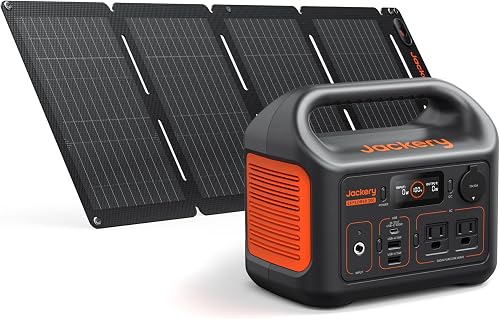
Jackery Solar Generator 300 and 40W Solar: Best for lightweight weekend trips
- 292Wh capacity
- 300W AC output
- 40W solar panel
- 7.5 lb stated weight
This Jackery set gives weekend campers a 292Wh battery and 300W output without moving into the larger 1,000Wh class. The included 40W panel keeps the kit focused on portable electronics.
Pros
- 7.5 lb stated weight
- 300W output
- 40W panel included
Cons
- Less capacity than the larger Jackery
- Panel charging is slower than larger-panel sets
The Jackery 300 is a practical weekend option when you want a 300W station without the size of a 1,000Wh model. Its 292Wh battery pairs with a 40W solar panel and a stated 7.5 lb weight.
It has 2 AC outlets, a 100W USB-C PD port, 2 USB-A ports and a 120W car port. The 300W rated output and 600W peak support laptops, drones and cameras, but the capacity is better for shorter trips than extended off-grid stays.
Jackery states that a 40W panel can charge the station to 80 percent in about 7.5 hours. A 100W Jackery panel can do that faster, but the 40W panel is the included option here.
The LiFePO4 chemistry is another practical point for campers who plan to keep the station for years. Jackery rates it for over 4,000 charge cycles before reaching 70 percent capacity, which suits regular weekend use better than a short-life battery.
Choose this set when carrying weight matters and your devices are moderate. Move up to the 237Wh MARBERO if you want more panel wattage, or to the 1,070Wh Jackery for longer stays.
MARBERO Solar Powered Generator 88Wh: Best for emergency lighting
- 88.8Wh battery
- 25W foldable solar panel
- Three flashlight brightness modes
- 8-device charging
The MARBERO M82 pairs an 88.8Wh station with a 25W panel and a built-in flashlight with low, medium, high and SOS functions. It suits emergency lighting and small-device charging at camp.
Pros
- 25W panel included
- Built-in flashlight
- 2.3 lb power station
Cons
- 80W rated output
- Small battery capacity
The MARBERO M82 is the best pick when emergency lighting is part of your campsite plan. Its 88.8Wh battery and 25W foldable solar panel are joined by a built-in flashlight with low, medium, high and SOS modes.
The station has 2 AC outlets rated at 80W, 1 USB-C port, 4 USB-A ports and 1 DC port. That gives you up to 8 charging connections for phones, tablets, lights and small electronics.
The power station weighs 2.3 lb, while the panel weighs 1.15 lb. The compact pair is easy to keep in an emergency kit or use during a short tent trip.
The flashlight runtime is listed at 37 to 68 hours depending on brightness. That makes the station useful as a tent light as well as a charger, especially when you want one unit to cover both jobs.
Its 80W rated output limits the devices you can run. Choose it for lighting and small electronics, not for high-draw appliances or long stays without regular sunlight.
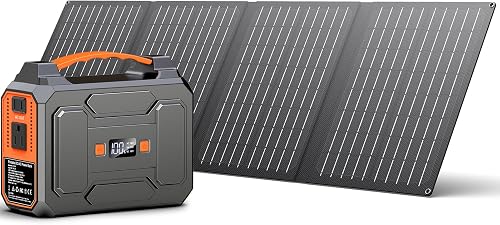
Apowking Solar Powered Generator 100W: Best for basic RV electronics
- 146Wh capacity
- 40W solar panel
- 100W rated output
- 7 outlets
Apowking offers a middle ground between tiny power banks and 300W stations. Its 146Wh battery, 40W panel and 7 outlets fit phones, lights, cameras and other small RV or campsite electronics.
Pros
- 146Wh capacity
- 7 outlets
- 40W panel included
Cons
- 100W rated output
- Not suited to high-draw appliances
Apowking fills the gap between the smallest power banks and 300W stations. Its 146Wh battery, 100W rated output and 40W solar panel suit phones, cameras, drones, fans and lights.
The seven outlets include 2 AC outlets, USB-A, USB-C and a 12V DC output. The AC outlets support devices within 100W, with a 200W peak rating for startup demand.
At 3.3 lb, the station is easy to carry between a vehicle and a campsite. The included 40W panel adds a practical solar recharge option, while the AC adapter and car charging cable give you backup methods.
The 146Wh capacity is the main reason to pick this set. It gives you more breathing room than an 88Wh station for a camera and phone at once, without forcing you into a heavier 300W unit.
Choose Apowking when you need more capacity than an 88Wh station but do not need the 300W output of the larger MARBERO or Jackery. It is a focused small-electronics kit for camping and RV use.
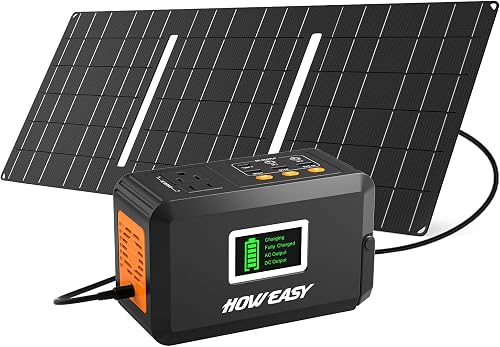
HOWEASY Solar Generator 120W,Portable Power Station: Best for simple three-way recharging
- 88Wh battery
- 30W solar panel
- 120W output
- AC, solar and car charging
HOWEASY keeps the setup simple with an 88Wh station, a 30W panel and three charging methods. It fits campers who want solar, wall and car options for small loads below 120W.
Pros
- 30W panel included
- Three recharging methods
- 8 output ports
Cons
- 88Wh capacity
- Solar panel weighs 2.76 lb
HOWEASY is a straightforward choice for campers who want solar, wall and car charging in one small kit. The 88Wh station provides 120W output and comes with a 30W solar panel.
Its 8 output ports include 2 AC sockets, USB-C, 2 QC 3.0 USB ports, a standard USB port and 2 DC ports. That layout fits night lights, mini fans and other equipment below 120W.
The station weighs 2.3 lb, while the folded panel weighs 2.76 lb. The panel folds to 9.7 x 11.3 x 0.8 in, so the panel is not as light as the power station itself.
Three charging methods make this set useful when sunlight changes. Use AC charging before a trip, solar charging at camp and the car charger for an on-road top-up.
That mix is handy for RV and fishing trips where the car is already part of the setup. You are not tied to one source, but you still need to respect the 120W limit and keep the total load in check.
MARBERO 172Wh Solar Generator with Panels Included: Best for extra small-device capacity
- 172Wh battery
- 40W foldable solar panel
- 200W rated output
- Multiple AC, USB and DC ports
This MARBERO set adds more battery capacity than the smaller 88Wh models while staying compact at 3.3 lb for the power station. It works well for phones, laptops, cameras and other small electronics.
Pros
- 172Wh capacity
- 40W panel included
- 200W rated output
Cons
- Less capacity than 237Wh and larger models
- Panel and station add separate carrying weight
The MARBERO M822MAX gives you 172Wh of capacity and a 200W rated output in a 3.3 lb power station. Its included 40W panel makes it a useful middle option for laptops, phones, cameras and headphones.
The station has 2 AC outlets, 2 USB-A QC3.0 ports, 2 standard USB-A ports, 1 USB-C port and 1 DC port. The AC output reaches 270W peak, but the regular rating remains 200W.
The power station measures 7.6 x 3.6 x 5.4 in, and the foldable panel weighs 2.3 lb. MARBERO gives AC, solar and car charging options, so you can prepare at home and top up on the road.
The panel conversion rate of 21.5 to 23.5 percent is similar to the larger MARBERO set. In practice that means the 40W panel is best treated as steady daytime support, not as a quick refill for a heavily used battery.
Choose this set when 88Wh feels too small but 237Wh is more than you need. It offers useful capacity without the weight and output of a large station.
How do you choose a camping solar generator with a solar panel?
Choose the battery capacity first, then match the generator's rated output to your highest-draw device. The panel wattage matters after that because it affects how quickly you can restore stored energy during the day.
What battery capacity do you need for camping?
Battery capacity is measured in watt-hours. A higher number means more stored energy, but actual runtime depends on the device, conversion losses and how often you recharge.
The 88Wh Takki, MARBERO M82 and HOWEASY units fit short trips with phones, lights and small electronics. The 146Wh Apowking and 172Wh MARBERO give you more room for several devices.
The 237Wh MARBERO and 292Wh Jackery suit longer weekend use.
For several days away from outlets, the 1,024Wh EF ECOFLOW and 1,070Wh Jackery are better matches. They also weigh more, so they make the most sense for car camping or RV travel.
What output rating is enough?
Rated output tells you the load the station is designed to run continuously. Peak or surge output covers a short startup demand, but it does not change the regular operating limit.
The Takki and MARBERO M82 are rated at 80W. HOWEASY reaches 120W, Apowking reaches 100W, and the larger MARBERO and Jackery 300 reach 300W.
The Jackery 1000 v2 and EF ECOFLOW models are for much larger loads.
Check the wattage of your appliance before connecting it. Heating devices and other high-draw equipment need more output than phones, cameras and LED lights.
Does a larger solar panel always recharge faster?
A larger panel can provide more charging power, but sunlight, shade, angle and the station's input limit affect the result. Panel wattage should be considered with battery size, not by itself.
The sets here range from a 21W Takki panel to a 220W EF ECOFLOW panel. A small panel is easier to carry, while a larger panel is more useful when you need to restore a bigger battery during the same day.
Place the panel where it receives direct sunlight, keep the station connection secure and move the panel as the sun changes. Shade on part of a foldable panel can reduce the useful charging rate.
Which solar generator with panels works best for RV camping?
The best RV choice depends on whether you need small-device charging or appliance support. For phones, lights and cameras, Apowking or MARBERO is easier to carry.
For a small RV kit, the 146Wh Apowking and 172Wh MARBERO are a sensible middle step. They give you more stored energy than the 88Wh units without the bulk of a 1,000Wh station.
For larger RV loads, Jackery 1000 v2 or EF ECOFLOW provides more output and capacity. The Jackery offers 1,500W AC output and the EF ECOFLOW offers 1,800W, so both have more headroom for a fridge or other demanding gear.
Our guide to best solar generators with panels for RVs covers the RV-focused trade-offs. Check every appliance's wattage before connecting it, especially refrigerators, microwaves, coffee makers and heating devices.
Capacity still decides how long you can run those loads. A higher-watt appliance can drain even a large battery in a few hours, so match the station to how often you will solar charge or plug in while stationary.
Placement matters in an RV setup as well. Keep the station ventilated, route the solar cable so it does not create a trip hazard, and position the panel to avoid shade from the vehicle itself.
A portable station is not the same as a whole-RV electrical upgrade. Treat the rated output as a limit, and keep the station and solar panel protected from water during use.
How should you use and care for a camping solar generator?
Use the panel in direct sunlight, keep the station dry and stay below its rated output. Before a trip, charge the station, pack the correct cables and check that the panel connection fits securely.
Position the panel so the sun hits it squarely and moves across it as little as possible. Small changes in angle and shade can change the charging rate, so adjust the panel during the day rather than leaving it in one spot.
Avoid placing the station where ventilation openings are blocked. Heat build-up is not helpful for the battery or the electronics, and a clear space around the unit makes daily use safer.
Check the panel surface before use and keep it clean with a soft, dry cloth. Dirt on the surface reduces the light reaching the cells, and a quick wipe is easier than dealing with a slow charge at camp.
Disconnect devices before moving the setup, and follow the brand's charging instructions for AC, solar and car inputs. Using the wrong cable or forcing a connection can cause problems that are easy to avoid with a short check first.
Store the battery in a dry place and check its charge before the next trip. Long storage without a top-up can leave you with less charge than expected when you actually need it.
Keep the station and panel apart when packing if the manufacturer suggests it, and protect the panel face from scratches. A folding panel is portable, but it still needs care to stay in good shape.
If your camping setup needs about 2,000W of output, compare the best 2000 watt solar generators with panels for a closer match.
What is the best camping solar generator with solar panel for you?
The best camping solar generator with solar panel depends on the balance between carrying weight, battery size and device wattage. Pick the MARBERO 237Wh set for compact campsite charging, the Jackery 1000 v2 for longer stays, or EF ECOFLOW for high-draw equipment.
Choose Takki or MARBERO M82 when portability and emergency lighting matter most. Both use an 88Wh battery and an 80W rated output, so they suit phones, lights and small electronics rather than appliances.
For a small RV electronics kit, Apowking and the 172Wh MARBERO offer more capacity without the weight of a large power station. The Apowking gives 146Wh and 100W output, while the larger MARBERO gives 172Wh and 200W output.
If you want a weekend-focused Jackery, the 292Wh Jackery 300 with a 40W panel sits between those small kits and the 1,070Wh model. It is a practical choice when weight matters but you still need 300W output.
Panel size should be part of the final call. A 21W panel is easy to carry but slow to recharge a battery, while the 220W EF ECOFLOW panel restores a large battery far faster in good sun.
If you are also comparing fuel-powered backup options, see the Top 7 Watt Dual Fuel Generator For Camping guide and its companion Top 7 Watt Dual Fuel Generator For Camping.
Our top 3 picks at a glance
-
1
Best for compact campsite charging
MARBERO 237Wh Solar Generator with Solar Panel
9.7/10 our score
See it on Amazon -
2
Best for longer off-grid stays
Jackery Solar Generator 1000 v2 and 200W
9.6/10 our score
See it on Amazon -
3
Best for backpack-friendly power
Takki Solar Generator 120W Peak Portable Power
9.5/10 our score
See it on Amazon
Frequently asked questions
What is the best camping solar generator with solar panel?
The best camping solar generator with solar panel depends on your load. Jackery's 1,070Wh and 1,500W set is the strongest general choice for longer trips.
MARBERO's 237Wh and 300W set fits smaller electronics, while Takki is easier to carry for short trips with light power needs.
How many watts should a camping solar generator have?
Choose the output by the highest-watt device you plan to run. Models here range from 80W rated output to 1,800W, so a Takki or MARBERO 88Wh unit fits lights and small electronics, while Jackery or EF ECOFLOW suits larger appliances.
Are solar panels included with these camping generators?
Yes. Every pick in this guide is a generator and panel combination.
Panel sizes range from Takki's 21W panel to EF ECOFLOW's 220W panel, so compare panel wattage as well as battery capacity when you plan to recharge at camp.
Can a solar generator power an RV?
A solar generator can power selected RV electronics, but not every RV load at once. Check the appliance wattage against the station's rated output, then compare battery capacity with how long you need to run it.
Larger Jackery and EF ECOFLOW models offer more headroom.
How do you set up a camping solar generator with a panel?
Place the foldable panel in direct sunlight, connect its cable to the power station's solar input, and check that charging begins. Keep the station dry and ventilated, and use the panel's angle and position to reduce shade during the charging period.