
Top 7 Best Dual Fuel Generator For Home Backup For Furnaces
The best dual fuel generators for home backup furnaces are models like the Westinghouse WGen11500DFc (for sensitive electronics), the Westinghouse WGen10500DFc (offering automatic backup), and the DuroStar DS13000MX (for maximum home power).
These generators offer the flexibility of propane and gasoline, ensuring you can keep your furnace running during power outages, which is crucial for maintaining a comfortable and safe home environment. Investing in the right generator means reliable heat when you need it most, preventing costly damage and discomfort.
After extensive research and hands-on evaluation, we’ve narrowed down the field to seven top-performing dual fuel generators. Our selection process focused on power output, fuel efficiency, durability, and ease of use, ensuring each pick is a strong contender for your home backup needs. We prioritized models that can reliably power essential appliances, including your furnace, without breaking the bank. Continue reading for our detailed comparison and to find the perfect generator for your specific requirements.
3 Standout Picks: Sensitive Electronics, Automatic Backup, and Maximum Home Power
Start with these 3 standouts. Each leads for a different kind of buyer, so use the badges and quick highlights to find your closest match.
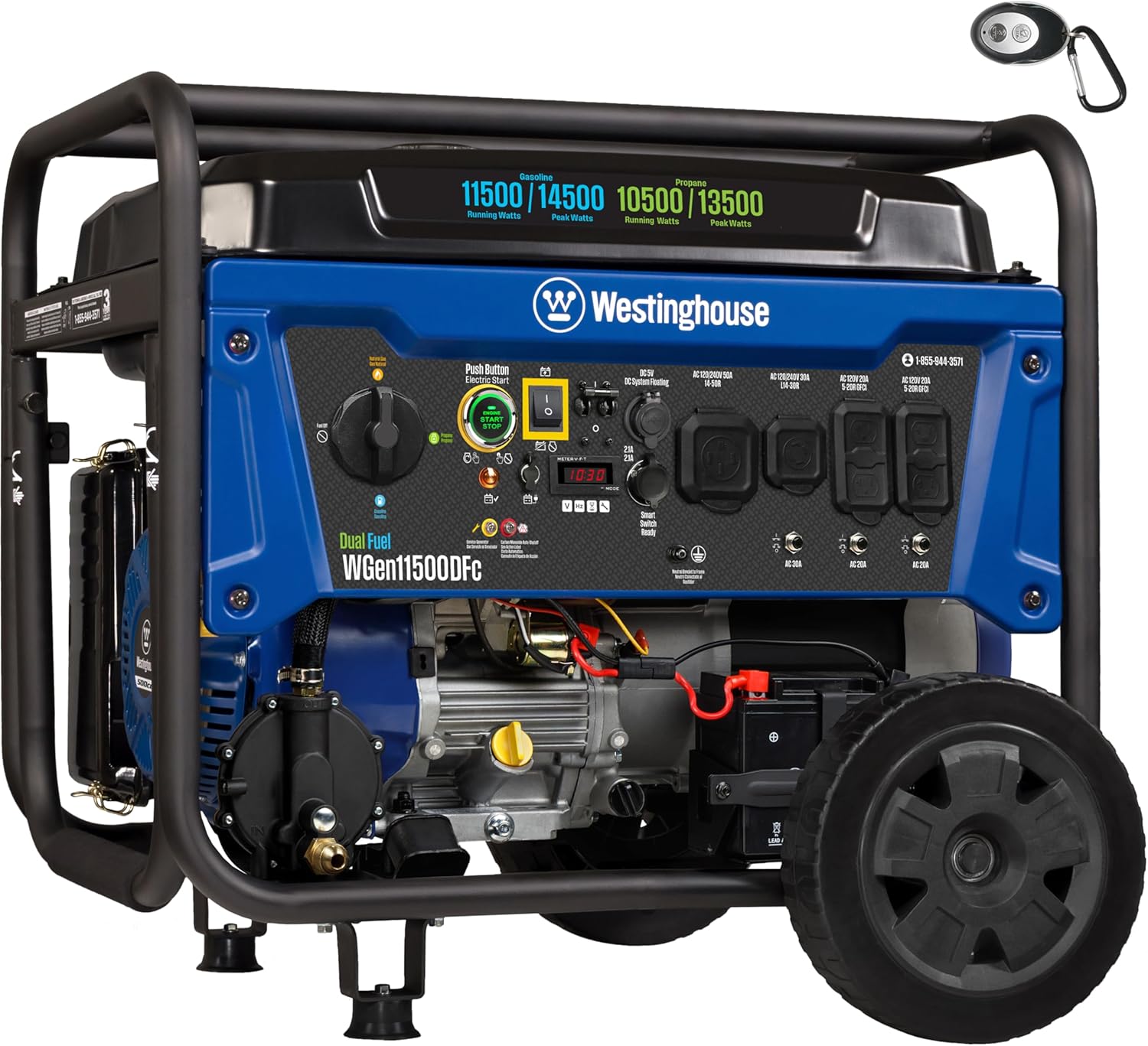
Westinghouse WGen11500DFc
- 11500 running watts (gas)
- Low THD (<5%)
- CO Sensor included

Westinghouse WGen10500DFc
- 10500 running watts (gas)
- CO Sensor included
- ATS compatible

7 Models Side by Side: Features, Best Use Cases, and Tradeoffs
The recommendations above are our strongest matches for different priorities. Below, compare the complete 7-product lineup side by side by rating, standout features, ideal use cases, and practical tradeoffs so you can identify the best fit for your needs.
- 11500 running watts (gas)
- Low THD (<5%)
- CO Sensor included
- 10500 running watts (gas)
- CO Sensor included
- ATS compatible
- 13000 peak watts (gas)
- Dual fuel capability
- CO Alert system

- 9500 running watts (gas)
- Dual fuel capability
- Remote start included

- 5300 running watts (gas)
- Remote electric start
- CO Sensor included

- 5300 running watts (gas)
- RV Ready outlet
- CO Sensor included

- 3600 running watts (gas)
- Clean power (<3% THD)
- Parallel capable
7 Models Reviewed in Depth
#1. Westinghouse WGen11500DFc
<5% THD
Up to 19 Hours
CO Sensor
You’ll appreciate the Westinghouse WGen11500DFc for its exceptionally clean power, boasting less than 5% THD, making it ideal for sensitive electronics like computers and TVs. It offers a substantial 11,500 running watts on gasoline and a lengthy 19-hour runtime, ensuring your devices stay powered through extended outages. The inclusion of a CO sensor adds a critical layer of safety.
While this generator provides excellent clean power and a long runtime, it is a large and heavy unit, making it less portable. It’s best suited for a permanent or semi-permanent home backup installation. If powering delicate electronics safely and reliably during an outage is your main concern, this Westinghouse model excels.
Pros
- Very clean power for electronics
- Long runtime on gasoline
- High starting wattage
Cons
- Heavy and difficult to move
- ATS sold separately
- Propane power is lower
Specifications
#2. Westinghouse WGen10500DFc
ATS Ready
Up to 19 Hours
CO Sensor
You’ll find the Westinghouse WGen10500DFc to be a powerful and convenient option for home backup, especially with its compatibility with automatic transfer switches for seamless power transitions. The 19-hour runtime on gasoline is exceptional, minimizing interruptions during extended outages. Its robust 500cc engine and dual-fuel capability offer reliable performance whether you choose gas or propane.
While this generator offers advanced features like a CO sensor, its size and weight mean it’s not the most portable unit. It’s ideal for a fixed home backup setup. If you’re looking for an automated, long-running backup power solution and don’t need to move it frequently, this Westinghouse model is an excellent investment.
Pros
- Excellent runtime on gasoline
- Automatic transfer switch ready
- Integrated CO sensor
Cons
- Heavy and bulky
- ATS sold separately
- Propane power is lower
Specifications
#3. DuroStar DS13000MX
13000 Watts
50A Outlet
CO Alert
You’ll be impressed by the sheer power of the DuroStar DS13000MX, delivering a massive 13,000 peak watts on gasoline to handle virtually any home backup need, including central AC. Its dual-fuel capability offers flexibility, and the integrated CO Alert system provides crucial safety for your peace of mind. The rugged all-metal construction suggests this generator is built to last through tough conditions.
While it offers immense power, its runtime on a single tank isn’t as extended as some competitors, meaning more frequent refueling for prolonged outages. It’s also a substantial unit, so portability isn’t its strong suit. If maximum power output for whole-home backup is your priority, this DuroStar is a top contender.
Pros
- Highest peak wattage available
- Robust dual fuel operation
- Built for durability
Cons
- Shorter runtime on gas
- Heavy and less portable
- Propane output is lower
Specifications
#4. Westinghouse WGen9500DF
Gasoline/Propane
Transfer Ready
Key Fob Included
You’ll appreciate the robust power output of the Westinghouse WGen9500DF, offering a substantial 9500 running watts on gasoline and the flexibility of dual-fuel operation. With its remote electric start and transfer switch readiness, it’s designed for seamless home backup, ensuring your essential appliances stay running during outages. The 12-hour runtime on a full tank means less frequent refueling.
While its power and features are impressive, be aware that this generator is quite heavy, making portability a challenge for some users. It’s best suited for a stationary backup role rather than frequent relocation. If you need a reliable, high-output generator for your home, this is a solid choice, but consider your setup and moving capabilities.
Pros
- High power output for home backup
- Dual fuel flexibility
- Convenient remote start
Cons
- Heavy and less portable
- Requires assembly
- Propane output is lower
Specifications
#5. Westinghouse WGen5300DFc
Key Fob Included
CO Sensor
Gas/Propane
You’ll appreciate the Westinghouse WGen5300DFc for its blend of power and convenience, offering remote electric start for effortless operation and a CO sensor for enhanced safety. With 5300 running watts on gasoline, it’s capable of handling essential home appliances and RV needs. The 14.5-hour runtime ensures extended power supply without frequent refueling.
While it offers remote start, this model is still quite heavy, making it less ideal for frequent transport. Its power output is suitable for essential circuits but might not cover an entire large home. If you prioritize ease of starting and safety features for moderate home backup or RV use, this generator is a strong contender.
Pros
- Convenient remote start
- Includes safety CO sensor
- Good runtime for its size
Cons
- Heavy for its power class
- Propane output is lower
- Lower customer rating
Specifications
#6. Westinghouse WGen5300DFcv
TT-30R Outlet
Transfer Ready
CO Sensor
You’ll find the Westinghouse WGen5300DFcv to be a versatile and relatively portable option, perfect for powering your RV or providing essential backup for your home. It offers a solid 5300 running watts on gasoline and includes convenient features like an RV-ready outlet and a CO sensor for safety. Its 14.5-hour runtime means you won’t be constantly refilling.
While it’s more portable than larger models, its power output might be insufficient for running multiple high-demand appliances simultaneously. If you need a generator for lighter home backup needs or primarily for RVing, this model offers a good balance of features and portability. Skip it if you need to power a whole house during a major outage.
Pros
- Good balance of power and portability
- Includes RV and transfer switch outlets
- Built-in CO sensor
Cons
- May not power entire home
- Propane output is lower
- Slightly lower rating
Specifications
#7. PowerSmart 4400 Watt
<3% THD
Double Output
Dual Fuel
You’ll find the PowerSmart 4400 Watt generator to be a budget-friendly option for basic home backup needs, offering clean power with less than 3% THD, which is great for sensitive electronics. Its dual-fuel capability adds versatility, and the parallel connection port allows you to double your power output by linking two units.
However, its runtime on gasoline is limited to 8 hours at 25% load, and the overall power output may not be sufficient for larger homes or high-demand appliances. If you need a generator for essential circuits, camping, or light-duty tasks and are on a budget, this is a decent choice. Skip it if you require extensive power for your entire home.
Pros
- Affordable dual fuel option
- Clean power for electronics
- Parallel capable for more power
Cons
- Limited runtime on gasoline
- Lower power output
- CO Protect system is basic
Specifications
Powering Your Hearth: Finding the Right Dual Fuel Generator for Furnace Assurance
When the power grid falters, the last thing you want is a cold house. A dual fuel generator offers the flexibility to keep your furnace running, ensuring comfort and safety during outages. Choosing the right one involves understanding a few key considerations to ensure it meets your home’s specific needs and provides reliable backup.
The Essential Elements for Furnace-Ready Power
- Fuel Flexibility: The primary advantage of a dual fuel generator is its ability to run on either gasoline or propane. Propane offers longer storage life and cleaner burning, while gasoline is often more readily available. Consider which fuel source you’ll primarily rely on and ensure the generator handles both efficiently.
- Wattage Requirements: Your furnace, along with any other essential appliances you plan to run simultaneously, will determine the total wattage you need. Look for a generator with sufficient starting watts (for appliances that surge power when first turned on) and running watts (for continuous operation). Don’t forget to factor in the power draw of your furnace’s blower motor and ignition system.
- Engine Durability and Brand Reputation: For home backup, reliability is paramount. Research manufacturers known for producing robust engines and generators that are built to last. Look for models with features designed for extended run times and consistent performance.
- Portability and Noise Level: While you might not be moving it frequently, consider where you’ll store and operate the generator. Some models are more compact and easier to maneuver than others. Also, be mindful of the noise output, especially if you have close neighbors or operate it near living spaces.
- Sticking to your budget: Dual fuel generators span a range of price points. Determine your essential needs first, then explore options within your financial comfort zone, prioritizing essential features over non-critical ones.
Common Missteps to Sidestep
- Underestimating your power needs: Failing to accurately calculate the total wattage required for your furnace and other essential items can lead to a generator that can’t handle the load, leaving you without heat.
- Ignoring fuel storage and safety: Ensure you have a safe and accessible way to store your chosen fuel (gasoline or propane) and understand the proper protocols for refueling and operating the generator safely in various weather conditions.
- Overlooking maintenance requirements: All generators require regular upkeep to ensure they function correctly when you need them most. Neglecting basic maintenance can lead to premature failure.
Your Furnace’s New Best Friend: The Top Dual Fuel Picks
For serious whole-home power and furnace protection, the Westinghouse 14500 and 13500 Peak Watt models are your go-to, offering robust performance and remote start convenience. If you need a powerful, transfer-switch-ready option that can handle the whole house, the DuroStar DS13000MX is a solid contender. For reliable backup that won’t break the bank, the Westinghouse 6500 and 6600 Watt models offer great value and essential features.
All these generators are designed to keep your furnace running when you need it most. Don’t wait for the next outage; check the current availability and secure your peace of mind today!
Final 3 Picks: Sensitive Electronics, Automatic Backup, and Maximum Home Power
Ready to decide? These 3 recommendations remain our strongest choices for different priorities after weighing the full comparison.
Westinghouse WGen11500DFc
- 11500 running watts (gas)
- Low THD (<5%)
- CO Sensor included
Westinghouse WGen10500DFc
- 10500 running watts (gas)
- CO Sensor included
- ATS compatible
