
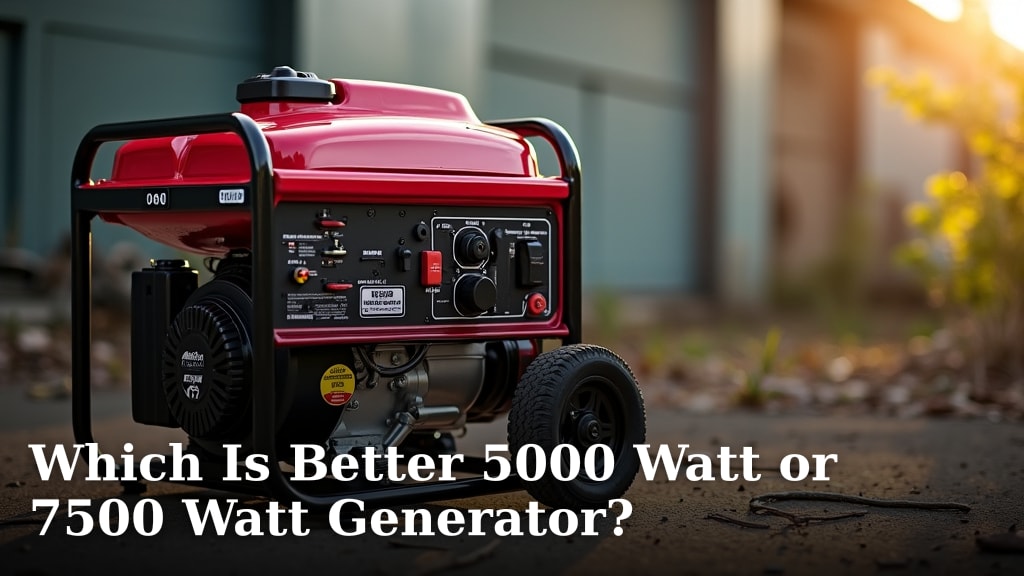
Which Is Better 5000 Watt or 7500 Watt Generator?
Choosing the Right Generator Size for Your Needs
Deciding between a 5000-watt and a 7500-watt generator hinges on your specific power requirements. You want enough power without overspending or wasting fuel. Let’s break down how to determine what’s best for you.
Understanding Your Power Needs: Starting vs. Running Watts
Before you pick a generator, you need to understand how appliances use power. Every device has two wattage ratings: starting watts and running watts.
Starting Watts (Peak or Surge Watts)
Starting watts are the extra burst of power an appliance needs to turn on. Think of it like a car accelerating from a stop. Motors, especially, need a lot more power to start than to run. This surge can be two or three times higher than the running wattage.
Running Watts (Rated or Continuous Watts)
Running watts are the power an appliance uses once it’s up and operating steadily. This is the power level it maintains continuously. This is what you’ll see most often listed on appliance labels.
When you’re sizing a generator, always account for the highest starting wattage of any single item you plan to run. Then, add up the running watts of all other items you want to power simultaneously.
What Can a 5000-Watt Generator Power?
A 5000-watt generator is a popular choice for many homeowners. It’s often seen as a good balance of power and portability. We found it’s excellent for powering essential items during an outage or for recreational use.
Typically, a 5000-watt generator can provide about 4000-4500 running watts after accounting for starting surges. This is usually enough for a few critical circuits in your home. You can keep your refrigerator running, some lights on, and charge your devices.
Common Appliances for a 5000-Watt Generator
- Refrigerator (around 600-800 running watts, 1200-2400 starting watts)
- Freezer (around 500-700 running watts, 1000-2000 starting watts)
- Sump pump (around 800-1500 running watts, 1500-3000 starting watts)
- Lights (60-100 watts per bulb)
- Television and cable box (around 100-300 watts)
- Microwave (600-1500 watts)
- Small window AC unit (5000 BTU: 500-600 running watts, 1200-1800 starting watts)
- Computer and charger (60-300 watts)
Remember, you can’t run all these at once. You’ll need to prioritize. For instance, you might run the refrigerator, a few lights, and the TV. Then, turn off the TV to use the microwave for a few minutes. It’s about managing your load.
What Can a 7500-Watt Generator Power?
Stepping up to a 7500-watt generator gives you significantly more power. This size is often recommended for larger homes or when you need to power more appliances simultaneously. You get more flexibility during an outage.
A 7500-watt generator typically offers around 6000-6500 running watts. This extra capacity means you can often power several major appliances at once, making outages less disruptive. It can even handle some central air conditioning units, depending on their size.
Common Appliances for a 7500-Watt Generator
- Refrigerator and freezer (combined, often without issue)
- Multiple lights and fans throughout the house
- Sump pump and well pump (around 1000-2000 running watts, 2000-4000 starting watts)
- Electric water heater (if small, around 3000-4500 watts)
- Central air conditioner (up to 3-ton unit: 2000-4000 running watts, 6000-12000 starting watts, may require careful management)
- Electric range/oven (some burners, not full oven)
- Hair dryer, coffee maker, toaster (high wattage items)
- Home office setup with multiple computers and monitors
With a 7500-watt model, you can run most of your essential items, plus a few comfort appliances. You might even power a small central AC unit, but you’ll need to be mindful of its starting watts and what else is running.
Cost, Fuel Consumption, and Portability Considerations
Beyond raw power, there are other important factors to weigh between these two generator sizes. We found these often influence the final decision as much as wattage does.
Initial Cost
Generally, a 7500-watt generator will cost more upfront than a 5000-watt model. You’re paying for the increased power output and often a more robust engine and frame. Think about your budget. Is the extra power worth the extra cost for your specific needs?
Fuel Efficiency
Bigger generators consume more fuel. A 7500-watt generator will burn through gasoline (or propane) faster than a 5000-watt generator when running at comparable loads. If you anticipate long power outages, the cost of fuel can add up quickly. We recommend considering how much fuel you’re willing to store and purchase.
Size and Weight (Portability)
Larger generators are heavier and bulkier. A 5000-watt generator is often easier to move around, lift into a truck, or store. A 7500-watt unit will be heavier, making it less portable. If you need to move your generator frequently for different uses (e.g., camping and home backup), portability becomes a key factor.
Making Your Decision: A Step-by-Step Approach
To help you decide, follow these steps. This systematic approach ensures you don’t overbuy or underbuy.
Step 1: List Your Essential Appliances
Start by listing every appliance you absolutely need to run during an outage. Don’t forget lights, phone chargers, and medical devices.
Step 2: Find Running and Starting Watts for Each Appliance
Look at the appliance’s label, manual, or search online for its wattage. Write down both the running watts and the starting watts. For example, a refrigerator might be 700 running watts and 2100 starting watts.
Step 3: Calculate Your Total Running Watts
Add up the running watts of all the appliances you want to power simultaneously. This gives you your baseline.
Step 4: Identify the Highest Starting Wattage
Look at your list of starting watts. Which appliance has the single highest starting wattage? This is your “peak” appliance.
Step 5: Determine Your Minimum Generator Size
Take your total running watts from Step 3. Add the highest starting wattage from Step 4. This sum is the absolute minimum surge wattage your generator needs to handle. For example, if your total running watts are 3500 and your highest starting wattage is 2000, you need a generator capable of at least 5500 starting watts. Its running watts should be at least 3500.
Many experts say to add a 10-20% buffer to this number. This gives you a cushion and prevents overloading your generator. Overloading can damage the generator and shorten its lifespan.
Checklist for Choosing Your Generator
Use this quick checklist to guide your final decision. We hope it simplifies the process for you.
- <strong>Wattage Calculation Complete?</strong> Have you accurately summed your running and starting watts?
- <strong>Essential vs. Comfort?</strong> Are you only powering essentials, or do you want some comforts too?
- <strong>Budget Aligned?</strong> Does the generator cost fit your financial plan?
- <strong>Fuel Consumption Acceptable?</strong> Are you prepared for the fuel costs of the larger unit?
- <strong>Portability Matters?</strong> Do you need to move the generator often, or will it stay in one place?
- <strong>Future Needs?</strong> Could your power needs increase in the coming years (e.g., new appliances)?
| Feature | 5000-Watt Generator | 7500-Watt Generator |
|---|---|---|
| <b>Typical Running Watts</b> | 4000-4500 watts | 6000-6500 watts |
| <b>Best Use Case</b> | Basic home backup, RVs, camping, small power tools | Larger home backup, multiple major appliances, small construction sites |
| <b>Cost (Approx.)</b> | Lower initial investment | Higher initial investment |
| <b>Fuel Consumption</b> | More fuel efficient (per hour) | Less fuel efficient (per hour) |
| <b>Portability</b> | Easier to move and store | Heavier, less portable |
| <b>Noise Level</b> | Generally quieter (under lower load) | Potentially louder due to larger engine |
Ultimately, neither generator is inherently “better.” The best choice is the one that precisely meets your power demands without being excessive. Don’t pay for power you don’t need, but don’t get stuck without enough either!
Conclusion
Making the right generator choice boils down to careful planning and understanding your household’s unique demands. We’ve seen that a 5000-watt generator is excellent for essential backup, keeping your critical items running without excess. However, if you need to power more creature comforts or larger appliances, a 7500-watt model offers that necessary boost.
Don’t just guess; take the time to calculate your specific wattage needs and consider factors like fuel, cost, and portability. By doing so, you’ll ensure you invest in a generator that provides reliable power precisely when you need it, avoiding both underpowering and overspending. Your next step is to grab that appliance list and start calculating!
Frequently Asked Questions
Is a 7500-watt generator overkill for a small home?
Not necessarily. While a 5000-watt generator often covers basic needs for a small home, a 7500-watt model provides more flexibility. If you want to run a well pump, a larger AC unit, or multiple high-wattage appliances simultaneously, the extra power is beneficial.
How much more fuel does a 7500-watt generator use compared to a 5000-watt?
A 7500-watt generator will generally consume more fuel per hour, especially when running at higher loads. The exact difference varies by model and load, but you can expect a noticeable increase in fuel consumption and cost compared to a 5000-watt unit.
Can a 5000-watt generator run a central air conditioner?
Typically, no. Most central air conditioners, even smaller units, have very high starting wattage requirements (often 6000-12000 watts) that exceed a 5000-watt generator’s capacity. You would likely need a 7500-watt generator or larger, and even then, careful load management is essential.
What’s the main advantage of choosing a 5000-watt generator over a 7500-watt?
The primary advantages of a 5000-watt generator are its lower initial cost, better fuel efficiency (when powering basic loads), and often greater portability. It’s a more economical choice if your power needs are truly limited to essential items.
Do generator watts refer to running watts or starting watts?
When a generator is advertised as “5000 watts” or “7500 watts,” this number typically refers to its maximum starting (peak) wattage. Its continuous running wattage will be slightly lower, which is an important distinction when calculating your needs.
