
What Is the Safest Way to Choose Propane Tank Size for a Generator?
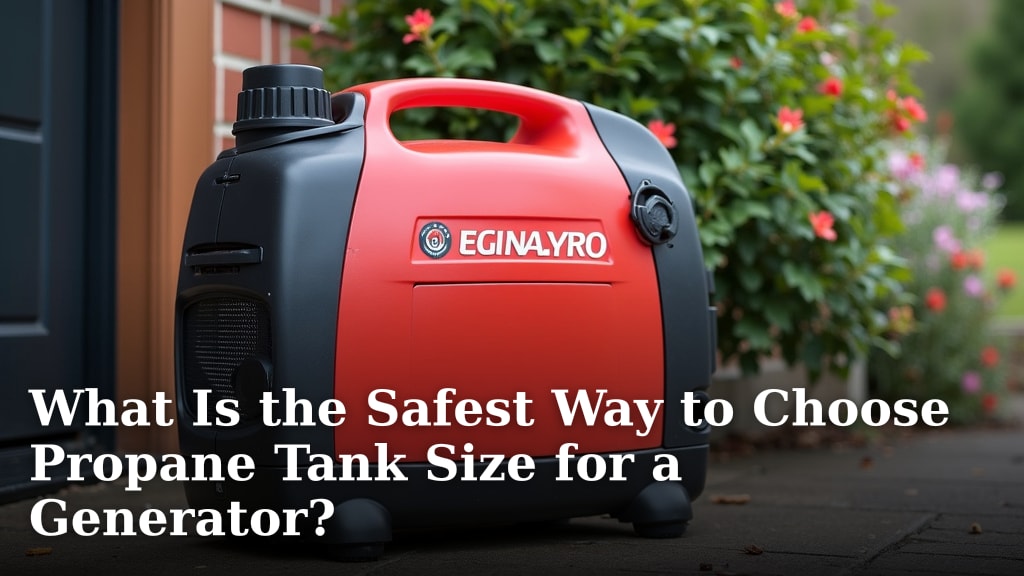
Choosing the right propane tank size for your generator involves matching its fuel consumption rate with your expected runtime needs. The safest way is to first determine your generator’s BTU per hour output and then calculate how long each tank size will last based on that. Don’t guess; let’s get this right so you’re powered up when you need it most.
Many people wonder if a larger tank is always better. While a bigger tank offers longer runtimes, it also needs more space and can be heavier to handle. Understanding your generator’s efficiency and your typical power demands will help you pick a tank that balances convenience with preparedness. This prevents running out of fuel unexpectedly during an outage.
- Calculate your generator’s BTU/hr output.
- Estimate your expected runtime during an outage.
- Research standard propane tank sizes (e.g., 20 lb, 30 lb, 100 lb).
- Use online calculators or formulas to find the best fit.
- Consider storage space and handling ease for your chosen size.
Let’s walk through exactly how to figure out the perfect propane tank size for your generator, making sure you’re always ready for whatever comes your way.
Picking the Right Propane Tank Size for Your Generator
Choosing the safest propane tank size for your generator is about smart planning. You want enough fuel to get you through an outage. But you also don’t want a tank that’s too big to handle or store. Let’s break down how to make the best choice for your needs.
Understanding Your Generator’s Fuel Needs
Your generator’s fuel consumption is the key factor here. Think of it like choosing a gas tank for your car. A small car sips fuel, while a big truck guzzles it. Generators are similar. Some are very efficient, while others use more propane.
Generator Fuel Consumption Explained
Generators are rated by their power output, often in watts. But for propane, we need to look at fuel consumption. This is usually measured in gallons per hour or pounds per hour. Your generator’s manual will be your best friend for this. Look for the section on fuel specifications.
The manual will often list consumption rates at different load levels. For example, it might say:
- At 50% load: X pounds of propane per hour
- At 100% load: Y pounds of propane per hour
Calculating BTU Output
Propane has a specific energy content. This is measured in British Thermal Units (BTU). One gallon of propane contains about 91,500 BTUs. This information helps us convert generator power ratings into propane needs. Your generator’s manual might list its BTU output per hour. If not, you can often find it or calculate it. A common conversion is that 1 watt equals about 3.412 BTU per hour. So, a 5,000-watt generator would theoretically output about 17,060 BTU per hour (5000 x 3.412). This is a simplified view, as generator efficiency plays a role.
Estimating Your Runtime Requirements
Now, let’s talk about how long you expect to need your generator. Are you preparing for short power flickers, or are you planning for a potential week-long outage? This is a very personal calculation. Think about your location and past experiences. How long have power outages typically lasted in your area?
Consider what you absolutely need to power. Is it just your refrigerator and some lights? Or do you need to run a furnace, a sump pump, and maybe even a well pump? The more appliances you run, the higher the load on your generator, and the more fuel you’ll use.
A good rule of thumb is to plan for at least 24 to 48 hours of runtime. This covers many common outage scenarios. If you live in an area prone to severe weather or extended outages, you might want to aim for even longer.
Understanding Standard Propane Tank Sizes
Propane tanks come in various sizes, each suited for different applications. For generators, you’ll typically be looking at portable tanks. These are the same tanks you might see used for grilling.
Common Propane Tank Sizes and Their Capacity
Let’s look at the most common sizes you’ll encounter:
20-Pound Propane Tanks:
These are the classic “grill tanks.” They are roughly 18 inches tall and 12 inches in diameter. They hold about 4.7 gallons of propane. When full, they weigh around 37 pounds. They are easy to handle and widely available. However, they hold the least amount of fuel, meaning you’ll need to swap them out more frequently for longer runtimes.
30-Pound Propane Tanks:
Slightly larger than 20-pound tanks, these hold about 7.1 gallons of propane. They weigh around 49 pounds when full. They offer a bit more runtime than 20-pound tanks but are still manageable for most people. They have a slightly taller profile, often around 24 inches.
100-Pound Propane Tanks:
These tanks are significantly larger, holding about 23.6 gallons of propane. They are much heavier, weighing around 130 pounds when full. They stand about 40 inches tall and are 14.5 inches in diameter. These offer much longer runtimes and are a good option if you have space and can manage the weight. You’ll also find them requiring a regulator that might be different from smaller tanks.
Larger ASME Tanks:
These are much larger, stationary tanks, often seen at homes for primary heating. They can range from hundreds to thousands of gallons. While they offer the longest runtimes, they are generally not practical or safe for portable generators due to installation and connection requirements. Stick to DOT-approved portable tanks for your generator.
How Much Propane Does a Generator Use? (An Example)
Let’s do some math to make this clearer. Suppose you have a 5,000-watt generator that consumes 2 pounds of propane per hour at 50% load. A standard 20-pound propane tank can hold approximately 20 pounds of propane (it’s filled to 80% capacity for safety). So, theoretically, a 20-pound tank would give you about 10 hours of runtime at 50% load (20 lbs / 2 lbs/hr = 10 hours). This is a simplified example, as actual consumption varies with load and generator efficiency.
Now, if you needed 48 hours of runtime, you’d need roughly 480 pounds of propane (48 hours * 10 lbs/hr if it consumed 10 lbs/hr at higher load). With 20-pound tanks, that’s 24 tanks (480 lbs / 20 lbs/tank). That’s a lot of tanks to manage! This is where a 100-pound tank starts to look more appealing. A 100-pound tank holds about 100 pounds of propane. So, in this scenario, you’d need about 4.8 of those 100-pound tanks (480 lbs / 100 lbs/tank). This is much more manageable.
Calculating the Best Fit for Your Generator and Needs
Now that you understand the variables, let’s put it together. The safest way is to combine your generator’s consumption rate with your desired runtime.
The Calculation Formula
Here’s a simple formula to help you estimate:
Total Propane Needed (lbs) = Generator Consumption Rate (lbs/hr) x Desired Runtime (hours)
Once you have your total propane needed, you can divide that by the capacity of the tank size you’re considering.
Number of Tanks Needed = Total Propane Needed (lbs) / Tank Capacity (lbs)
For example, if your generator uses 1.5 lbs/hr and you want 30 hours of runtime: Total Propane Needed = 1.5 lbs/hr * 30 hours = 45 lbs. If you’re using 20-pound tanks (approx. 16 lbs usable capacity per tank): Number of Tanks = 45 lbs / 16 lbs/tank = 2.8 tanks. So, you’d need 3 x 20-pound tanks. If you’re using 100-pound tanks (approx. 80 lbs usable capacity per tank): Number of Tanks = 45 lbs / 80 lbs/tank = 0.56 tanks. So, you’d need 1 x 100-pound tank.
Remember to always consider the usable capacity of the tank, which is about 80% of its total weight capacity for safety. Many online calculators can do these calculations for you if you prefer not to do the math yourself.
Using Online Calculators Wisely
Many websites offer propane tank calculators for generators. These are excellent tools. You typically input your generator’s wattage, its fuel consumption rate (if known), and your desired runtime. The calculator then suggests tank sizes. Always double-check the results against your own calculations. Ensure the calculator is using accurate conversion factors. These tools are a great starting point for understanding your needs.
Factors Beyond Runtime: Storage and Handling
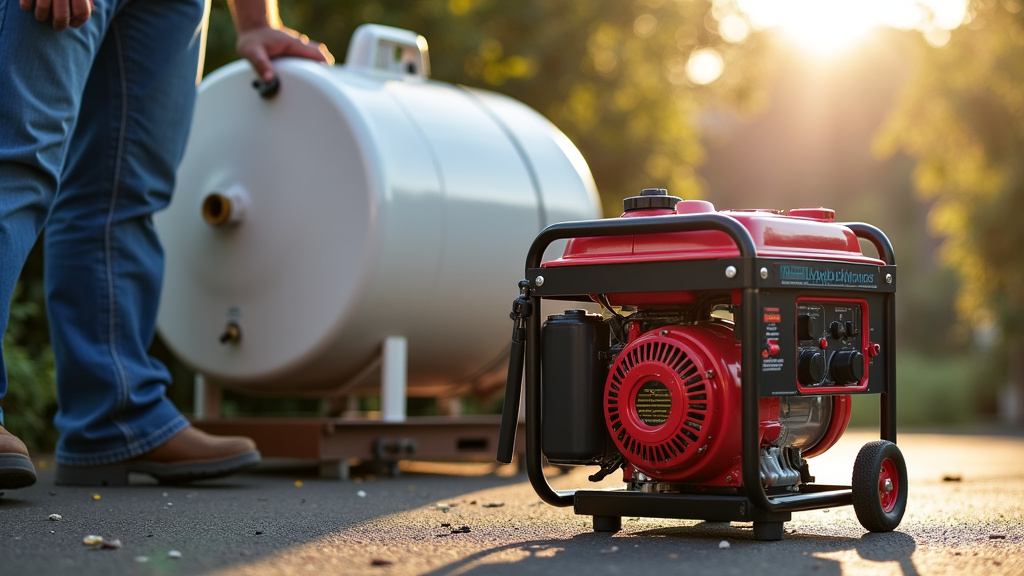
While runtime is critical, don’t forget about the practicalities of tank size. A bigger tank means more propane, but it also means more weight and space requirements.
Weight and Portability Concerns
A full 20-pound tank weighs about 37 pounds. A full 100-pound tank weighs about 130 pounds. Can you comfortably lift and move a 130-pound tank? If not, using multiple smaller tanks might be a safer approach. Many generators have connections for two smaller tanks, allowing you to run one while the other is ready to go.
Storage Space Requirements
Where will you store your propane tanks? Propane tanks should always be stored upright, outdoors, and away from ignition sources and living spaces. A large 100-pound tank takes up more floor space than several smaller tanks. Consider your available storage area, especially if you need to store multiple tanks for extended outages.
Safety Guidelines for Propane Storage
Proper storage is paramount. Propane is flammable. Always store tanks upright in a well-ventilated area. Keep them away from heat sources, flames, and direct sunlight. Ensure tanks are secured to prevent tipping. For extended outages, having a safe and accessible storage plan is as important as having enough fuel. Following guidelines from organizations like the National Propane Gas Association can provide further safety information.
Making Your Final Decision: A Checklist
To ensure you choose the safest and most appropriate propane tank size, run through this quick checklist:
- Generator Consumption Rate: What is your generator’s BTU/hr output or lbs/hr consumption?
- Desired Runtime: How many hours or days do you realistically need to power your essential items?
- Tank Capacity Research: Understand the usable propane volume (in lbs or gallons) of common tank sizes (20, 30, 100 lb).
- Runtime Calculation: Calculate how many hours a single tank of each size will last based on your generator’s needs.
- Total Tank Calculation: Determine how many tanks of your chosen size you’ll need for your desired total runtime.
- Storage & Handling Check: Confirm you have adequate, safe storage space and can safely handle the weight of the tanks.
Conclusion
You’ve learned that picking the right propane tank size for your generator is all about smart math and practical planning. It’s not just about having enough fuel; it’s about balancing your generator’s consumption rate with your expected runtime needs. Remember to check your generator’s manual for its fuel consumption and consider your local outage history. You now have the tools to calculate exactly how much propane you’ll need. Your next step is to use this knowledge to confidently select a tank size that ensures you’ll stay powered up when it matters most, without unnecessary hassle.
Frequently Asked Questions
How do I find my generator’s exact propane consumption rate?
Check your generator’s owner’s manual. It will usually list fuel consumption in pounds or gallons per hour, often at different load percentages (like 50% or 100%). If it’s not listed, look for its BTU/hr output and convert that using propane’s energy content.
Can I connect multiple small propane tanks to my generator at once?
Yes, many generators are designed to connect to two smaller tanks simultaneously. This allows you to extend your runtime without having to swap tanks during an outage. Your generator’s manual will detail its fuel connection capabilities.
What’s the difference in usable fuel between a 20-pound and a 100-pound propane tank?
A 20-pound tank holds about 16 pounds of usable propane, while a 100-pound tank holds about 80 pounds. This means a 100-pound tank offers roughly five times the runtime of a 20-pound tank, making it more convenient for longer outages.
Do I need a special regulator for larger propane tanks (like 100-pounders)?
Often, yes. Larger tanks, like 100-pound tanks, may require a different type of regulator than the standard ones used for smaller grill tanks. Your generator’s manual or the tank supplier can confirm the correct regulator needs for safe operation.
How often should I check my propane levels during a power outage?
It’s wise to monitor your fuel levels regularly, especially if you’re nearing your calculated runtime. Knowing your generator’s consumption rate helps predict when a tank will need changing, allowing you to do so safely before it runs empty.
