
What Is the Difference Between 2000 Watt or 4000 Watt Generator?
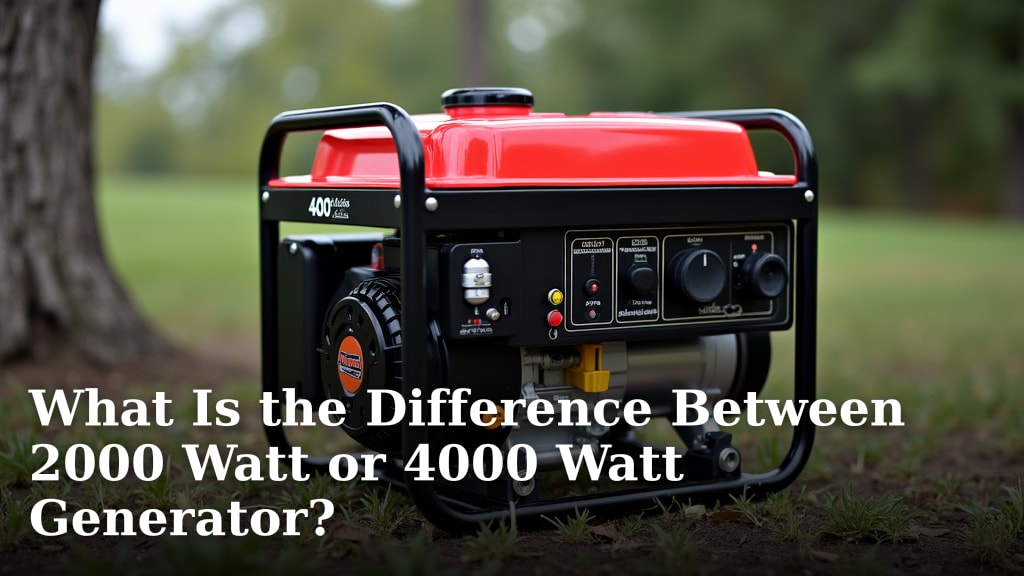
The main difference between a 2000-watt and a 4000-watt generator is their power output and the types of devices they can run. A 4000-watt generator provides twice the power, allowing you to operate more appliances or larger, more demanding equipment simultaneously.
When choosing, you’ll need to think about your specific needs. Do you want to power a few small items or heavy-duty tools and multiple household appliances? We found that the right choice often depends on whether you need it for camping, home backup, or job site use.
- 2000-watt generators are great for light use.
- 4000-watt generators handle more power.
- Consider your power needs carefully.
- Portability and fuel efficiency differ.
Let’s break down everything you need to know about these generators, helping you pick the perfect one for your situation.
Exploring the Differences Between 2000-Watt and 4000-Watt Generators
Understanding the core differences between a 2000-watt and a 4000-watt generator helps you make an informed decision. It’s not just about more power; it’s about the right power for your needs. We found that the main distinctions lie in their capacity, portability, and typical applications.
Understanding Generator Wattage
Wattage tells you how much electricity a generator can produce. Think of it like the horsepower of a car. A higher wattage means it can run more appliances or larger, more power-hungry devices. You’ll often see two wattage numbers: starting watts and running watts.
Starting Watts vs. Running Watts
Every appliance needs a burst of extra power to start up. This is its starting wattage. Once it’s running smoothly, it settles into a lower running wattage. Your generator needs to handle both. We found that many people forget about starting watts, leading to overloaded generators (U.S. Department of Energy).
- Starting Watts: The brief surge of power an appliance needs to turn on.
- Running Watts: The continuous power an appliance uses once it’s operating.
Comparing Power Output and Capacity
This is where the numbers really count. A 4000-watt generator offers a significantly higher power ceiling. This impacts everything you can plug into it. Do you just need to keep your phone charged and a few lights on, or do you need to power a refrigerator and a sump pump?
A 2000-watt generator typically offers around 1600-1800 running watts. A 4000-watt model usually provides about 3000-3500 running watts. That extra capacity makes a big difference.
What Can Each Generator Run?
Let’s look at some common scenarios. This helps put the wattage numbers into perspective. We often hear people ask, “Can I run my coffee maker?” or “Will it power my RV air conditioner?”
Typical Uses for a 2000-Watt Generator
These smaller generators are perfect for lighter tasks. They’re like the trusty sidekick for casual adventures. Think camping, tailgating, or powering a few essentials during a short outage.
- Charging phones, laptops, and tablets.
- Running a few lights or a small fan.
- Powering a small TV or radio.
- Operating a portable cooler or mini-fridge.
- Great for small power tools like drills (one at a time).
You can often run a couple of these items together. But you’ll need to be mindful of the total wattage. Overloading it will trip the breaker or even damage the generator.
Typical Uses for a 4000-Watt Generator
A 4000-watt generator steps up the game considerably. It’s more like a reliable workhorse. This capacity opens up possibilities for more substantial needs, including some home backup or heavier-duty job site tasks.
- Running a full-sized refrigerator or freezer.
- Powering multiple lights and entertainment systems.
- Operating a microwave or coffee maker.
- Handling larger power tools simultaneously (e.g., circular saw, air compressor).
- Can often run a small RV air conditioner (check specific unit wattage).
- Providing essential backup power for a few critical home circuits.
With a 4000-watt unit, you have more flexibility. You can usually run several common household appliances at once without worry. It offers a much greater sense of security during an outage.
Portability and Size Considerations
Power comes with a price, and sometimes that price is weight and bulk. This is a significant factor in your decision. We found that people often overlook how much a generator weighs until they try to move it.
2000-Watt Generator Portability
These generators are designed for easy transport. They’re typically lighter and more compact. You can often carry them with one hand. This makes them ideal for situations where you need to move them around frequently, like camping trips or moving from one job site to another.
Many 2000-watt models are “inverter” generators. This means they are generally quieter and more fuel-efficient. Their smaller fuel tanks contribute to their lighter weight.
4000-Watt Generator Portability
A 4000-watt generator is noticeably heavier. Expect them to weigh between 80 to 120 pounds or more. While some might have wheels for easier movement, they are not as simple to pick up and carry. You might need two people or a ramp to load them into a vehicle.
Their larger size often means a bigger fuel tank. This offers longer run times but adds to the overall weight. Consider where you’ll store it and how you’ll move it when needed.
Fuel Efficiency and Run Time
How long can your generator run on a tank of gas? This matters, especially during extended power outages or long camping trips. We found that fuel costs can add up, so efficiency is key.
Generally, 2000-watt inverter generators are very fuel-efficient. They often have an “eco-mode” that adjusts engine speed to match the load, saving gas. They might run for 8-10 hours on a small tank at a quarter load.
4000-watt generators consume more fuel, naturally. They have larger engines. While their tanks are bigger, their overall fuel efficiency per watt produced might be lower than smaller inverter models. They still offer good run times, but you’ll burn through more gas for the increased power.
Noise Levels
Nobody wants a roaring engine disturbing the peace. Noise is a major consideration for many buyers. This is another area where the generator types often differ.
Most 2000-watt generators, especially inverter models, are remarkably quiet. They often operate at volumes similar to a normal conversation (around 50-60 decibels). This makes them perfect for campsites or neighborhoods where noise restrictions apply.
4000-watt generators tend to be louder. While some inverter models exist at this wattage, many are traditional open-frame generators. These can be quite noisy, often reaching 70-80 decibels or more. If noise is a concern, always check the decibel rating before buying.
Cost Differences
Budget is always a factor, right? The price difference between these two generator sizes can be substantial. You’re paying for more power, features, and often, a larger engine.
2000-watt generators are generally more affordable. You can find good quality models for a few hundred dollars. This makes them an attractive option for those with lighter power needs or a tighter budget.
4000-watt generators will cost more. Prices can range from about $500 to well over $1000, depending on features, brand, and whether it’s an inverter model. This higher price reflects the increased power output and capability.
Making Your Choice: A Quick Checklist
Deciding between these two can be simple if you consider your primary uses. Ask yourself a few key questions to guide your decision. Here’s a quick rundown to help you:
- What specific appliances or tools do you need to power?
- Do you need portability, or will it stay mostly in one place?
- How important is quiet operation for your intended use?
- What is your budget for the generator and its fuel?
- How long do you need it to run on a single tank?
| Feature | 2000-Watt Generator | 4000-Watt Generator |
|---|---|---|
| Power Output (Running Watts) | ~1600-1800W | ~3000-3500W |
| Typical Use | Camping, tailgating, small electronics, light backup | RV, job site, essential home backup, multiple appliances |
| Portability | Highly portable, lightweight (30-60 lbs) | Less portable, heavier (80-120+ lbs), often with wheels |
| Fuel Efficiency | Very efficient, longer run time per gallon | Less efficient, uses more fuel for power |
| Noise Level | Quieter (50-60 dB), often inverter models | Louder (70-80+ dB), can be open frame |
| Cost | More affordable | Higher price point |
Conclusion
Choosing between a 2000-watt and a 4000-watt generator really boils down to your specific power demands. We found that if you need light, portable power for camping or minimal backup, the 2000-watt unit is your best bet. If you’re looking to run more appliances, tackle larger tools, or provide more substantial home backup, the 4000-watt model offers the necessary muscle.
Consider your usage, portability needs, and budget. By evaluating these factors, you can confidently select the generator that perfectly suits your power requirements.
Frequently Asked Questions
Can a 2000-watt generator run a small RV air conditioner?
It’s unlikely a 2000-watt generator can run most RV air conditioners, as they typically require 2000-3500 starting watts. You would likely need a 3000-watt generator or larger for that specific appliance.
Is a 4000-watt generator too loud for camping?
Many 4000-watt generators, especially non-inverter models, can be quite loud (70-80+ dB). This might be too disruptive for quiet campgrounds. Look for 4000-watt inverter generators, which are generally quieter.
How much fuel does a 4000-watt generator use compared to a 2000-watt?
A 4000-watt generator will naturally consume more fuel than a 2000-watt model because it has a larger engine and provides more power. While its tank might be bigger, its fuel efficiency per watt produced is often lower.
Can I use a 2000-watt generator to power my entire house in an emergency?
No, a 2000-watt generator is not sufficient to power an entire house. It can only handle a few essential items like lights, a phone charger, and possibly
