
Is It Worth Buying 5000 Watt or 7500 Watt Generator?
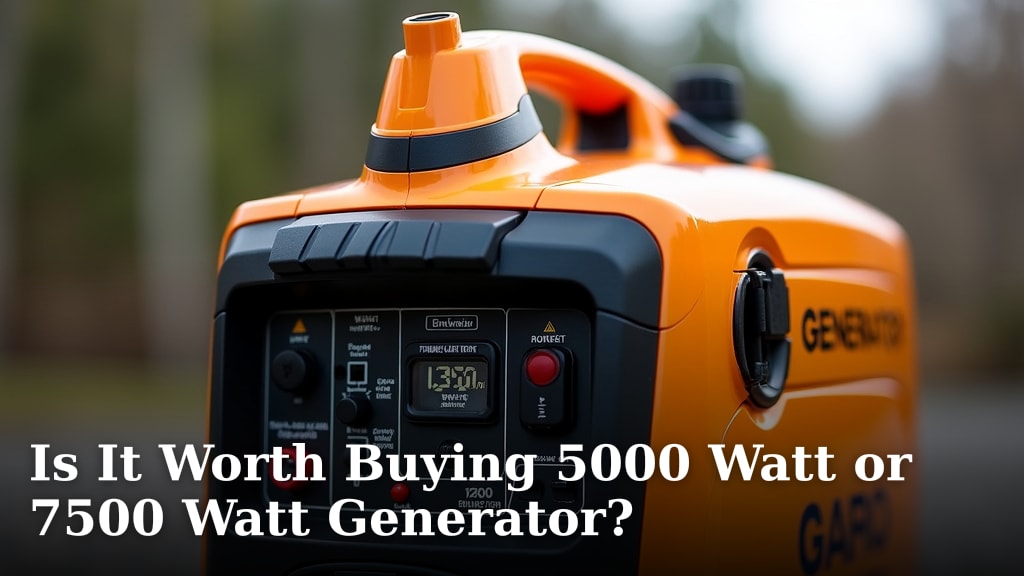
Deciding if it’s worth buying a 5000-watt or 7500-watt generator really depends on your specific needs, but for most homes needing backup power for essential appliances, 7500 watts often provides more versatility and peace of mind.
You’ll want to consider what appliances you plan to run during a power outage. A 5000-watt generator handles basics, but a 7500-watt model offers more power for additional comforts or larger items.
- For essential home backup, 7500 watts is generally better.
- 5000 watts powers core appliances like a fridge and some lights.
- 7500 watts adds flexibility for HVAC fans, a well pump, or more.
- Consider your budget and the cost difference between the two.
- Think about fuel efficiency and storage for each size.
Let’s walk through how to figure out which generator size truly fits your home and why one might be a better investment for you.
Understanding Your Power Needs: 5000W vs. 7500W Generators
Choosing between a 5000-watt and a 7500-watt generator really comes down to what you need to power during an outage. It’s like picking a car; a compact sedan gets you around, but an SUV offers more space and capability. Let’s break down the actual difference in what each generator can handle.
What Can a 5000-Watt Generator Power?
A 5000-watt generator is often considered a good starting point for essential home backup. It will keep your critical appliances running, preventing major disruptions.
Think of it as your survival kit. It handles the basics to keep your household functioning, but not much more.
Typical Appliances for a 5000W Generator
With a 5000-watt model, you can usually run a combination of the following:
- Refrigerator: Keeping your food from spoiling is a top priority.
- Lights: A few lamps or overhead lights to navigate your home safely.
- Television: For entertainment or news updates.
- Sump pump: Crucial for preventing basement flooding in some homes.
- Small window AC unit: Just enough to cool one room.
- Microwave: For quick meal preparation.
- Phone chargers: Staying connected is important.
You probably wouldn’t run all of these simultaneously. You’d need to prioritize. You can’t just plug everything in and expect it to work; that’s when you trip the breaker.
What Can a 7500-Watt Generator Power?
Stepping up to a 7500-watt generator gives you significantly more power. This extra capacity means more comfort and flexibility during an outage.
It’s like upgrading from that compact sedan to a mid-size SUV. You have room for more passengers and luggage – or in this case, more appliances.
Typical Appliances for a 7500W Generator
A 7500-watt generator can handle everything a 5000-watt unit can, plus more. Here’s what you might add to your list:
- Central furnace fan: Keeping your home warm in winter.
- Well pump: Essential if you rely on well water for your home.
- Larger appliances: Like a small electric water heater or a clothes dryer (though probably not both simultaneously).
- Multiple window AC units: Or a larger single unit.
- More lights and electronics: Spreading power across more rooms.
- Electric stove elements: For cooking, but likely only one or two burners at a time.
This increased capacity means you can maintain a more normal household routine, which can be a huge relief during an extended outage.
Comparing Power Output and Practical Use
It’s not just about the peak watts; it’s about what you can run consistently. Generators have both starting watts and running watts. Starting watts, often called surge watts, is the brief burst of power needed to kick-start an appliance with a motor, like a refrigerator or an AC unit (Energy.gov).
Understanding Starting vs. Running Watts
When you look at generator specifications, you’ll see two numbers. The higher number is the starting watts. The lower, and more important, number is the running watts. This is the continuous power your generator can provide.
Many people overlook starting watts, but it’s crucial. If your generator can’t handle the initial surge, your appliance simply won’t start.
Why Starting Watts Matter for Your Selection
For example, a refrigerator might need 600 running watts but a surge of 1800 watts to start. An air conditioner could need 1500 running watts and 4500 starting watts.
This is where a 7500-watt generator really shines. It has a higher capacity for those surges, meaning you can start more motors without tripping the system.
Sizing Your Generator: The Appliance Checklist
The best way to decide between a 5000-watt and a 7500-watt generator is to list everything you absolutely need to run. Don’t guess; take a moment to really think about it.
This is your personal power plan. We found that homes with specific needs, like a well pump or central heating, often lean towards the larger unit.
Your Home’s Unique Power Demands
Every home is different. Do you live in an area prone to harsh winters? Then your furnace fan is likely a critical item. Does your home rely on a septic system with a pump? That needs power too.
Consider the “must-haves” versus the “nice-to-haves.” This distinction will guide your choice.
Performing a Wattage Calculation
Grab a pen and paper. Seriously. Go around your house and list the appliances you’d want running during an outage. Look for the wattage on the appliance label or in its manual. If you can’t find it, a quick online search for “appliance name wattage” usually works.
Add up the running watts for all your “must-have” items. Then, identify the appliance with the highest starting wattage among your “must-haves.” Add that highest starting wattage to your total running watts. This gives you a good estimate of the minimum generator size you’ll need.
Here’s a simplified comparison table for typical appliances:
| Appliance | Running Watts (Approx.) | Starting Watts (Approx.) |
|---|---|---|
| Refrigerator (Energy Star) | 600 W | 1800 W |
| Sump Pump (1/2 HP) | 800 W | 1500 W |
| Microwave (1000W) | 1000 W | 1000 W |
| Furnace Fan (1/2 HP) | 800 W | 2350 W |
| Well Pump (1/2 HP) | 1000 W | 3000 W |
| Window AC (10,000 BTU) | 1200 W | 3600 W |
| TV (LCD 42″) | 200 W | 200 W |
| Incandescent Light Bulb | 60-100 W | 60-100 W |
As you can see, those starting watts can really add up, especially for larger appliances.
Cost, Fuel, and Portability Considerations
Beyond just power, you’ll want to think about the practical aspects of owning either size generator. Budget, how much fuel it uses, and how easy it is to move are all part of the equation.
Budget and Initial Investment
Generally, a 7500-watt generator will cost more upfront than a 5000-watt model. Is that extra cost justified for the additional power? For many, the peace of mind is worth it.
However, don’t just look at the sticker price. Factor in potential installation costs if you’re connecting it to your home’s electrical panel (CDC).
Fuel Efficiency and Storage
A larger generator, like a 7500-watt model, will naturally consume more fuel than a 5000-watt one when running at similar loads. This means you’ll need to store more gasoline (or propane, depending on your model).
Fuel storage is a significant consideration. Gasoline degrades over time and needs proper storage containers in a safe, well-ventilated area.
Size and Portability
7500-watt generators are typically larger and heavier than 5000-watt units. While many come with wheels and handles, they are still substantial pieces of equipment.
Think about where you’ll store it and how you’ll move it when needed. Is it going to be a struggle every time you need to pull it out?
The “What If” Scenario: Preparing for Extended Outages
Power outages aren’t always just a few hours. Sometimes they last days, or even longer, especially after a major storm. This is where the extra capacity of a 7500-watt generator becomes very appealing.
We found that people who experience frequent or long-duration outages often regret not going for the larger unit.
Maintaining Comfort During Long Outages
With a 7500-watt generator, you can often keep more of your home running. This means more comfort for your family and less disruption to your daily life.
It’s the difference between merely surviving an outage and weathering it with some semblance of normalcy.
Future-Proofing Your Power Solution
Consider your future needs. Are you planning to add a new appliance that draws a lot of power? Or perhaps you anticipate needing to run more things as your family grows?
Investing in a slightly larger generator now can save you from needing to upgrade sooner than you’d like. It’s an investment in preparedness.
Final Checklist for Your Generator Decision
Before you make your final choice, run through this quick checklist. It helps solidify your thinking and ensures you haven’t missed anything important.
- Calculated Total Wattage: Have you added up the running and starting watts for all your essential appliances?
- Critical Appliances Identified: Do you know exactly which items absolutely need power?
- Budget Considerations: Are you comfortable with the initial cost and ongoing fuel expenses for your chosen size?
- Storage and Portability: Do you have a safe, accessible place to store the generator, and can you move it easily?
- Frequency of Outages: How often do you lose power, and for how long?
- Future Needs: Will your power demands increase in the next few years?
Ultimately, the “worth” of a 5000-watt versus a 7500-watt generator is personal. But by going through these steps, you’ll be well-equipped to make the decision that’s right for your home.
Conclusion
Making the right generator choice for your home comes down to careful planning. While a 5000-watt generator handles basic necessities, we found that a 7500-watt model often offers a better balance of essential power and comfort for most homeowners. It provides extra capacity for common household items like well pumps or furnace fans, giving you more peace of mind during extended outages.
Ultimately, your decision hinges on your specific needs, budget, and how much comfort you want to maintain. Take the time to calculate your wattage, consider your long-term needs, and you’ll confidently choose the generator that keeps your home running smoothly when the power goes out.
Frequently Asked Questions
Is a 7500-watt generator enough to power a whole house?
For most average-sized homes, a 7500-watt generator can power essential circuits and several high-demand appliances, but it’s generally not enough to run everything simultaneously like central air conditioning and electric dryer. It allows you to prioritize and maintain a good level of comfort and functionality during an outage.
How long can a 5000-watt generator run on a tank of gas?
The run time for a 5000-watt generator on a full tank of gas varies widely. It depends on the fuel tank size and the load you’re placing on the generator. Typically, at a 50% load, you might expect it to run for 8-12 hours, but always check the specific model’s specifications.
Can I safely connect a generator directly to my home’s electrical panel?
No, directly plugging a generator into a standard wall outlet or wiring it directly into your home’s electrical panel without proper equipment is extremely dangerous. You must use a transfer switch, installed by a qualified electrician, to safely connect a portable generator to your home’s wiring. This prevents backfeeding electricity into the grid, which can harm utility workers.
What kind of fuel is best for a home backup generator?
Most portable home backup generators run on gasoline, though many dual-fuel models also use propane. Propane has a longer shelf life and burns cleaner, but it might be less convenient to store large quantities. Gasoline is readily available but degrades over time and requires fuel stabilizer for storage.
Do I need an inverter generator for home backup?
While inverter generators offer cleaner power, making them ideal for sensitive electronics, a traditional conventional generator is often sufficient for general home backup. If you plan to run only basic appliances and don’t have many sensitive devices, a conventional generator at 5000W or 7500W might be more cost-effective. However, an inverter model will protect all your devices better.
