
How to Size a Dual Fuel Generator for Home Backup?
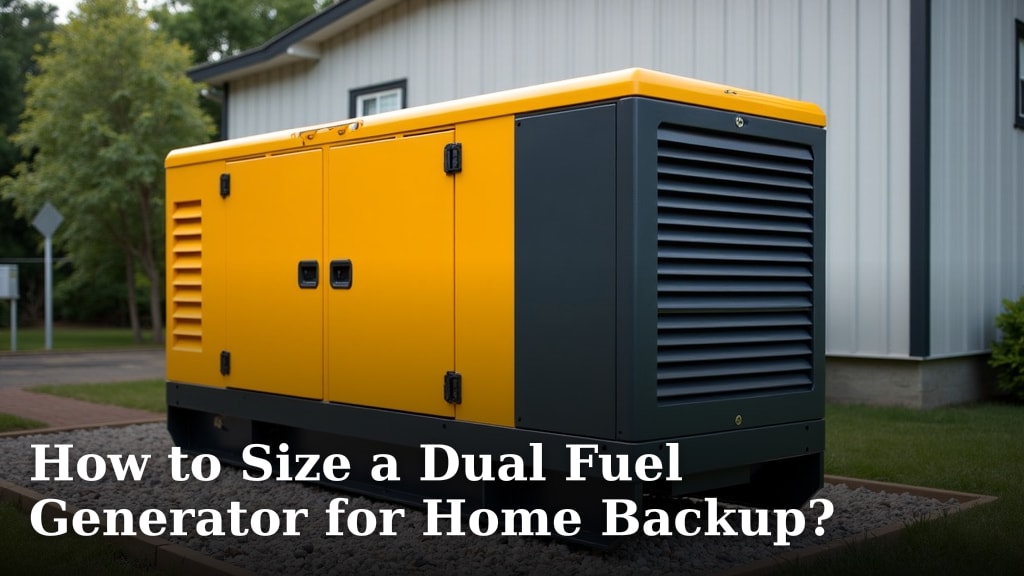
To accurately size a dual fuel generator for home backup, start by calculating your home’s total running wattage and then identify the highest surge wattage appliance. You’ll need a generator that can handle both the continuous power needs and the short, intense power spikes of your largest starting appliance.
Picking the right generator size saves you from being without power during an outage or, conversely, buying a unit that’s far too big and inefficient for your needs. We found that overestimating can lead to wasted fuel, while underestimating leaves you in the dark. It’s all about finding that sweet spot for reliability.
TL;DR:
- Calculate your home’s total running wattage.
- Identify the highest surge wattage for starting appliances.
- Add a 10-20% buffer to your total wattage for safety.
- Consider if you need to power essential items or your whole house.
Let’s research together how to choose the perfect dual fuel generator for your peace of mind.
Determining the Right Generator Size for Your Home Back-Up
To determine the right generator size, you need to calculate your home’s total running wattage and then account for surge wattage. This ensures your generator can handle both constant power needs and initial power spikes.
Understanding Watts: Running vs. Starting (Surge) Amps
Watts are the unit of electrical power. Generators are rated in watts. You’ll encounter two main types when sizing your generator: running watts and starting watts.
Running watts are the continuous power an appliance needs to operate normally. Think of your refrigerator humming along. Starting watts, also called surge watts, are the extra burst of power an appliance needs for a few seconds to kick on. Motors often require a lot more power to start than to run (U.S. Department of Energy).
Why Starting Watts Matter
Imagine your air conditioner. It might run at 2,000 watts, but it could need 4,000 watts to start its compressor. If your generator can’t provide that initial surge, the AC won’t turn on. We found that forgetting this detail is a common mistake when choosing generator size.
Making Your Appliance Wish List
Before you do any math, decide what you truly need to power during an outage. Are you looking for whole-house backup, or just the essentials?
Most people opt for essential items. Powering your entire home can require a much larger, more expensive generator. We found focusing on crucial appliances makes the sizing process easier and more affordable.
Essential Home Items Checklist
Here’s a simple checklist to get you started:
- Refrigerator/Freezer: Keeps food from spoiling.
- Well Pump: Provides water for your home.
- Furnace Fan: Essential for heat in winter.
- Medical Equipment: Life-sustaining devices.
- Sump Pump: Prevents basement flooding.
- Lights & Communication: A few lamps, cell phone charger.
Have a pen and paper ready. You’ll want to list the running and starting watts for each item.
Calculating Your Home’s Power Needs (The Math Part!)
This step is where the rubber meets the road. You need to find the wattage for each appliance on your list. Look for a sticker on the appliance or check its manual. Online searches for “[appliance name] wattage” are also helpful.
How to Find Wattage Information
Often, you’ll see amps and volts instead of watts. No problem! Use this simple formula:
Watts = Amps × Volts
Most homes in the US use 120 volts for standard outlets and 240 volts for larger appliances like electric dryers or central AC. If an appliance lists only ‘amps’, assume 120 volts for smaller items and 240 volts for larger, dedicated circuits.
Assembling Your Wattage Table
Create a table like this to keep your numbers organized:
| Appliance | Running Watts | Starting/Surge Watts |
|---|---|---|
| Refrigerator (18 cu ft) | 800 | 1200 |
| Microwave (.7 cu ft) | 700 | 1200 |
| Furnace Fan (1/2 hp) | 800 | 2350 |
| Sump Pump (1/3 hp) | 800 | 1300 |
| TV (LCD 42″) | 100 | 100 |
| Lights (6 x 60W bulbs) | 360 | 360 |
| Phone Charger | 10 | 10 |
| Medical Device (CPAP) | 30 | 30 |
Fill in this table with your specific appliances. Don’t worry if the numbers aren’t exact; estimations are fine. The goal is to get a good general idea.
Adding It All Up: Total Running and Peak Starting Wattage
Once your table is complete, do two key calculations:
- Total Running Watts: Add up all the running watts from your list. This is the continuous power your generator needs to supply.
- Highest Starting Wattage: Find the single appliance with the highest starting (surge) wattage. Your generator must be able to meet this demand, no matter what else is running.
We found that many people mistakenly add all the starting watts together. That’s usually not necessary. A generator only needs to “surge” for one appliance at a time. For instance, you likely won’t start your refrigerator and your well pump at the exact same second during an outage.
Applying a Safety Buffer
Always add a safety buffer to your total running watts. We recommend 10-20% extra wattage. Why? Because you never know when you might need to plug in one extra thing or if your refrigerator’s motor is aging and needs a little more oomph to get going.
This buffer acts like an insurance policy for your generator, preventing it from being constantly overloaded or struggling.
The Final Wattage Range You Need
Here’s how to put it all together: Your generator’s “running watts” rating should be:
(Your Total Running Watts) + (10-20% Buffer)
And your generator’s “starting watts” rating must be at least:
(Your Highest Single Starting Wattage from one appliance)
For example, if your total running watts are 3,000 W, and your furnace fan has the highest starting watts at 2,350 W. With a 15% buffer, your running watts requirement becomes 3,000 W x 1.15 = 3,450 W. So you’d look for a generator with at least 3,450 running watts and a starting wattage of at least 2,350 W.
Considering Dual Fuel Efficiency
Remember, you’re looking for a dual fuel generator. These generators can run on both gasoline and propane. We found that the wattage output can sometimes be slightly lower when running on propane compared to gasoline. Always check the manufacturer’s specifications for both fuel types.
If you plan to primarily use propane, make sure the propane wattage rating meets your calculated needs. Many homeowners appreciate the flexibility of dual fuel, especially for longer outages where gasoline might be scarce (The Propane Education & Research Council).
Generator Sizing Checklist
To recap, here’s a quick checklist to help you size your generator:
- List all essential appliances you wish to power.
- Find the running wattage for each appliance.
- Find the starting/surge wattage for each appliance.
- Calculate your total running wattage.
- Identify the single highest starting wattage appliance.
- Add a 10-20% safety buffer to your total running wattage.
- Verify the generator’s propane wattage rating if applicable.
By following these steps, you’ll confidently choose a generator that won’t leave you in the dark. It’s about being prepared, not buying the biggest generator on the market.
Conclusion
Sizing your dual fuel generator doesn’t have to be overwhelming. By systematically listing your essential appliances, calculating their running and starting watts, and applying a smart safety buffer, you’re well on your way. You’ve learned how to find that perfect balance, ensuring enough power without overspending or wasting fuel.
Remember to consider the wattage difference when using propane versus gasoline. This careful planning guarantees peace of mind during any power outage. Now, confidently take your calculated wattage needs and choose the dual fuel generator that’s just right for your home.
Frequently Asked Questions
Is it better to get a slightly oversized generator?
Yes, getting a slightly oversized generator (with a 10-20% buffer) is generally recommended. This buffer protects your generator from constant overloading and gives you flexibility for unforeseen needs or slight increases in appliance draw over time.
Can I use a dual fuel generator indoors?
Absolutely not. Generators, including dual fuel models, produce carbon monoxide, a colorless and odorless gas that can be deadly. Always operate your generator outdoors in a well-ventilated area, far from windows and doors.
How often should I test my dual fuel generator?
It’s a good practice to test your dual fuel generator monthly for about 15-30 minutes, especially under a partial load (like a few lights or a dedicated space heater). This keeps the engine components lubricated, charges the battery, and ensures it’s ready when you need it most.
Does a generator’s wattage decrease with age?
Not typically. A generator’s rated wattage remains constant. However, its performance might degrade over time due to lack of maintenance, dirty fuel, or worn components, which can reduce its effective output. Regular maintenance is key.
What’s the main benefit of a dual fuel generator for home backup?
The primary benefit of a dual fuel generator is its versatility in fuel options. You can use readily available propane, which stores longer than gasoline and burns cleaner, or switch to gasoline for higher power output or when propane supplies are low. This flexibility is great for extended outages.
