9 Best Gas Cans for Generators (November 2026)
The best gas cans for generators include the Scepter 12 Gallon Portable Marine Gas Can for long generator runs, the No-Spill No Spill 1405 2.5 Gallon Gasoline for small generator tanks, and the Scepter 5 Gal Gas Can for most home backup.
On this page (10 sections)
- How to choose a gas can for generator refueling
- Side by side: how these gas cans compare
- How we compared these cans
- What size gas can for generator use should you buy?
- Which spout gives you the cleanest pour?
- Plastic vs metal: which material is safer for storage?
- Type I vs Type II: which safety can fits your needs?
- How to pour fuel into a generator safely
- How to store and care for generator fuel
- Our verdict for a gas can for generator use
The best gas can for generator refueling depends on tank size and how far you carry fuel. The Scepter 12 Gallon Portable Marine Gas Can leads for capacity, while the Scepter 5 Gal Gas Can is the easier everyday pick for most homes.
Start with capacity, then spout control, then material. A can that is too large to lift safely will not help you during an outage.
Our score weighs specs, features and buyer feedback against what you are shopping for. We compared capacity, pouring control, venting, materials, and certifications across all nine picks.
Our picks at a glance
-
1
 Best for long generator runs
Scepter 12 Gallon Portable Marine Gas Can
9.7/10 our score
See it on Amazon -
2
 Best for small generator tanks
No-Spill No Spill 1405 2.5 Gallon Gasoline
9.5/10 our score
See it on Amazon -
3
- 4
 Check it
Justrite Type II Gasoline Safety Can
Best metal safety can for pouring - 5
 Check it
Eagle 5 Gallon Type I Red Safety
Best simple metal safety can - 6
 Check it
SureCan 5 Gallon Type II Storage Container
Best rotating spout can - 7
 Check it
Justrite Type I Gasoline Safety Can
Best for compliant storage - 8
 Check it
Eagle 5 Gallon Type I Yellow Safety
Best for diesel storage - 9
 Best accessory to avoid liftingCheck it
How to choose a gas can for generator refueling
A good generator fuel can pours slowly at the end, vents without spilling, and stays stable on the ground. Check the opening size on your generator before you buy a spout.
If your generator tank is small, a large can will be hard to control. If you run the generator for many hours, a small can will mean constant trips to the pump.
For a broader look at container types, our fuel storage container buying guide explains sizes and safety basics. It helps you match a container to your storage space.
Why generator tanks punish sloppy pouring
Most generators place the fill port high, near hot engine parts, and away from the edge of the frame. That layout means a wide spout can splash fuel onto metal before you can stop the flow.
A can with trigger, button, or hose control lets you slow the last portion of the pour. That final slowdown matters more on a generator than on a lawn mower with a larger, more accessible opening.
Scepter 12 Gallon Portable Marine Gas Can: Best for long generator runs
- 12 gallon capacity
- 2-way vented cap
- Built-in fuel gauge
- HDPE shell
- 22.9 x 14.3 x 13.9 in
A large 12 gallon tank with a built-in gauge fits buyers who want fewer refills during long outages.
Pros
- 12 gallon capacity reduces refill trips
- Built-in fuel gauge checks level fast
- Vented cap releases pressure above 5 PSI
Cons
- Large size is heavy when full
- Fuel line sold separately
This Scepter suits buyers who run a generator through long outages and want fewer trips for fuel. Its 12 gallon capacity means one fill can cover far more generator runtime than a standard 5 gallon can.
The built-in fuel gauge helps you check the level without opening the cap. The 2-way vented cap releases pressure above 5 PSI, which helps prevent vapor buildup during storage and pouring.
Its HDPE shell resists rust, corrosion, and UV damage, and Scepter describes it as a 5-layer crush-resistant design. The tall profile and molded hand holds make carrying easier, but a full 12 gallon tank will still be heavy.
It is an EPA and CARB approved gasoline container, and it is also compatible with diesel and ethanol-blended fuels. The fuel line is sold separately, so budget for that part if you need it.
Choose it for maximum runtime and fewer refills. Skip it if you must carry fuel up stairs or down a long driveway often.
No-Spill No Spill 1405 2.5 Gallon Gasoline: Best for small generator tanks
- 2.5 gallon capacity
- Thumb button control
- 7/8-inch funnel spout
- 20 mesh stainless steel screen
- Attached dust cover
A small 2.5 gallon can with precise thumb-button pouring suits generators with small fuel openings.
Pros
- Precise thumb button control
- Small spout fits small openings
- Dust cover keeps spout clean
Cons
- Small capacity means more refills
- Plastic body is less tough than steel
This No-Spill suits generators with small fuel openings and buyers who spill often with standard spouts. Its thumb button control lets you start and stop flow with your hand, which is useful at the end of a pour.
The 7/8-inch funnel spout fits even small equipment tanks. That narrow tip helps you reach a recessed port without resting the spout against hot frame parts.
An integrated 20 mesh stainless steel screen helps keep debris out of your generator. You should still check it now and then, since grit can slow the flow.
The attached dust cover keeps the spout clean when the can is stored in a garage or shed. A clean spout matters during an outage, when you may use the can in poor light.
Fuel level stripes on the front and back let you check supply at a glance. They are a guide only, so pause near the top of the tank and watch the level.
At 2.5 gallons and 2 lb empty, it is light to carry and easy to hold steady while pouring. That control is the main trade-off against larger cans.
Choose it for precision and light weight. Skip it if you need to refuel for many hours without returning to the pump.
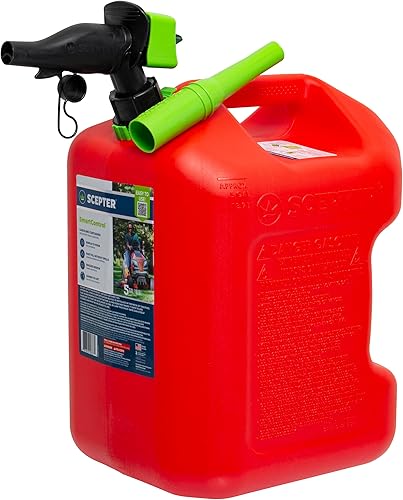
Scepter 5 Gal Gas Can: Best for most home backup
- 5 gallon capacity
- SmartControl spout
- Spout extender and funnel
- Flame mitigation device
- EPA / CARB compliant
A 5 gallon plastic can with controllable flow balances capacity, weight, and easy pouring for home use.
Pros
- Controllable flow reduces spills
- Fast fills up to 3 gallons per minute
- Funnel included for filling
Cons
- Plastic construction
- Must be gasoline only
This Scepter suits most home backup users who want a standard 5 gallon can with better flow control. Its SmartControl spout lets you squeeze less for a small amount or more for a fast fill.
The spout has an integrated air vent, and Scepter says flow can reach up to 3 gallons per minute. That speed helps when you are filling a generator tank outside in cold weather.
A funnel with a storage ring is included, which makes filling from a pump easier. It also helps when you transfer fuel into a smaller container at home.
The flame mitigation device helps prevent internal vapor ignition, and its 5-layer construction helps preserve gasoline longer. The design aims to limit vapor leaks during storage.
It is EPA and CARB compliant and built for gasoline only. That limit matters, so do not use it for diesel or other fuels.
At 2.5 lb empty, the can stays light enough for most people to carry full. You can also set it down and lift it in stages if needed.
Choose it as the balanced home pick. Skip it if you prefer a metal safety can for storage rules or long-term durability.
Justrite Type II Gasoline Safety Can: Best metal safety can for pouring
- 5 gallon capacity
- Galvanized steel
- Safe-Squeeze trigger
- 9-inch flexible metal hose
- Stainless steel flame arrester
A 5 gallon galvanized steel Type II can gives precise, glug-free pouring through a flexible metal hose.
Pros
- Smooth glug-free dispensing
- Flexible hose reaches small openings
- FM Approved and OSHA compliant
Cons
- Heavy empty at 8.7 lb
- Premium steel construction
This Justrite suits buyers who want metal durability and precise pouring into a generator. Its Safe-Squeeze trigger and patented manifold give smooth, glug-free dispensing.
The flexible metal hose is 9 inches long and directs fuel into smaller openings with more accuracy than a rigid spout. That helps when a generator fill port sits low or behind a frame.
Galvanized steel with a chemical-resistant powder-coat finish is built for repeated use. The solid body also resists dents better than plastic during daily garage work.
A stainless steel flame arrester helps reduce flashback ignition risk during pouring. It is one part of a system that also includes the self-closing lid.
The self-closing, leak-tight lid supports safer storage, and the can is FM Approved, UL and ULC listed, and TÜV certified. Justrite says it is designed to support OSHA and NFPA requirements.
The fill port and lift lever are shaped to make refilling faster and more convenient. That helps in a shop setting where the can is filled often.
Choose it for control and industrial use. Skip it if weight matters, because it weighs 8.7 lb empty.
Eagle 5 Gallon Type I Red Safety: Best simple metal safety can
- 5 gallon capacity
- 24-gauge galvanized steel
- Self-closing gasketed cap
- Non-sparking flame arrestor
- Funnel included
A simple 5 gallon Type I steel can with a self-closing cap suits buyers who want basic, durable storage.
Pros
- Single opening keeps use simple
- Self-closing cap prevents leaks
- Meets OSHA and NFPA requirements
Cons
- No separate vent or trigger control
- Less precise pouring than Type II cans
This Eagle suits buyers who want a simple metal can without complex spout controls. Its Type I design uses a single opening for filling and pouring, which keeps daily use straightforward.
The gasketed spout cap self-closes to help prevent leaks and spills. That spring action is useful when you set the can down after a pour.
The cap assembly opens automatically to vent internal vapors, which helps pouring stay smoother. Less vent pressure can mean less sputtering at the end of a fill.
A non-sparking flame arrestor helps prevent liquid inside from igniting and keeps flames from spreading. It sits in the spout area where flashback risk is highest.
The fixed handle and double interlock no-weld bottom seam support durability. The fixed handle suits garage storage better than a swinging handle on a shelf.
It is made from 24-gauge hot dipped galvanized steel with a baked on powder-coat finish. Eagle says it meets OSHA Standard 1910.106 and NFPA code 30 requirements, and it is FM, UL, and ULC approved.
Choose it for simple, compliant storage. Skip it if you want the precise trigger control of a Type II can.
SureCan 5 Gallon Type II Storage Container: Best rotating spout can
- 5 gallon capacity
- Rotating spout
- Self-venting Type II design
- Thumb-trigger dispensing
- Plastic construction
A 5 gallon Type II plastic can with a rotating spout helps direct flow into generator openings.
Pros
- Rotating spout aids pouring angle
- Self-venting reduces splashing
- Backed by a 3-year limited warranty
Cons
- Plastic body
- Spout design needs space to rotate
This SureCan suits buyers who struggle to pour from a fixed spout into a low generator tank. Its rotating spout turns downward to help direct flow where you need it.
The ergonomic thumb-trigger system gives controlled dispensing. You can ease the flow down as the tank fills, instead of relying only on the angle of the can.
Its self-venting Type II design supports steady flow and reduces splashing during a pour. That helps on generators where the port is set back from the edge.
At 5 gallons and 4 lb empty, it is lighter than the steel safety cans here. That makes it easier to carry from a garage to an outdoor generator.
The rotating spout needs clear space around the port to move. Check the clearance on your generator before you commit to this design.
SureCan backs it with a 3-year limited warranty. The plastic body is durable for regular use, but it will not match steel for dent resistance.
Choose it for spout angle and light weight. Skip it if you prefer metal construction or a traditional trigger hose.
Justrite Type I Gasoline Safety Can: Best for compliant storage
- 5 gallon capacity
- 24-gauge galvanized steel
- Self-closing lid
- Stainless steel flame arrester
- Counterbalanced swinging handle
A 5 gallon Type I steel can focuses on safe storage, transport, and dispensing with a swinging handle.
Pros
- Self-closing lid with pressure relief
- Swinging handle improves balance
- FM Approved and UL listed
Cons
- Single opening pours less precisely
- Heavy at 7 lb empty
This Justrite suits buyers who prioritize safe storage and transport over pouring precision. Its Type I single-spout design keeps filling and dispensing in one opening.
The counterbalanced swinging handle and integrated bottom lip help you carry and tilt the can with better balance. That matters when the can is full and you pour at arm's length.
A stainless steel flame arrester helps reduce flashback ignition risk. The self-closing lid has automatic positive-pressure relief to help manage vapor release.
It is built from 24-gauge galvanized steel with a chemical-resistant powder-coat finish. The steel body resists rust and dents during transport in a truck or trailer.
Justrite says it is FM Approved, UL and ULC listed, and TÜV certified, with OSHA and NFPA compliance in mind. Those marks matter most for workplaces with strict rules.
The single opening keeps parts simple, but it also means pouring is less precise. You will need to tilt slowly and watch the tank level closely.
Choose it for compliant, no-fuss storage. Skip it if you want a flexible hose for small generator openings.
Eagle 5 Gallon Type I Yellow Safety: Best for diesel storage
- 5 gallon capacity
- 24-gauge galvanized steel
- Self-closing gasketed cap
- Non-sparking flame arrestor
- Funnel included
A 5 gallon yellow Type I steel can is made for diesel, which helps separate fuels by color.
Pros
- Yellow color identifies diesel
- Same durable steel build as the red Eagle
- Funnel included
Cons
- Diesel only, not gasoline
- Single opening pouring
This Eagle suits buyers who store diesel separately from gasoline for a diesel generator. Its yellow color helps identify diesel at a glance and reduces mix-ups in a garage.
It uses the same Type I design as the red Eagle, with a single opening for filling and pouring. One opening keeps filling and dispensing simple for regular use.
The gasketed spout cap self-closes to help prevent leaks and spills. That helps during transport, when vibration can loosen a loose cap.
The cap assembly opens automatically to vent internal vapors. A steadier vent can help the pour run with less sputtering.
A non-sparking flame arrestor helps prevent ignition inside the can and keeps flames from spreading. It is a standard safety feature on this type of steel can.
It is made from 24-gauge hot dipped galvanized steel with a powder-coat finish that resists scratches and wear. Eagle says it meets OSHA and NFPA requirements and is FM, UL, and ULC approved.
Choose it to keep diesel clearly separated. Skip it for gasoline use, because this can is labeled for diesel.
MISFANS Fuel Transfer Pump: Best accessory to avoid lifting
- 3.8 GPM flow rate
- Auto-stop sensor
- 51-inch discharge hose
- 4 adapters included
- USB or 4 AA battery power
An electric transfer pump with auto-stop lets you move fuel from a can to a generator without lifting.
Pros
- Auto-stop prevents overfilling
- 51-inch hose reaches awkward tanks
- Works with gasoline and diesel
Cons
- Batteries not included
- Can is not included
This MISFANS pump suits buyers who do not want to lift a full 5 gallon can to a generator. Its auto-stop sensor cuts off flow when the tank is full, which helps prevent overflow.
It delivers 3.8 gallons per minute, so transferring fuel is faster than pouring by hand. That speed suits top ups during a long outage.
The 51-inch discharge hose and 19-inch intake hose help reach awkward fill angles. You can keep the can on the ground while the hose reaches up to the tank.
It runs on 4 AA batteries, which are not included, or via USB Type-C with a power bank. Keep spare batteries with the pump so it is ready in an emergency.
The kit includes 4 adapters for most North American plastic gas cans and racing jugs. Match the adapter to your can opening before you start a transfer.
MISFANS says it works with gasoline, diesel, kerosene, and non-potable water. The ABS shell and kink-resistant transparent hose help you monitor flow.
Choose it if lifting is your main problem. Skip it if you want a simple can with no batteries or moving parts.
Side by side: how these gas cans compare
Capacity, material, and weight tell you most of the story at a glance. A larger can holds more fuel, but it also adds weight when full.
Plastic cans stay lighter, while steel cans feel tougher and meet stricter storage rules. Check the weight column before you choose a can you must carry far.
For a generator, the right pick balances runtime with how far you lift and carry fuel. A can that is too heavy to move safely will not help in an outage.
| Product | Best for | Capacity | Material | Weight | Our score |
|---|---|---|---|---|---|
| Scepter 12 Gallon Portable Marine Gas Can | long generator runs | 12 gallons | High Density Polyethylene | 6.8 lb | 9.7 |
| No-Spill No Spill 1405 2.5 Gallon Gasoline | small generator tanks | 2.5 gallons | High Density Polyethylene | 2 lb | 9.5 |
| Scepter 5 Gal Gas Can | most home backup | 5 gallons | Plastic | 2.5 lb | 9.4 |
| Justrite Type II Gasoline Safety Can | metal safety can for pouring | 5 gallons | Alloy Steel | 8.7 lb | 9.3 |
| Eagle 5 Gallon Type I Red Safety | simple metal safety can | 5 gallons | Metal | 5.3 lb | 9.0 |
| SureCan 5 Gallon Type II Storage Container | rotating spout can | 5 gallons | Plastic | 4 lb | 8.8 |
| Justrite Type I Gasoline Safety Can | compliant storage | 5 gallons | Alloy Steel | 7 lb | 8.6 |
| Eagle 5 Gallon Type I Yellow Safety | diesel storage | 5 gallons | Metal | 5.3 lb | 8.3 |
| MISFANS Fuel Transfer Pump | accessory to avoid lifting | ABS, PE | 8.1 |
How we compared these cans
We checked capacity, spout type, venting, materials, certifications, and weight for each pick. We also looked at how each design fits a typical generator fill port.
Plastic cans are lighter and resist rust. Metal safety cans are heavier but meet strict storage and handling rules for flammable liquids.
Spout control matters most at the end of a pour. Thumb buttons, triggers, and flexible hoses all help you stop before the tank overflows.
What the specs actually mean for a generator
Capacity tells you how many refills you will need during a long outage. Weight tells you whether you can carry that fuel safely from storage to the generator.
Venting tells you whether the can will glug or splash while pouring. A self-venting design usually gives a steadier stream into a narrow generator opening.
Materials tell you how the can will handle drops, dents, and long storage. Plastic resists rust, while galvanized steel resists punctures and meets workplace rules.
Certifications tell you whether the can was built for regulated flammable liquid handling. FM, UL, OSHA, and NFPA references matter most for metal safety cans.
What size gas can for generator use should you buy?
A 5 gallon can is the best size for most homeowners. It holds enough fuel for a typical outage without becoming too heavy to carry.
A 2.5 gallon can is better if your generator tank is small or you have limited strength. You will refill it more often, but pouring will feel safer.
A 12 gallon tank is best for long runs and fewer trips. It is also the hardest to lift, so think about distance and stairs before you choose it.
If you carry fuel a long distance
If your generator has a small tank
If you run the generator for many hours
Our best 5 gallon gas can guide covers the standard size in more detail. Read it if you want to compare 5 gallon models beyond this list.
Which spout gives you the cleanest pour?
A controllable spout beats a wide open spout for generator tanks. Slow flow at the end prevents spills on hot metal and concrete.
Thumb-button cans like the No-Spill let you stop flow instantly. Trigger cans like the Justrite Type II use a squeeze handle for similar control.
Rotating spouts help when the fill port faces sideways. A gas can bottom spout can also change the pouring angle, so check clearance before you change a spout.
Flexible hoses reach small openings that a rigid spout cannot. The Justrite Type II hose is a good example for low or recessed generator ports.
Thumb button spouts
Trigger and squeeze spouts
Rotating and bottom spouts
If your metal can has a worn spout, see our metal gas can spout replacement guide. A replacement spout must still meet safety rules for your can type.
Plastic vs metal: which material is safer for storage?
Both plastic and metal cans can be safe when they are approved for gasoline. Material choice depends on weight, durability, and your storage rules.
Plastic cans like the Scepter 5 Gal weigh less and resist rust. They are easier to carry full and cheaper to replace if dropped.
Metal safety cans like the Eagle and Justrite models resist dents and punctures. Many workplaces require them for flammable liquid handling.
Color also matters for fuel type. Red is for gasoline, yellow is for diesel, and blue is often for kerosene.
When plastic makes sense
When metal makes sense
What certifications to look for
If you also fuel a car, our best gas can for car guide covers spouts for vehicle tanks. The best choice for a car may not fit a small generator port.
Type I vs Type II: which safety can fits your needs?
Type II cans pour better, while Type I cans are simpler for storage. The difference is the number of openings on the can.
Type I cans use one opening for both filling and pouring. They are common for basic gasoline storage and transport.
Type II cans use separate openings for filling and dispensing. That design improves venting and reduces glugging during a pour.
The Justrite Type II is the best Type II pick here for precision. The Eagle Type I is the best simple pick for basic use.
Choose a Type I can if you want fewer parts to learn and clean. The single opening also suits a can that stays in one spot in a garage.
Choose a Type II can if you pour into a small generator port often. Separate venting helps the stream stay steadier near the end of the fill.
For generator use, pouring control matters more than the label alone. Test the spout angle on your tank before you settle on either type.
Choose a Type I can if
Choose a Type II can if
How to pour fuel into a generator safely
Let the generator cool before you open the fuel cap. Hot metal can ignite vapors, and spills on a hot engine are a fire risk.
Place the can on stable ground and keep the spout clean. A dust cover or cap helps keep dirt out of your fuel.
Pour slowly as the tank fills, and watch the level instead of relying on the can's stripes. Stop before the tank is completely full to allow for expansion.
If you use a pump, keep the hose nozzle in the tank opening. The MISFANS auto-stop helps, but you should still watch the fill.
For motorcycles and small tanks, our gas can for motorcycle guide explains small-spout pouring in more detail.
How to store and care for generator fuel
Store gasoline upright in an approved container in a cool, ventilated place. Keep it away from living space, heaters, and ignition sources.
Label the container with the fuel type and date if you rotate fuel often. Old gasoline can cause starting problems in a generator.
Check caps, gaskets, and spouts for cracks or leaks. Replace a can that no longer seals or vents correctly.
If you own a dual fuel model, learn how to switch a dual fuel generator from gas to propane before an outage. Propane storage avoids many gasoline issues, but you still need a safe place for tanks.
To understand fuel options, read what is a dual fuel generator and how does it work. That guide helps you decide if gasoline storage is still right for you.
Our verdict for a gas can for generator use
Pick the Scepter 5 Gal Gas Can for most homes, the No-Spill for small tanks, and the Justrite Type II for metal safety and precision. The Scepter 12 Gallon is the best choice only if you need long runtime and can handle the weight.
If lifting is hard, add the MISFANS pump instead of buying a larger can. It moves fuel without raising a full container to shoulder height.
Choose by tank size first, then by how far you carry fuel. That order will help you avoid a can that is technically good but hard to use in a real outage.
Our top 3 picks at a glance
-
1
Best for long generator runs
Scepter 12 Gallon Portable Marine Gas Can
9.7/10 our score
See it on Amazon -
2
Best for small generator tanks
No-Spill No Spill 1405 2.5 Gallon Gasoline
9.5/10 our score
See it on Amazon -
3
Frequently asked questions
What size gas can for generator use is best?
A 5 gallon gas can for generator use fits most homes because it balances capacity and weight. A 2.5 gallon can suits small tanks and easy pouring.
A 12 gallon tank suits long outages but is heavy when full, so choose by how far you carry it.
Can I use a metal gas can for a generator?
Yes, metal Type I and Type II safety cans store and dispense gasoline safely when they meet OSHA and NFPA rules. Type II cans pour more precisely through a hose.
Type I cans are simpler and often cheaper to own for basic refueling.
What is the difference between Type I and Type II gas cans?
Type I cans have one opening for filling and pouring, while Type II cans have separate openings for filling and dispensing. That split helps Type II cans vent and pour with less glugging.
Choose Type II for precision and Type I for simplicity.
How should I store gasoline for a generator?
Store fuel in an approved container, upright, in a cool ventilated place away from living space and ignition sources. Check local rules for quantity and storage location.
Use a container clearly marked for gasoline and keep the cap closed.


