
What Is the Difference Between Transfer Switch or Interlock Kit?
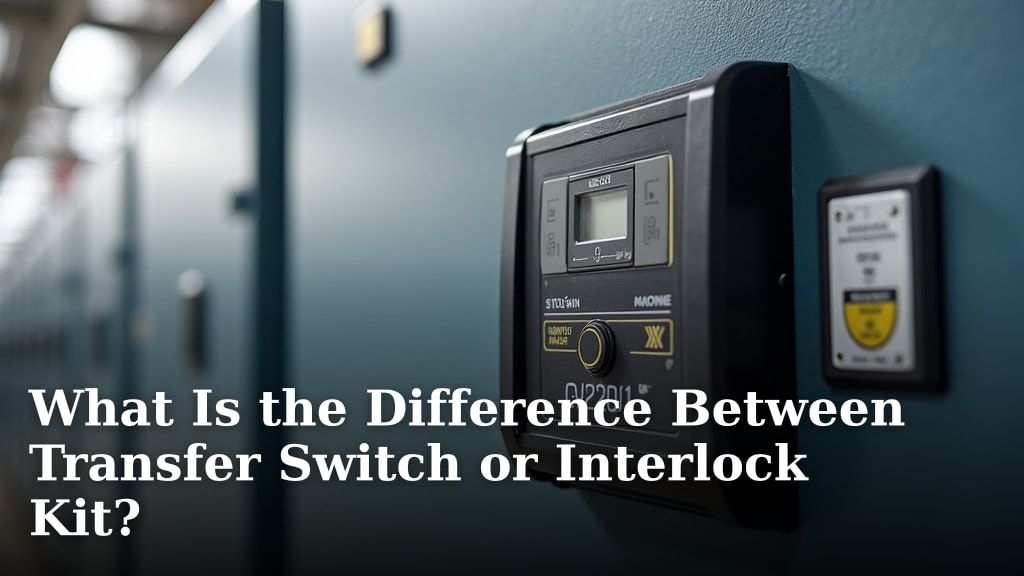
The main difference between a transfer switch and an interlock kit lies in their function and installation. A transfer switch is a self-contained unit that safely disconnects your home from the utility grid before connecting to a generator. An interlock kit is a mechanical device that prevents you from simultaneously turning on both your main breaker and a generator breaker.
Both devices help you safely connect a generator to your home’s electrical system. They prevent power from flowing back to the utility lines, protecting utility workers. We found that choosing between a transfer switch or interlock kit often depends on your generator size and your budget.
TL;DR:
- Transfer switches are separate electrical panels.
- Interlock kits are mechanical safety plates for your existing panel.
- Both prevent dangerous backfeeding.
- Transfer switches often offer more automation.
- Interlock kits are generally less expensive to install.
Ready to figure out which one is right for your home? Let’s walk through everything you need to know about these essential generator safety devices.
Understanding the Core Differences Between Generator Connection Methods
You’re looking to keep your home powered during outages, and that’s a smart move. But how do you safely connect a generator? We found the decision often comes down to two main players: a transfer switch or an interlock kit. While both help you power your home, they do it in very different ways. Understanding these differences is key to making the right choice for your family and your budget.
What is a Transfer Switch?
Think of a transfer switch as a dedicated traffic controller for your home’s electricity. It’s a completely separate electrical panel that sits between your main electrical panel and your generator. When the power goes out, this switch manually or automatically disconnects your home from the utility grid. Then, it safely connects your home to your generator’s power output. This ensures that utility workers are protected from “backfeeding” – a dangerous situation where your generator sends electricity back down the power lines.
Types of Transfer Switches
Transfer switches come in a few flavors, each with its own benefits. We’ve seen homeowners choose based on their comfort level with manual operation versus wanting a more hands-free experience.
- Manual Transfer Switches: These require you to physically flip switches to change power sources. When the grid goes down, you start your generator, then go to the transfer switch and manually move a lever or flip a breaker. This disconnects the utility and connects the generator. It’s straightforward but requires your direct involvement.
- Automatic Transfer Switches (ATS): If you prefer a “set it and forget it” approach, an ATS might be for you. These switches constantly monitor the utility power. The moment an outage occurs, the ATS automatically starts your generator, waits for it to stabilize, and then switches your home’s power source. When utility power returns, it switches back and shuts down the generator. Many experts recommend ATS for whole-home generator systems (National Electrical Code).
What is an Interlock Kit?
An interlock kit is a clever, mechanical safety device. Instead of being a separate panel, it attaches directly to your existing main electrical panel. Its job is simple: to make sure that you can never turn on your main utility breaker and your generator breaker at the same time. It’s like a physical lock that prevents both from being engaged simultaneously. This prevents backfeeding and keeps utility workers safe.
How an Interlock Kit Works
When the power goes out, you open your main electrical panel. You would then slide the interlock plate into position, which physically blocks you from turning on your main breaker. Once blocked, you can then safely turn on your generator breaker, which then feeds power into your home’s panel. When utility power returns, you reverse the process: turn off the generator breaker, slide the interlock plate, and turn on the main breaker. It’s a simple, reliable mechanical solution.
Key Differences: Transfer Switch vs. Interlock Kit
Let’s lay out the main distinctions to help clarify which might be a better fit for your home. We found that capacity, installation, and cost are often the biggest deciding factors for homeowners.
Installation and Complexity
- Transfer Switch: Installation often involves adding a new electrical sub-panel next to your existing one. This can be a more involved electrical job, potentially requiring more wiring and labor.
- Interlock Kit: These are typically simpler to install because they modify your existing panel. An electrician will mount the mechanical plate, often requiring fewer wiring changes.
Cost Implications
Generally, cost is a major differentiator. We’ve seen homeowners weigh upfront expenses against long-term convenience.
- Transfer Switch: Due to their more complex nature and often larger electrical components, transfer switches typically have a higher material and installation cost. Automatic transfer switches, in particular, will be more expensive.
- Interlock Kit: These are usually the more budget-friendly option. The parts are simpler, and the installation tends to be less labor-intensive, resulting in a lower overall cost.
Power Management and Automation
How much control and automation do you want during an outage? This is where these two solutions really diverge.
- Transfer Switch: Especially with an automatic transfer switch, you get significant automation. It handles the entire power transition for you. Manual transfer switches still give you a dedicated, centralized control point for switching power. Many allow you to select specific circuits to power.
- Interlock Kit: This system is entirely manual. You must manually start your generator, go to your main panel, and physically manipulate the breakers according to the interlock’s design. It provides safety but no automation or circuit selection within the interlock itself.
Generator Size and Home Needs
Your generator’s size and what you plan to power also play a role in your decision. Do you want to power your entire house or just a few critical appliances?
- Transfer Switch: These are ideal for larger generators and for powering multiple circuits, or even your entire home. Many models allow you to prioritize certain circuits, meaning you can power your fridge, furnace, and a few lights without worrying about overloading.
- Interlock Kit: While they can technically allow you to power anything connected to your main panel (up to your generator’s capacity), they are often favored for smaller, portable generators where you might only be powering essential circuits. You must be careful not to overload your generator by turning on too many high-draw appliances simultaneously (Electrical Safety Foundation International).
Here’s a quick comparison table to help summarize the differences:
| Feature | Transfer Switch | Interlock Kit |
|---|---|---|
| Function | Separate panel, switches power source | Mechanical lock on existing panel |
| Installation | More complex, often new wiring/panel | Simpler, modifies existing panel |
| Cost | Generally higher (materials & labor) | Generally lower (materials & labor) |
| Automation | Manual or Automatic (ATS) options | Fully manual operation |
| Circuit Control | Can select specific circuits | Powers entire panel (manage loads carefully) |
| Ideal For | Larger generators, whole-home power, convenience | Smaller portable generators, essential circuits, budget-conscious |
Choosing What’s Right for Your Home
So, how do you decide? We understand it can feel like a lot of information, but it really boils down to your specific needs, your budget, and how much convenience you’re looking for during a power outage.
Consider these points when making your decision:
- Your Generator Type: Do you have a small portable generator, or a large standby generator?
- Budget: What are you comfortable spending on installation?
- Desired Convenience: Do you want automated power transfer, or are you fine with manual operation?
- Circuits to Power: Do you need to power your entire home, or just critical appliances?
- Existing Electrical Panel: Is your panel large enough for an interlock kit, or would a separate transfer switch be better?
- Local Codes: Always check with your local authority having jurisdiction; electrical codes vary by area (NFPA 70).
Ultimately, both options provide essential safety by preventing dangerous backfeeding. Your best bet is to discuss your specific situation with a qualified electrician. They can assess your home, your generator, and your needs to recommend the safest and most efficient solution for you.
Conclusion
Choosing between a transfer switch and an interlock kit means balancing safety, convenience, and your budget. We’ve seen that both reliably prevent dangerous backfeeding to the utility grid, protecting you and workers. Your ideal choice hinges on your generator’s size, how much automation you desire during an outage, and your comfort with manual operation. Consider your specific needs and how often you anticipate using your generator.
For a truly informed decision tailored to your home, your next step should always be to consult with a qualified, local electrician. They can assess your existing electrical system and recommend the safest and most efficient solution for your power-backup needs.
Frequently Asked Questions
Can I install an interlock kit myself?
No, we strongly recommend against DIY installation for both interlock kits and transfer switches. These devices deal with high voltage electricity. Incorrect installation can be extremely dangerous, potentially leading to electrocution, fire, or damage to your electrical system. Always hire a licensed electrician for generator connection work.
Do all electrical panels accept an interlock kit?
Not all panels are compatible with interlock kits. We’ve found that interlock kits are specific to certain panel brands and models. An electrician will need to inspect your main electrical panel to determine if a compatible kit is available for your setup. Sometimes, a transfer switch is the only viable option.
Is a transfer switch required for a whole-home generator?
Yes, for a permanently installed, whole-home standby generator, a transfer switch is essential and legally required by the National Electrical Code. It safely manages the automatic transition between utility power and generator power, providing the convenience and protection necessary for such systems.
Can an interlock kit power my entire house?
An interlock kit allows your generator to power circuits in your main panel, but whether it can power your “entire house” depends on your generator’s capacity. You must carefully manage your electrical load to avoid overloading your generator. It’s often better suited for powering essential circuits, not every single appliance simultaneously.
Are transfer switches only for large generators?
Not necessarily. While automatic transfer switches are common with large, whole-home standby generators, manual transfer switches can be used with smaller, portable generators too. They offer a dedicated and safe connection point, allowing you to select specific circuits to power without needing to move around extension cords.
