
What Do You Need to Power an Air Conditioner with a Dual Fuel Generator?
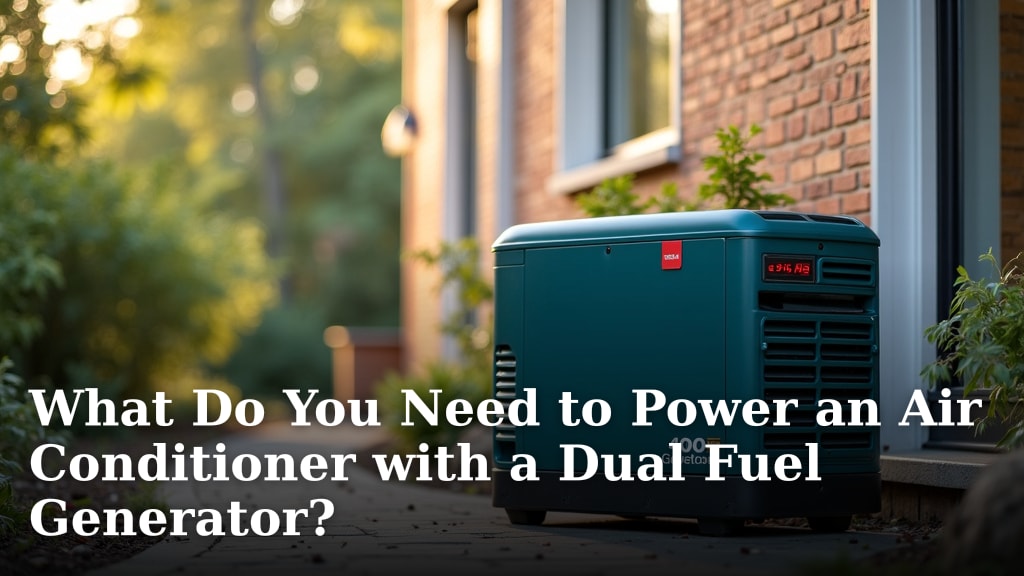
Yes, you can power an air conditioner with a dual fuel generator, but it requires careful planning. You’ll need to ensure your generator has enough wattage to handle the AC’s starting surge and running watts. Many dual fuel generators can power smaller window units, while larger central air systems need more robust power.
Choosing the right generator involves understanding your air conditioner’s power needs. It’s not just about the continuous power output. We found that the initial startup power for an AC unit can be surprisingly high. Knowing these numbers helps you avoid overloading your generator and potentially damaging your appliances.
- Determine your AC’s starting watts and running watts.
- Select a dual fuel generator with ample wattage.
- Consider the fuel type: propane offers longer storage than gasoline.
- Always check your generator’s peak wattage and continuous wattage.
Below, we’ll break down exactly what you need to consider to successfully power your air conditioner with a dual fuel generator.
Powering Your Air Conditioner with a Dual Fuel Generator
You’re likely wondering if your dual fuel generator is up to the task of running your air conditioner. The short answer is yes, but with some important considerations. It’s not as simple as just plugging it in. You need to match your AC’s power demands with your generator’s capabilities. We found that understanding these demands is key to avoiding a hot, sticky situation.
Understanding Your Air Conditioner’s Power Needs
Before you even think about plugging in your AC, let’s talk about what it needs. Air conditioners are notorious power hogs, especially when they first kick on. This initial surge is called “starting watts” or “surge watts.” Once it’s running, it needs less power, which is called “running watts” or “continuous watts.”
Starting Watts vs. Running Watts: The Big Difference
Think of it like starting a car. It takes more effort and fuel to get the engine turning than it does to keep it idling. Your air conditioner compressor is the same way. The motor needs a big jolt of electricity to overcome inertia and begin its cycle. This surge can be two to three times higher than its normal running requirement.
For example, a window AC unit that runs at 800 watts might need 1,500 to 2,400 watts just to start up. This is the most critical number to consider when sizing your generator. If your generator can’t meet this peak demand, it might trip a breaker, shut down, or worse, damage the AC unit’s motor.
Finding Your AC’s Wattage Specifications
So, how do you find these numbers for your specific air conditioner? The easiest place to look is the appliance’s data plate. This is usually a sticker or metal plate on the back or side of the unit. It will list the voltage, amperage, and often the wattage. If wattage isn’t listed directly, you can calculate it.
You’ll need the volts (V) and amps (A). Multiply them together to get watts: Watts = Volts x Amps. For example, a unit drawing 120V and 10A would need 1200 running watts.
What about those starting watts? This is trickier to find on the unit itself. Your best bet is to:
- Check the owner’s manual that came with your air conditioner.
- Search online for your specific model number. Manufacturers usually provide detailed specifications.
- If all else fails, use a wattage estimation chart. Many AC manufacturers provide these online. For a typical 5,000-8,000 BTU window unit, expect starting watts to be around 1,500-2,000 watts, and running watts around 600-800 watts. Larger units will need significantly more.
Choosing the Right Dual Fuel Generator
Now that you know what your air conditioner needs, let’s talk about the generator. Dual fuel generators offer flexibility, running on either gasoline or propane. This is a great advantage for extended power outages. Propane, in particular, stores much longer than gasoline, which can go stale. We found that many people prefer propane for its stability.
Wattage: The Most Important Factor
Your generator needs to have more than enough wattage to cover your AC’s needs. Here’s a simple rule of thumb we found helpful:
- Generator Running Watts should be at least 10-20% higher than your AC’s running watts.
- Generator Starting Watts (Peak Watts) must be higher than your AC’s starting watts.
For instance, if your AC needs 800 running watts and 2,000 starting watts, you’d want a generator that provides at least 880 running watts (let’s round up to 1000 for a buffer) and, more importantly, at least 2,000 starting watts. Most generators list both their continuous wattage and their peak wattage. Always ensure the peak wattage meets or exceeds your AC’s surge requirement.
Considering Generator Size and Output
Generators are rated in watts. You’ll see numbers like 3500 watts, 5000 watts, 7500 watts, and so on. A small 10,000 BTU window unit might run on a 3000-watt generator if it has enough starting capacity. However, a larger AC unit or a central air conditioning system will require a much larger generator, often in the 7500-watt range or higher, especially if you plan to power other appliances too. For larger AC units or central air, you’ll likely need a generator in the 7500-watt range or higher.
Here’s a quick comparison table for common AC sizes. Remember, these are estimates, and your specific unit may vary:
| AC Unit Size (BTU) | Approx. Running Watts | Approx. Starting Watts | Recommended Generator (Running Watts) | Recommended Generator (Starting Watts) |
|---|---|---|---|---|
| 5,000 – 8,000 (Window Unit) | 600 – 800 | 1,500 – 2,000 | 1,000 – 1,500 | 2,000 – 2,500 |
| 10,000 – 12,000 (Window/Portable) | 900 – 1,200 | 2,000 – 3,000 | 1,500 – 2,000 | 3,000 – 3,500 |
| 13,500 – 15,000 (Portable/RV AC) | 1,300 – 1,600 | 3,000 – 4,000 | 2,000 – 2,500 | 4,000 – 4,500 |
| Central AC (Small Home) | 3,500 – 5,000+ | 7,000 – 10,000+ | 5,000 – 6,500+ | 10,000 – 12,000+ |
Fuel Considerations: Gasoline vs. Propane
Dual fuel generators give you options. Gasoline is readily available, but it degrades over time. If you don’t use it within a few months, it can clog your generator’s carburetor. Propane, on the other hand, has a virtually unlimited shelf life when stored properly in its tank. Many experts suggest having a few extra propane tanks on hand for emergencies.
Propane also tends to burn cleaner, which can lead to less maintenance on your generator’s engine. It’s a good idea to familiarize yourself with how to switch between fuels and how to properly store both.
Essential Accessories and Safety Measures
Beyond the generator and AC unit, you’ll need a few other things. A heavy-duty extension cord specifically rated for outdoor use and capable of handling the wattage is crucial. Always use a cord that is thick enough (low gauge number) and short enough to prevent voltage drop.
Safety is paramount. Generators produce carbon monoxide, a deadly, odorless gas. You must operate your generator outdoors, far away from windows, doors, and vents. Never run it in a garage, even with the door open.
Protecting Your Equipment
To ensure a stable power supply for your AC and prevent damage, consider a power conditioner or surge protector. While some generators have built-in protection, an external unit can offer an extra layer of security, especially for sensitive electronics like your AC’s control board.
Also, make sure your generator has a low-oil shutdown feature. This automatically turns off the generator if the oil level gets too low, preventing engine damage. We found this to be a standard but very important feature.
A Quick Checklist for Success
Getting ready to power your AC with a dual fuel generator? Here’s a simple checklist:
- Know Your AC’s Needs: Find and record both running and starting wattages.
- Generator Wattage Match: Ensure your generator’s peak watts exceed your AC’s starting watts, and running watts provide a buffer.
- Fuel Ready: Have enough gasoline or propane available and properly stored.
- Right Cords: Use a heavy-duty, outdoor-rated extension cord that can handle the load.
- Safe Location: Always operate the generator outdoors and away from living spaces.
- Test Run: If possible, test your setup before you truly need it during an outage.
Conclusion
Powering your air conditioner with a dual fuel generator is absolutely achievable. You’ve learned that the key lies in understanding your AC’s specific power demands, especially those crucial starting watts. We found that selecting a generator with ample peak and running wattage, along with having the right accessories and prioritizing safety, sets you up for success. Don’t forget to check your AC’s data plate and owner’s manual for the most accurate figures. Your next step should be to identify your AC’s exact wattage needs and then compare that to the specifications of potential dual fuel generators. This careful matching ensures you stay cool and comfortable during any power outage.
Frequently Asked Questions
Can I run my central air conditioner with a dual fuel generator?
Yes, you can, but it requires a much larger generator than a window unit. Central air systems have significantly higher running and starting wattages. Always check the specifications for your specific central AC unit and choose a generator with enough peak wattage to handle its startup surge. You’ll likely need a generator rated at 7500 watts or higher.
How much of a buffer should I leave between my AC’s wattage and my generator’s output?
It’s wise to have a buffer of at least 10-20% for the running watts. For starting watts, the generator’s peak wattage should comfortably exceed your AC’s starting wattage. This buffer helps prevent the generator from being overloaded and ensures a stable power supply, protecting your air conditioner’s motor.
Is propane or gasoline better for powering an air conditioner with a dual fuel generator?
Propane is generally preferred for extended use because it has a much longer shelf life than gasoline, which can degrade and clog your generator’s fuel system. Propane also tends to burn cleaner, potentially reducing engine maintenance. However, gasoline might be more readily available in some situations.
What kind of extension cord do I need for my air conditioner and generator?
You need a heavy-duty, outdoor-rated extension cord that can handle the wattage your AC unit draws. Look for a thick gauge (lower gauge number like 10 or 12) and keep the cord length as short as possible to minimize voltage drop. Using an undersized cord can be a fire hazard and won’t deliver sufficient power.
Will running an air conditioner strain my dual fuel generator if I also have other appliances plugged in?
Yes, it absolutely will. An air conditioner is one of the biggest power draws in a home, especially when it starts up. If you plan to run other appliances simultaneously, you must add their wattage requirements (both running and starting, if applicable) to your AC’s needs. Ensure your generator’s total capacity exceeds the combined wattage of all appliances you intend to run at the same time.
